

In the field of industrial, commercial and residential floor decoration, both Epoxy floor coatings and Polyaspartic floor coatings occupy an important position. As two types of resin-based coating materials, they both boast excellent protective properties. However, due to differences in their chemical compositions, they exhibit distinct disparities in curing characteristics, environmental adaptability, durability and other aspects. This article will conduct a multi-dimensional comparison, deeply analyze the advantages and disadvantages of each, and provide some references for material selection in different application scenarios.
1.Core Basis: Differences in Chemical Composition
The difference in chemical composition is the root cause of the performance gap between the two materials, which directly determines their subsequent curing mechanisms and core properties:
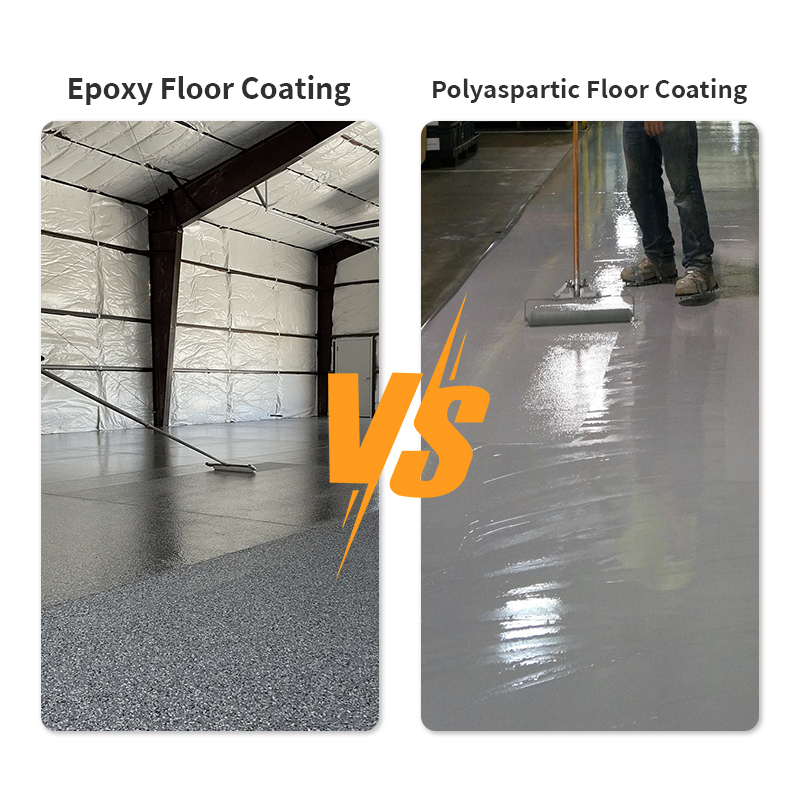
Epoxy Floor Coating: It is a thermosetting polymer composed of a two-component system of epoxy resin and curing agent as the core components. During construction, the two components must be mixed in a specified ratio, and a chemical reaction occurs between them to form a dense solid coating. The coating has a high-rigidity structure and forms a chemical bond with the substrate.
Polyaspartic Floor Coating: It is a macromolecular compound produced by the reaction of polyaspartic ester resin and HDI trimer. It can form a new type of aliphatic coating with excellent weather resistance, featuring a coating structure with both rigidity and flexibility, and has superior chemical stability.
2、Key performance comparison and analysis of advantages and disadvantages
(1)Curing efficiency and construction cycle: Fast curing vs. long waiting time
Curing time is the most intuitive difference between the two materials, directly affecting construction efficiency and site downtime:
Epoxy Floor Coating: It has a relatively long curing cycle. Under normal ambient conditions, it requires 24–72 hours to fully cure; in some working conditions, it may even take more than 5 days before it can be put into regular service. Low-temperature environments (below 10℃) will significantly slow down the curing rate, and may even cause incomplete curing, which impairs the coating performance. This characteristic means that the site must be closed for an extended period after epoxy coating application, resulting in considerable disruption to production and operational activities.
Advantages: The relatively long gel time provides ample buffer for construction operations, facilitating coating leveling and repair, and is suitable for ensuring flatness during large-area integral construction.Disadvantages: Long construction cycle, high site downtime costs, and poor adaptability to low-temperature construction.
Polyaspartic Floor Coating: It boasts outstanding curing efficiency and is classified as a “fast-curing” material. Under normal ambient conditions, it allows pedestrian access in 4–6 hours and can meet the requirements for vehicle traffic or regular use within 24 hours; some high-performance formulations can even achieve initial service strength in just 1–2 hours. More notably, it has excellent low-temperature adaptability—still capable of curing normally even in environments below 0℃—which greatly extends the construction time window.
Advantages: Short construction cycle, rapid site reoccupation, and significant reduction in downtime costs; strong adaptability to low-temperature construction, free from seasonal restrictions.Disadvantages: The fast-curing characteristic places extremely high technical requirements on construction personnel, with a narrow operation window (usually only tens of minutes). Once mixed, the material must be applied promptly; otherwise, issues such as poor leveling and uneven coating are prone to occur, and errors during construction are difficult to correct.
(2)Durability vs. Environmental Adaptability: Rigid Protection vs. All-Round Endurance
Durability encompasses multiple dimensions such as wear resistance, chemical resistance, UV stability and crack resistance, which directly determines the service life of the coating:
Epoxy Floor Coating: It has good basic durability, with excellent wear resistance and compression resistance. It can withstand the frequent movement and impact of heavy objects, making it suitable for high-intensity application scenarios such as machinery processing and warehousing & logistics. It also has good tolerance to common chemicals including acids, alkalis and oils, which can meet the basic protection needs of industries like chemical engineering and food processing. However, it has obvious shortcomings in special environments: first, its UV stability is poor. Long-term exposure to sunlight tends to cause yellowing, chalking and gloss reduction, so it is more suitable for indoor use. Second, it has insufficient flexibility as a rigid coating. When the concrete substrate develops micro-cracks due to temperature changes or settlement, the coating is prone to cracking accordingly.
Advantages: Stable durability under high-intensity indoor working conditions, with balanced compression and wear resistance; chemical protection covers most conventional scenarios.Disadvantages: Poor UV stability, not suitable for outdoor or strong ultraviolet environments; insufficient flexibility, weak ability to resist substrate cracking.
Polyaspartic Floor Coating: It offers more comprehensive durability and is regarded as an “all-around” protective material. It is comprehensively superior to epoxy coating in terms of wear resistance and chemical resistance, and can resist erosion by harsh media such as gasoline, transmission fluid and brake fluid (only sensitive to extreme strong acids like concentrated sulfuric acid). It has excellent UV stability and will not yellow or fade when exposed to sunlight for a long time, making it perfectly suitable for outdoor scenarios. Meanwhile, it has moderate flexibility, which can adapt to slight expansion, contraction and deformation of the concrete substrate and effectively prevent coating cracking. In addition, it has a wider temperature tolerance range, maintaining stable performance in environments ranging from -30℃ to 140℃, and also has certain fire resistance (able to withstand high temperatures up to 300°F).
Advantages: Balanced durability across all scenarios, with UV stability, chemical resistance and crack resistance all superior to epoxy; strong temperature and fire resistance adaptability, suitable for both indoor and outdoor use; long service life of over 20 years.Disadvantages: There is a limit to the coating thickness, with the normal thickness ranging from 1 to 2 mm. It has higher requirements for the flatness of the substrate surface. If the substrate is uneven, it is difficult to compensate for the defect by adjusting the coating thickness.
(3)Aesthetics and Maintenance Cost: Diverse Decoration vs. Long-Term Convenience
Epoxy floor coating: Offer a wide range of decorative options, allowing for various construction schemes with different aggregates and substrates, such as epoxy metallic flooring and epoxy colored sand flooring. Suitable for aesthetically pleasing settings like commercial showrooms, kindergartens, and indoor playgrounds. However, maintenance costs are high, gloss levels decrease significantly over time, and damaged coatings are difficult to repair after curing, often requiring partial or complete reapplication.
Advantages: Flexible and diverse decorative options, meeting personalized design needs; Disadvantages: Prone to gloss loss over time, high repair costs, and higher maintenance frequency than polyaspartic acid ester coatings.
Polyaspartic floor coating: High and durable surface gloss, presenting a uniform mirror effect, high color saturation, and resistant to fading; the dense and smooth coating surface does not easily attract dirt, making cleaning and maintenance simple, requiring only regular wiping, resulting in extremely low long-term maintenance costs. However, the degree of decorative customization is lower than epoxy coatings, with relatively limited options for special patterns and textures.
Advantages: Long-lasting gloss, easy cleaning and maintenance, and low long-term operating costs; Disadvantages: Fewer decorative customization options, making it difficult to meet complex aesthetic design needs.
(4)Construction Requirements & Environmental Friendliness: High Fault Tolerance vs. Green & High Efficiency
Epoxy Floor Coating:It has strict requirements for the construction environment. The ambient temperature (10-35℃) and humidity (below 85%) must be controlled; otherwise, problems such as reduced adhesion and blistering are likely to occur. It also imposes extremely high standards for substrate pretreatment: the substrate must be thoroughly cleaned and dried. Any oil stains or moisture remaining on it will cause coating peeling.
In terms of environmental friendliness, traditional solvent-based epoxy coatings have a relatively high VOC (Volatile Organic Compounds) content, emitting a noticeable odor during construction, which requires adequate ventilation. Although water-based epoxy coatings have improved this issue, their performance is slightly inferior to that of solvent-based alternatives.
Advantages: High construction fault tolerance and a long operation window, making them suitable for construction teams with moderate experience.
Disadvantages: Strict control of construction environment and complicated substrate pretreatment.
Polyaspartic Floor Coating:It has loose requirements for the construction environment. There is no need for strict humidity control, and it can even be applied in low-temperature conditions. Substrate pretreatment is relatively simple, yet due to its fast curing speed, it has higher requirements for the flatness of the substrate surface.
It boasts remarkable environmental advantages: most products adopt high-solid or zero-VOC formulations, emitting minimal odor during construction and causing little impact on human health and the environment. Thus, it is ideal for scenarios with stringent environmental requirements such as schools and hospitals.
Advantages: Wide adaptability to construction environments, excellent environmental friendliness, and low odor.
Disadvantages: Extremely high technical requirements for construction personnel, low operation fault tolerance, and strict requirements for substrate flatness.
(5)Cost Comparison: Economical Initial Investment vs. Cost-Effective in the Long Run
Epoxy Floor Coatings
It features a lower initial cost, with both material unit price and construction fees being cheaper than those of polyaspartic coatings, making it ideal for projects with limited budgets. However, due to its relatively shorter service life (usually around 10 years) and high maintenance costs, it does not hold an advantage in terms of long-term overall costs.
Polyaspartic Floor Coatings
It comes with a higher initial cost: the material unit price is about 1.5–2 times that of epoxy coatings, and the construction fees are also more expensive because of its high technical requirements. Nevertheless, benefiting from its longer service life (15–20 years) and extremely low maintenance costs, it gains a more distinct advantage in long-term overall costs instead.
3、Precise matching of applicable scenarios
Epoxy floor coatings: More suitable for indoor settings, especially for: 1. Indoor industrial plants, underground garages, and warehousing and logistics centers with limited budgets; 2. Commercial showrooms, playgrounds, laboratories, kindergartens, etc., where high color and decorative requirements are needed; 3. Indoor office areas or hospital corridors with relatively stable substrates and no strong ultraviolet radiation.
Polyaspartic floor coatings: Suitable for indoor and outdoor settings with high requirements for efficiency and durability, especially for: 1. Commercial complexes, supermarkets, and manufacturing workshops requiring rapid completion and reduced downtime; 2. Outdoor parking lots, terraces, stadium stands, and other scenarios with strong ultraviolet exposure; 3. Low-temperature environments (such as cold storage) or schools, hospitals, and food processing plants with high environmental protection requirements; 4. Chemical workshops and auto repair shops with frequent contact with chemical media.
4、Summary: How to choose?
Epoxy and Polyaspartic floor coatings are not a matter of “which is better or worse,” but rather “compatibility.” The key to choosing between them lies in balancing project needs, budget, and long-term costs: If the budget is limited, the focus is on interior aesthetics, the construction team’s skills are average, and the site can be closed for extended periods, Epoxy floor coatings are a more economical choice. If the priority is quick application, long-term durability (especially outdoors or in harsh environments), low maintenance costs, and a sufficient budget, Polyaspartic floor coatings offer greater long-term value.
Furthermore, jincheng Resin offers a composite solution of “epoxy + polyaspartic ester”: using epoxy coating as a primer/intermediate coat to provide rigid protection and thickness support, and polyaspartic ester coating as a topcoat to provide UV protection and a wear-resistant surface, balancing cost and performance, suitable for transitional indoor/outdoor scenarios where high durability is required.