



Epoxy flooring coating are widely used in industrial plants, underground garages, warehouses, and commercial settings due to their excellent wear resistance, dust resistance, and ease of cleaning, coupled with their cost-effectiveness. Many people are concerned about the lifespan of epoxy flooring coatings when choosing one.
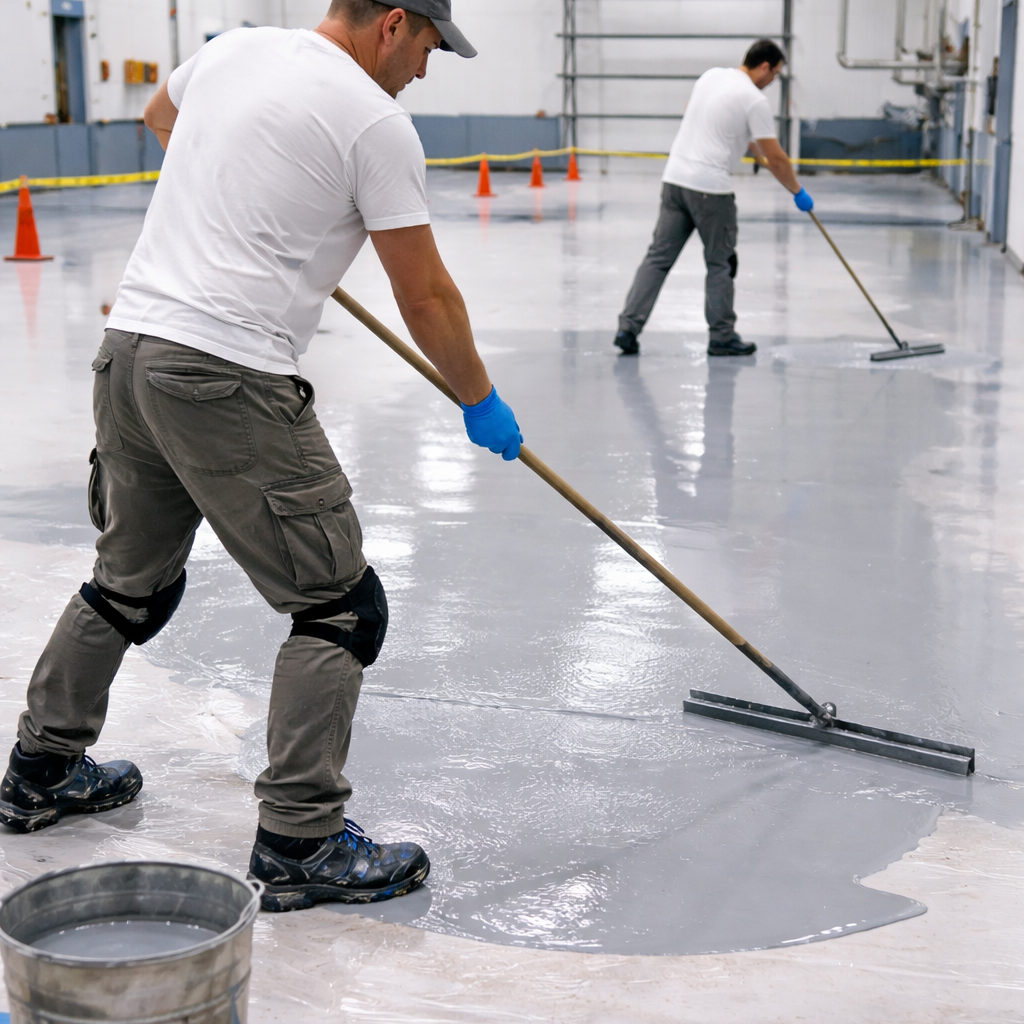
For a more intuitive reference, under normal use and proper maintenance, the lifespan of epoxy flooring coatings is generally 5-15 years. However, this range varies greatly, as the lifespan of epoxy flooring is not a fixed number and is generally affected by factors such as construction quality, usage environment, and maintenance methods.
Today, Jingcheng will explain in detail the factors affecting the lifespan of epoxy flooring from several aspects.
First, the most significant factor affecting the lifespan of epoxy flooring coatings is undoubtedly the usage environment. For example, in light-load environments such as offices, office buildings, and small shops, where the primary use is for walking, without heavy equipment or chemical corrosion, 8-12 years is perfectly fine. Many office building epoxy floors remain smooth and shiny even after ten years.
However, in heavy-duty environments like factory workshops, logistics warehouses, and underground parking garages, where forklifts constantly drive over surfaces, warehouses store heavy loads, and cars frequently enter and exit, resulting in tire friction and impacts, the lifespan of epoxy flooring can be shortened to 5-8 years. Without any maintenance, peeling and cracking may occur within 3-5 years.
Secondly, different types of epoxy flooring have different lifespans. For example, epoxy thin-coat flooring, typically 0.3mm-0.8mm thick, has lower construction costs and is often used in light-duty areas such as office areas and office buildings. Under normal use and proper maintenance, its lifespan is approximately 8-10 years.
Another option is epoxy mortar flooring, typically 1mm-3mm thick, reinforced with quartz sand, significantly improving wear resistance. It is mainly used in heavy-duty environments, such as factories and logistics warehouses, and usually lasts 5-8 years.
Therefore, when choosing epoxy flooring types, we should focus on the intended use case rather than simply pursuing low cost.
Of course, the epoxy flooring material itself is also a key factor affecting its lifespan. High-quality epoxy coatings, after curing, have high hardness and strong adhesion, and are not prone to powdering or peeling; while inferior coatings may start to discolor and sand after only one or two years, ultimately costing more money. The quality of the substrate is also crucial. Many people believe that the lifespan of epoxy flooring depends solely on the coating quality, but the concrete substrate is equally important. If the substrate has the following problems, it will seriously affect the lifespan of the flooring: insufficient concrete strength, excessively high ground moisture content, sandy or loose ground, or oil or dust on the surface. These problems will all lead to decreased adhesion of the epoxy coating, and over time, peeling, delamination, or even cracking may occur. It is generally recommended that the concrete strength reach C25 or higher and the moisture content be below 8% before epoxy flooring construction to ensure long-term stable use.
Construction techniques are a point that many people easily overlook. In the floor coating industry, there’s a saying: “30% depends on materials, 70% on construction.” If the floor isn’t sanded unevenly, the primer is missed, or the coating ratio is uneven, even the best materials won’t last long. For example, some contractors cut corners and apply paint before cleaning the floor properly, which will soon lead to hollow spots and peeling—this is a problem of improper construction.
Finally, there’s routine maintenance. Extending the lifespan of epoxy flooring doesn’t require much effort; simply follow these routine maintenance measures: avoid scratching the surface with sharp objects (such as metal tools or gravel), avoid direct contact with heavy equipment, clean up spilled oil and chemicals promptly, mop with a neutral detergent regularly, and avoid using strong acid or alkali cleaners to prevent corrosion of the coating; minor wear on the floor surface can be repaired by recoating with a new topcoat.
In general, the lifespan of epoxy flooring isn’t a fixed number. Choosing the right type for your specific needs, hiring a professional team for installation, and paying close attention to maintenance will maximize its lifespan, saving you time and money. If you’re unsure which epoxy flooring coating to choose for your site, or how to maintain it, feel free to contact Jingcheng. We have engineers and sales staff with 20 years of experience in the flooring coating field, ready to serve you.