



In a garage, moisture is mostly a surface-level concern — something to mop up after a rainy night. In a basement, the floor itself is fighting you. Water vapor pushes up through the slab from the soil below. Humidity settles in and doesn’t leave. The slab expands and contracts with the seasons. And when a floor coating fails in a finished basement, the consequences aren’t just cosmetic — you’re moving furniture, displacing a living space, and starting the whole project over from scratch.
None of that is inevitable. But it does mean the approach that works in a garage won’t necessarily work down there. Moisture has to be dealt with before any floor coating touches the concrete — full stop, regardless of which system you’re considering. This guide walks through what that looks like, which products are worth knowing about, and which coating options actually hold up below grade.
The Real Problem: Why Basement Slabs Are Different
Most homeowners know basements can get damp. Fewer understand the mechanism well enough to make good decisions about it.
A basement slab sits on or below the frost line, in direct contact with soil that holds groundwater year-round. Through a process called moisture vapor transmission (MVT), water vapor is constantly moving upward through the concrete — not as liquid water, but as vapor, driven by temperature and pressure differentials between the soil and the interior air. It happens even in slabs that feel bone dry to the touch.
The catch: once an epoxy or polyurea floor coating cures, it’s essentially airtight. That rising vapor hits the underside of the coating, has nowhere to go, and starts building pressure. The coating blisters. Edges lift. Eventually you get full delamination across the floor — and people assume the product failed, when what actually failed was the decision not to test for moisture before installing it.
This is the single most common failure mode in basement coating projects. It’s also entirely avoidable.
Don’t Choose a Coating Until You’ve Done This
Moisture testing isn’t a nice-to-have. Whatever you put on that floor, the test result should be informing the decision.
Calcium chloride test (ASTM F1869) A sealed dish of calcium chloride sits on the slab for 60–72 hours. The weight gain tells you the moisture vapor emission (MVE) rate in pounds per 1,000 square feet per 24 hours. The safe threshold for most floor coating systems without a vapor barrier is somewhere between 3 and 5 lbs — exceed that and you’re in trouble territory without additional mitigation.
In-situ RH probe (ASTM F2170) A probe inserted into the slab measures relative humidity at depth rather than just at the surface. Most systems flag anything above 75–80% RH as requiring moisture mitigation before coating.
If either test comes back high, the path forward isn’t picking a different coating product. It’s installing a Moisture Vapor Barrier first. A better coating won’t solve a moisture problem — it’ll just fail in a different way.
Moisture Vapor Barrier Primer: What It Does and What to Look For
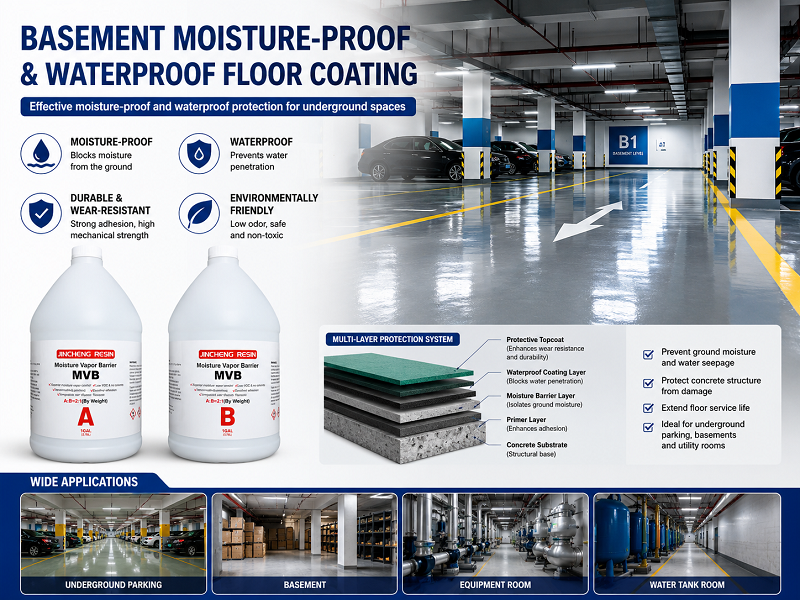
A Moisture Vapor Barrier (MVB) primer is a specialized epoxy compound that goes down before everything else — before the base coat, before any color or decorative layer, before anything. It penetrates the concrete’s pore structure, bonds chemically with the slab, and creates a sealed interface that keeps vapor from pushing into the coating system above.
It’s not a waterproofing membrane. It won’t stop an active water leak or seal a crack that’s taking on water. What it does is reduce the vapor permeance of the slab surface to a level that a floor coating can actually bond to and stay bonded to over time.
A few things matter when evaluating MVB products:
- Vapor control rating: Look for products rated to handle at least 20 lbs/24hr/1000 sq ft (ASTM F1869). That covers the overwhelming majority of residential basement slabs
- Perm rating ≤ 0.10: This is what qualifies a product as a Class I Vapor Diffusion Retarder under building science standards — the threshold that matters for long-term coating performance
- ASTM F3010 compliance: The industry standard for two-component resinous moisture mitigation systems. Not every product meets it; the ones that do have been tested to a defined performance benchmark
- Zero-VOC or low-VOC: Basement spaces have limited ventilation. This matters more during application than people usually consider
Products worth knowing:
- ArmorPoxy ARM409X — 100% solids, two-part epoxy rated to 20 lbs MVE. Can function as a standalone treatment or as the first layer under a full coating system
- Spartan VAPOR PRO — Two-component, ASTM F3010-compliant, approximately 94 sq ft per gallon at 17 mils. Well-established in commercial applications
- Bostik Roll-Cote — Water-based, single-component, no mixing required. Combines primer and vapor mitigation in one step — a practical choice for slabs with moderate readings where simplicity matters
- LATICRETE VAPOR BAN Primer ER — Single-application system compatible with a wide range of finish flooring types: tile, vinyl, wood, and epoxy coatings
- Jinchengresin Moisture Vapor Barrier Primer — Two-component, 100% solids, zero-VOC epoxy built for high-moisture concrete substrates. One feature that stands out in basement applications specifically: it cures at room temperature and at low temperatures — relevant in below-grade spaces that can run significantly cooler than the rest of the house. Industrial-grade formulation focused on preventing blistering, delamination, and long-term coating failure. Worth considering on residential and commercial projects where eco-friendly application is part of the brief
One coat on a properly ground slab handles readings up to 20 lbs in most cases. Above that, the moisture intrusion is likely active rather than vapor-driven, and needs to be addressed structurally — drainage corrections, exterior waterproofing, or a sump system — before any floor coating is a viable option.
Which Floor Coating Actually Works in a Basement?
With moisture handled, here’s how the main options perform in a below-grade environment.
Epoxy
The most common basement floor coating by a wide margin, and the reasonable starting point for most projects.
Epoxy creates a seamless, non-porous surface — good for resisting standing water, chemical spills, pet messes, and general ground-level abuse. It builds at 8–15 mils per coat in 100% solids formulations, which is enough to cover minor surface irregularities. And the range of finishes — solid color, decorative chip, metallic — means it can do real aesthetic work in a basement that’s being finished as living space.
The one thing worth flagging: aromatic epoxy yellows under UV. In a windowless basement, irrelevant. In a basement with egress windows, a stairwell that gets sun, or a walkout — worth knowing, because you’ll see color shift in two to three years.
Materials: $3–$7/sq ft | Installed: $5–$10/sq ft | Lifespan: 10–15 years
Polyaspartic / Polyurea
The higher-cost option, and the one with the most performance margin in challenging conditions.
What makes it better suited to basements than standard epoxy isn’t just the UV stability — it’s the flexibility. Polyurea and polyaspartic systems are elastomeric. They move with the slab rather than resisting its movement. Basement slabs shift more than garage slabs do, driven by soil pressure fluctuations and seasonal moisture changes in the ground. A rigid coating on a slab that’s quietly moving eventually cracks at stress points. An elastomeric one doesn’t.
Cure speed is a practical bonus in finished basement spaces: walk-on time is typically 1–4 hours, full service within 24. That’s one day of disruption rather than three.
Installed: $7–$16/sq ft | Lifespan: 15–20+ years
Epoxy Base + Polyaspartic Topcoat
Ask an experienced floor coating contractor what they’d put in their own basement and this is usually the answer — epoxy base for thickness and build, polyaspartic topcoat for UV stability, flexibility, and surface hardness. The layer sequence runs: MVB → epoxy base → decorative broadcast → polyaspartic topcoat. Each layer does something the others don’t.
Installed: $8–$14/sq ft | Lifespan: 15–20 years
Penetrating Concrete Sealer
Not really a floor coating in the traditional sense — more of a surface treatment. Silane, siloxane, or silicate-based sealers soak into the concrete and reduce absorption without building a film layer on top. The floor looks basically the same after application.
Useful for unfinished storage areas or utility spaces where protection matters more than appearance, and as a first step when a full coating isn’t in the current budget.
Applied: $0.50–$2/sq ft | Lifespan: 3–7 years before reapplication
Where Basement Floor Coating Projects Go Wrong
Nobody tested for moisture. Still the leading cause of basement coating failure, by a significant margin. The slab looks fine, the test gets skipped, no MVB goes in, and the floor starts lifting before the first year is out.
Using a garage kit on a basement slab. Garage-grade DIY epoxy systems are formulated for conditions that basements frequently don’t meet — lower vapor readings, more stable temperatures, better ventilation during application. The products aren’t bad; they’re just not designed for this environment.
Sealing cracks before testing. Crack repair is necessary, but doing it before you know the vapor reading can trap moisture in the slab and increase pressure concentrations under the coating. Test first, then repair, then coat.
Stopping the coating at the floor. The cove joint — where floor meets wall — is a primary entry point for moisture in most basements. The floor coating or the MVB layer should run up the wall 4–6 inches to seal that transition. Contractors who skip this tend to see edge failures before anything else.
Questions to Ask Before Accepting a Quote
Four things worth confirming before any contract gets signed:
- Are you testing for moisture vapor before you start? No is a disqualifying answer
- If the reading exceeds your system’s threshold, is MVB included in this price? Get it in writing
- What’s your surface prep process? Diamond grinding is correct; acid etch alone isn’t sufficient for most basement applications
- What topcoat are you finishing with? Polyaspartic or aliphatic polyurethane. Bare epoxy as the final layer is not the right call in a basement
The Short Version
Basement floor coatings fail for one reason more than any other: moisture vapor that nobody tested for and nobody addressed. Fix that first — with a proper MVB primer on a mechanically ground slab — and the coating on top has a real chance of lasting 15 to 20 years.
Get the moisture right, match the coating to how the space actually gets used, and a basement stops being the room you tolerate and starts being the room you use.