
When renovating your garage floor, you definitely want a durable and hassle-free floor coating. Polyaspartic coating is absolutely one of the best choices. The reason is simple: it offers excellent performance, durability, fast construction, and great results. You can walk on it the day after application and park your car the third day. This advantage is very attractive compared to the curing time of epoxy floor coatings.
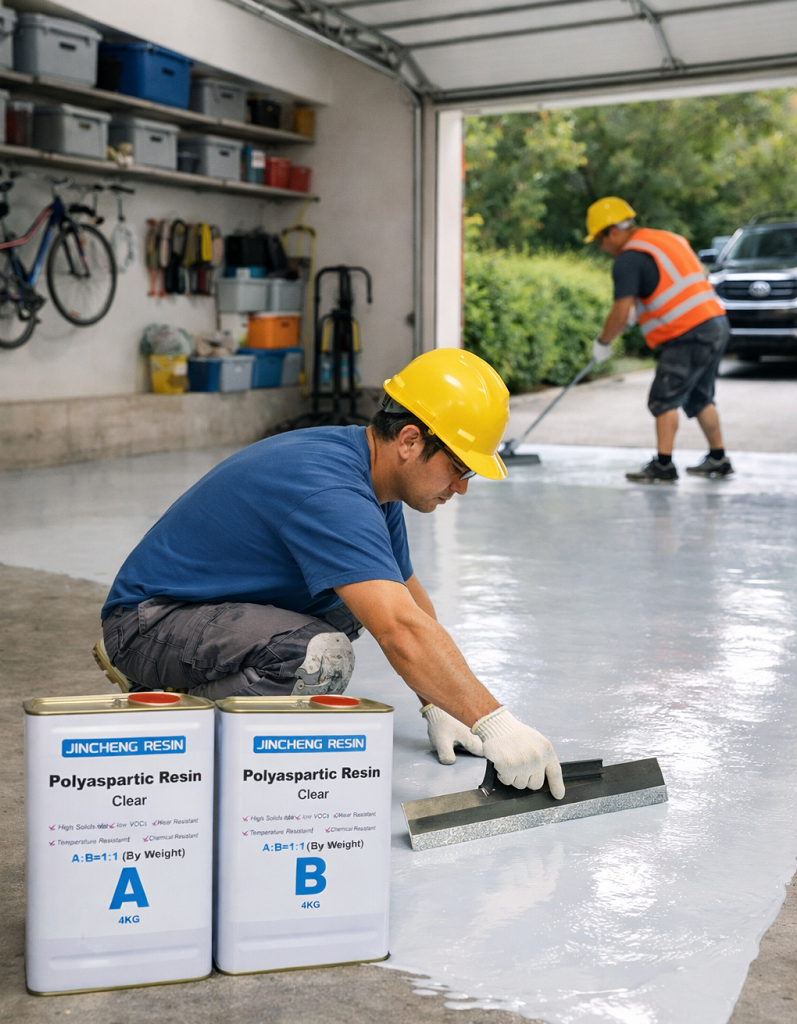
However, there are many polyaspartic coating on the market with varying quality and application scopes. Many people make the wrong choice if they only look at the price. Today, Jincheng explains from multiple dimensions: how to choose the right polyaspartic coating for your garage floor.
What Makes Polyaspartic Coating So Good?
The garage is actually the “most stressed” floor in the home. Daily vehicle entry and exit, tire friction, oil drips, temperature changes, water stains, salt, and more put the floor to a severe test. Ordinary concrete floors have several problems: they are prone to dusting, oil absorption, cracking, and are difficult to clean. Therefore, many people apply floor coatings to protect the concrete base.
So why are more and more people choosing polyaspartic (Polyaspartic) coating for garage floors, and how are they superior to traditional epoxy floor coatings?
- Weather-resistant and non-yellowing, long-lasting appearance: This is the biggest highlight that outperforms epoxy. Epoxy floors tend to yellow and chalk over time in garages with natural light, looking very old. Polyaspartic coating have a stable molecular structure, are resistant to UV radiation, maintain bright color and long-lasting gloss even under long-term exposure, and will not deteriorate even in semi-open garages.
- Ultra-fast curing, no vehicle downtime: Traditional epoxy floor paint requires at least 3-7 days of waiting after application for normal use, which is unbearable for households with cars. Polyaspartic coating is surface-dry in just 1-4 hours and can withstand vehicle traffic within 24 hours, greatly shortening the construction period—especially suitable for garage renovation projects that cannot be closed for a long time.
- Tough and stain-resistant, immune to oil stains: The garage is the “home” of cars, and engine oil, brake fluid, antifreeze, car wash liquid are common. Polyaspartic coating have strong resistance to these chemicals, are not easy to penetrate or leave stains, and can be easily cleaned with clean water or neutral detergent daily, making maintenance very hassle-free.
- High elasticity, wear resistance, and impact resistance: It has certain flexibility to absorb impacts from vehicle rolling and sudden braking, reducing the risk of floor cracking; it also has high hardness, compression resistance, and wear resistance, capable of withstanding high-frequency vehicle entry and exit for a long time. Its service life can reach 10-15 years, nearly twice that of epoxy floors (5-8 years).
- Eco-friendly and low-odor, construction-friendly: Most mainstream products use high-solid or solvent-free formulas with low VOC content and low odor during construction, making them safer for families and construction workers, and suitable for enclosed spaces such as home garages.
Key Comparison with Epoxy Floors (Avoid Pitfalls)
| Comparison Item | Polyaspartic Coating | Epoxy Floor Paint |
| Yellowing Resistance | Excellent, UV-resistant | Poor, easy to yellow and chalk |
| Curing Time | Usable for vehicles in 24 hours | Usable for vehicles in 3-7 days |
| Weather Resistance | Strong, suitable for semi-open/outdoor | Weak, only suitable for enclosed indoor spaces |
| Service Life | 10-15 years | 5-8 years |
| Initial Cost | Relatively high (about 1.5-2 times that of epoxy) | Relatively low |
| Construction Difficulty | High, requires professionals and equipment | Medium, DIY possible |
Clarify Your Garage Needs
When choosing a polyaspartic coating, you should first confirm the conditions of your garage or project. Do not follow the trend blindly; ask yourself these questions first—the answers directly determine your purchasing direction.
Garage Type and Usage Scenario
Private independent garage: Small area (20-60㎡), mainly for private cars, focusing on aesthetics, easy cleaning, and fast delivery.
Commercial/public garage: Large area, high traffic volume, requires high wear resistance, compression resistance, and anti-slip properties; priority is given to big brands with stable performance.
Semi-open/outdoor garage: Exposed to natural light or rain splashes; must choose polyaspartic coatingswith strong weather resistance to avoid later yellowing and peeling.
Floor Base Condition
Newly poured concrete: Smooth and dry surface (moisture content <8%), can be constructed directly, with relatively low coating requirements.
Old floor renovation: First check for sanding, cracks, hollowing, old coating peeling, etc. Old epoxy floors need grinding treatment to ensure the base is clean and rough; otherwise, the new coating is easy to fall off.
Budget and Cost PerformancePolyaspartic coating have higher material unit price and construction cost than epoxy, but they win with long service life and low maintenance. If the budget is limited, you can consider the combined scheme of “epoxy intermediate coating + polyaspartic top coating”, which reduces costs while enjoying the weather resistance and wear resistance advantages of polyaspartic.
5 Core Points for Purchasing Polyaspartic Coating
After determining your needs, focus on these 5 indicators when purchasing—they directly determine product quality and service life.
Solid Content: Higher = More DurableSolid content refers to the proportion of effective ingredients in the coating. The higher the solid content (usually ≥90%), the thicker the coating, the better the wear resistance, and the longer the service life. Low-solid coatings seem cheap, but the coating is thin, easy to wear and peel, and the later maintenance cost is higher. Be sure to ask the supplier: “What is the solid content of this polyaspartic coating?”
Mixing Ratio and Pot Life: Precisely Match Construction CapacityPolyaspartic coating are mostly two-component (A and B), with common ratios of 2:1 or 1:1. They must be mixed by weight strictly according to the ratio and stirred evenly (at least 2-3 minutes); otherwise, problems such as non-curing and coating cracking will occur. Also pay attention to the pot life (constructible time after mixing), usually 20-30 minutes at room temperature, shorter in high-temperature environments. Choose suitable products according to the construction area and speed to avoid material waste.
Construction Method and Supporting ToolsPolyaspartic coating are recommended for airless spraying, which is efficient, uniform, and effective; roller coating or trowel coating can also be used, but with low efficiency, suitable for small areas or local repairs. Confirm when purchasing:
Whether the product is compatible with your construction method;
Whether the supporting primer and intermediate coating (if needed) are of the same brand to ensure compatibility;
For DIY, prepare rollers, trowels, mixers, sandpaper, etc.; professional construction requires airless spraying equipment.
Environmental Protection and Certification: Safety FirstPrioritize low-VOC, formaldehyde-free products, check product inspection reports, and confirm compliance with national environmental protection standards (such as GB 18581-2020). Especially for home garages that need to be put into use as soon as possible after construction, eco-friendly coatings reduce residual odors and are safer and healthier.
Brand and After-sales Service: Choose Reliable OnesPolyaspartic coating have a high technical threshold; prioritize big brands or reputable merchants for guaranteed product quality and performance. After-sales service is also very important: good after-sales provides technical support (such as construction guidance and mixing instructions); check for warranty commitments (such as 5-10 years warranty) to avoid no responsibility for quality problems later.
Common Mistakes to Avoid
Many people make common mistakes during purchasing and construction. Jincheng informs you of these problems in advance to help you during purchasing or construction.
Only Looking at Price, Ignoring QualityPolyaspartic coating are generally relatively expensive. If you see low-priced coatings on the market, they are most likely to have very low solid content or poor weather resistance. It seems to save a lot of money, but later problems such as yellowing, peeling, and falling off are prone to occur, and you have to spend more money on renovation—losing more than you gain. Remember: for polyaspartic coating, you get what you pay for.
Ignoring Base TreatmentThe base is the foundation of the floor. Poor treatment makes even the best coating useless. Old floors need thorough grinding, oil removal, and crack repair; new concrete needs curing until the moisture content meets the standard; otherwise, bulging and falling off are easy to occur. Consult the supplier for specific base treatment requirements when purchasing, and hire professionals if necessary.
Blind Construction in High-temperature/High-humidity EnvironmentsPolyaspartic coating have environmental requirements: construction temperature 5-35℃, humidity <85%. High temperature (>35℃) accelerates coating reaction, shortens pot life, and easily causes bubbles and sagging; high humidity (>85%) leads to coating blistering and reduced adhesion. If construction must be done in special environments, choose special products resistant to high temperature/humidity, or take cooling and dehumidification measures.
Wrong Mixing Ratio and Uneven StirringThis is the most common construction mistake! Components A and B must be mixed by weight strictly according to the merchant’s ratio, not by guess. Stir fully along the barrel wall and bottom for 2-3 minutes to ensure even mixing; otherwise, local non-curing and insufficient coating strength will occur.
Ignoring Anti-slip RequirementsAnti-slip is important for vehicle entry/exit and pedestrian walking in the garage. If the garage has a slope or you are worried about slipping on rainy days, choose polyaspartic coating that can add anti-slip particles when purchasing, or do anti-slip treatment during construction (such as roller coating anti-slip layer) to improve safety.
V. Purchasing Channels and Cost Reference
Reliable Purchasing Channels
E-commerce platforms such as Alibaba and Amazon: Look for big brands or merchants with high purchase volumes, which generally have good product quality and after-sales guarantee.
Offline building materials markets: Local coating dealers in building materials markets, where you can check products on-site and consult construction workers—suitable for bulk purchases or on-site guidance needs.
Factory direct supply via Google (for dealers or large projects): Suitable for engineering procurement (such as commercial garages), direct contact with manufacturers for better prices, customized solutions, and technical support.
Cost Reference (Taking a 50㎡ Home Garage as an Example, for Reference Only, Not Final Actual Price)
| Item | Cost Range (Reference) | Description |
| Material Cost | $75–$250 | Ordinary polyaspartic coating: approx. $5–$10/kg; includes primer and top coat (0.3–0.5 kg/㎡) |
| Construction Cost | $1,250–$2,500 | Professional construction: approx. $25–$50/㎡, including base preparation |
| Total Cost | $1,325–$2,750 | Larger area = lower unit price; poorer base condition = higher construction cost |
This is the price for thin-coat type for home garages. If used in commercial, industrial and other places, the dosage per kilogram will be more, and the price will increase accordingly.
Quick Display of Polyaspartic Coating Construction Process
After purchasing, a brief understanding of the construction process helps better communicate with construction workers to ensure the effect.
Base treatment: Grind, remove oil, repair cracks, remove dust, ensure the base is flat, dry, and rough.
Primer application: Roll or spray special primer to seal the base and enhance adhesion; wait until the primer is completely dry (about 2-4 hours).
Intermediate coating (if needed): If the base is uneven, scrape epoxy mortar or polyaspartic intermediate coating, level and grind clean.
Top coat application: Mix polyaspartic coating according to the ratio, roll or spray evenly 1-2 times; decorative/functional materials such as color flakes and anti-slip particles can be added.
Curing: Avoid vehicle rolling within 24 hours after construction, normal use after 72 hours; keep ventilation during this period to avoid dust contamination.
If you are considering renovating and upgrading your garage floor, polyaspartic coating is definitely a good choice. If you have a limited budget, you can consider the combination of polyaspartic coating + epoxy coating (intermediate coating), which is very cost-effective. Grasp the three cores when purchasing: “check solid content, choose regular brands, and pay attention to the base”, and you can avoid most pitfalls. Hope this guide helps you choose the right coating to create a durable, beautiful, and easy-to-maintain garage floor!
Of course, if you have any questions during purchase or need to purchase garage floor coatings, welcome to consult Jincheng. We have the most professional floor coating engineers and salesmen to serve you.