


Technically yes, but it depends entirely on the condition of that paint. This is the question that comes up constantly from homeowners staring at a garage floor someone painted years ago, wondering if they can skip the demolition and just coat over it.
The honest answer sits in a gray area, and most articles online either oversimplify it into a flat yes or a flat no. Neither is accurate. Whether an epoxy floor coating will bond successfully over existing paint comes down to a handful of testable conditions — and skipping the testing is how most of these projects fail.
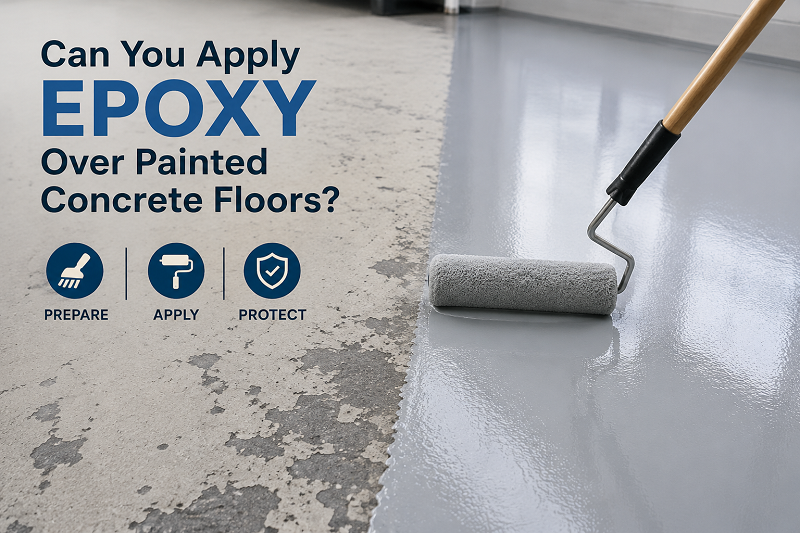
Why This Question Is More Complicated Than It Sounds
Epoxy adheres best when it bonds directly to porous, prepared concrete. That’s the baseline assumption behind every epoxy floor coating product on the market — the chemistry is engineered to grip into a mechanically opened concrete surface.
Paint changes that equation entirely. When you coat over old paint, the success of the new epoxy relies completely on the bond strength of the existing paint layer to the concrete underneath. The epoxy isn’t bonding to concrete anymore — it’s bonding to paint, which is in turn bonding to concrete. You’ve added a link to the chain, and that link can be weaker than either end.
If that paint layer is compromised in any way — flaking, chalking, soft spots, poor original adhesion — the new epoxy has nothing reliable to hold onto. It might look fine for a few weeks. Then it starts coming up in sheets, often taking the old paint with it.
Step One: Test the Existing Paint Before You Do Anything Else
This isn’t optional, and it isn’t a five-minute formality. The test result determines your entire project path.
The tape test. Cut a small “X” into the paint with a utility knife. Press a strip of strong duct tape firmly over the cut, then rip it off quickly in one motion. Check what came up. If more than about 10% of the paint lifted with the tape, the existing coating is failing and needs to come off completely before any epoxy floor coating goes down.
Visual inspection. Walk the entire floor, not just one spot. Look for peeling edges, chalking (a powdery residue that rubs off on your hand), bubbling, or soft areas that give when pressed. Any of these signs across meaningful sections of the floor point toward full removal rather than coating over.
The water test. A few drops sprinkled on the surface tell you something useful: if the water beads up, the paint is likely oil-based; if it soaks in, it’s probably water-based or latex. This matters because the two paint types behave very differently under epoxy.
A small test patch. Before committing to the whole floor, mix a small batch of epoxy and apply it to an inconspicuous section. Let it cure fully per the product’s schedule, then check for adhesion issues, lifting, or soft spots. This is the closest thing to a guarantee you’ll get before the real project starts.
What the Paint Type Actually Means for Your Project
Not all paint behaves the same way under a new coating, and this is where a lot of DIY projects go sideways.
Oil-based or alkyd paint generally provides a better foundation than latex — it’s a harder, denser film with less porosity issue, and when it’s fully cured and properly profiled, it gives the new epoxy something more stable to key into.
Latex or water-based paint poses more of a challenge for epoxy adhesion. These paints are more flexible and less dense, which means the mechanical bond an epoxy needs to form is harder to achieve without aggressive surface prep. It’s not impossible — just less forgiving of shortcuts.
Multiple layers or unknown coatings are where caution is warranted. If you don’t know how many coats are on the floor, what products were used, or how old the bottom layer is, you’re working blind. Heavily weathered, many-coats-thick paint jobs are a strong signal to strip everything back to bare concrete rather than gamble on layering a new system on top.
Previous two-component epoxy paint is a specific exception worth flagging: don’t apply a new coating directly over an existing epoxy paint system without proper mechanical profiling first. Epoxy doesn’t absorb new epoxy the way concrete absorbs primer — without sanding or grinding to open the surface, the new layer just sits on top rather than bonding into it.
Surface Preparation: The Step That Actually Determines Success
Once you know the paint passes the tests, the real work starts — and it’s more labor-intensive than coating bare concrete, not less.
Clean everything first. Sweep and vacuum to remove loose debris, then degrease any oily or greasy areas — garages in particular tend to have automotive fluid stains that need targeted attention. A power washer handles heavily soiled sections effectively. Skipping this step means trapping contaminants under the new coating, which shows up later as adhesion failure.
Create a mechanical profile. This is the part that actually matters most. Light sanding works for small areas or thin paint layers; mechanical grinding with diamond tooling is the more reliable approach for full-floor projects. The goal is roughening the painted surface enough that the new epoxy floor coating has something to physically grip, not just sit on. Acid etching is generally not recommended over painted surfaces — it’s designed to work on bare concrete and doesn’t perform the same function on paint.
Consider a bonding primer. If the adhesion test showed marginal results, or if you’re working with oil-based paint, a primer specifically designed to bridge old coatings to new epoxy can meaningfully improve the odds. Manufacturers typically specify which primers are compatible with their epoxy systems — check the product data sheet rather than guessing.
Don’t skip moisture considerations. If the slab has any history of moisture issues, painting over it doesn’t solve that — it often masks it. Moisture vapor pushing up from below the concrete can cause blistering regardless of how well the paint and epoxy are bonded to each other. If you suspect moisture intrusion, that needs to be tested and addressed before any coating goes on, painted surface or not.
When You Should Just Strip the Paint and Start Fresh
There are situations where trying to save time by coating over paint actually costs more time in the long run.
The paint fails the tape test. If more than 10% lifts, that’s your answer. Coating over a failing bond just adds weight and stress to a connection that’s already breaking down.
You see active peeling or bubbling anywhere. Even isolated sections are a warning sign — those areas indicate the paint-to-concrete bond is already compromised, and it tends to spread.
You want maximum durability or a warranty. Commercial garages, high-traffic residential spaces, or any project where you’re investing in a premium epoxy floor coating system with a long-term warranty — most manufacturers won’t warranty an install over an unknown or marginal substrate. If durability is the priority, mechanical removal down to bare concrete is the safer investment.
You don’t know the paint’s history. Unknown coatings, unknown age, unknown number of layers — when you genuinely don’t know what you’re dealing with, the safe assumption is removal, not a hopeful coat-over.
Mechanical removal — diamond grinding being the gold standard — strips the old paint completely while simultaneously profiling the bare concrete underneath. You end up with the same clean slate you’d have on a never-painted floor, which is the most reliable foundation any epoxy floor coating can have.
Quick Decision Framework
| Condition | Recommended Path |
|---|---|
| Paint passes tape test, no visible damage, oil-based | Light grinding + prime + coat |
| Paint passes tape test, latex/water-based | Aggressive sanding/grinding + prime + coat |
| Paint fails tape test or shows peeling | Full mechanical removal first |
| Multiple unknown layers, heavily weathered | Full mechanical removal first |
| Previous 2-part epoxy paint underneath | Grind to profile before recoating |
| Any sign of moisture issues | Test and resolve moisture before either path |
| Commercial use or warranty required | Full removal — don’t risk an unverified substrate |
What Happens If You Skip the Testing and Just Coat Over It
This is worth spelling out plainly, because it’s the most common version of this project going wrong.
Someone sees old paint that “looks fine,” skips the tape test, does a quick clean and maybe a light sand, and applies a fresh epoxy floor coating directly over it. For a few weeks, it looks great. Then foot traffic, hot tires, or just time start finding the weak points. The new epoxy peels — but it peels along with the old paint underneath it, in sheets, because the failure point was never the new coating. It was the paint-to-concrete bond that was already failing before anyone touched it.
At that point, you’re not just redoing the epoxy. You’re removing two failed coating layers instead of one, which costs more in labor and material than if you’d ground the floor down to bare concrete from the start.
The Bottom Line
You can apply epoxy over painted concrete — but only when the existing paint passes a real adhesion test, the surface gets properly profiled rather than just cleaned, and the paint type and history are actually known rather than assumed. When any of those conditions aren’t met, mechanical removal back to bare concrete isn’t the more cautious option — it’s the only option that reliably works.
A few hours spent testing and preparing properly is the difference between a floor that lasts 10-plus years and one that needs to be redone twice.