


Floor coating is the strongest shield for concrete floors. It can protect floors from erosion by various substances, prevent dust, extend the service life of concrete floors, and achieve a good aesthetic effect. This is why it is used in commercial, industrial, residential and other major scenarios. However, even the best floor coatings often have problems during construction or use due to missing some details. Today, Jincheng will take you to understand the common problems of floor coatings and prevention methods, hoping to help you.
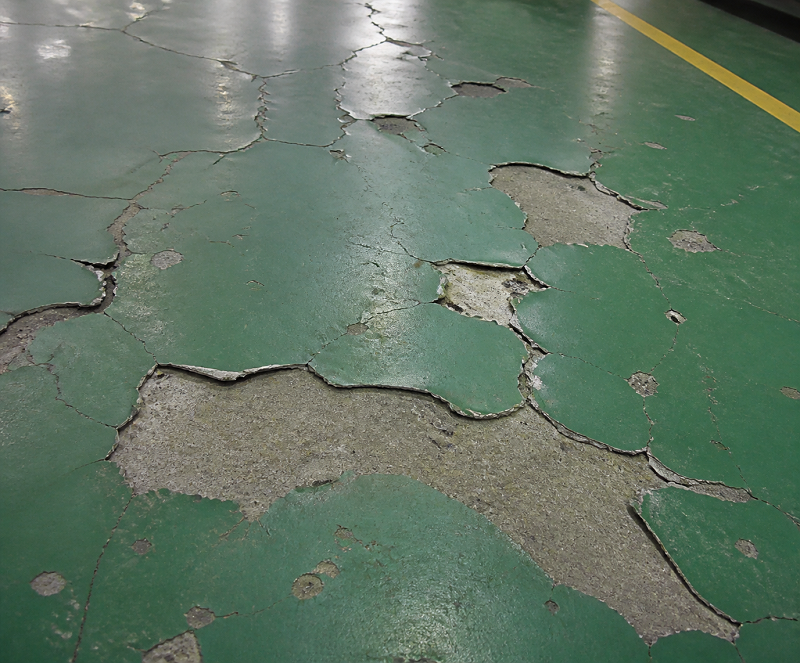
Peeling and Falling Off of Floor Coating
Peeling and falling off of floor coatings are common problems in daily use, caused by insufficient adhesion between the coating and the concrete floor. Common reasons for insufficient adhesion are: the concrete base is not carefully cleaned, leaving dust, grease, chemicals and other substances on the surface, which will hinder the bonding between the coating and concrete; it is also possible that the moisture content of the concrete base is too high, and excessive moisture will also hinder the adhesion of the coating; and the floor is not polished. The concrete surface is usually smooth and needs to be polished to make the surface rough, thereby improving adhesion.
Solutions: Remove dirt from the concrete base, use a vacuum cleaner for dust, and a degreaser for oil stains; for bases with excessive moisture content, a water-based primer or MVB primer can be applied first to provide a good moisture barrier for intermediate and top coats; the floor can be roughened with a grinder or shot blasting machine – this can open the concrete pores and form a rough surface for better coating adhesion.
Blistering and Pinholes of Floor Coating
Coating blistering (bubbles of different sizes under the coating) and pinholes (tiny holes on the surface) are common problems in the construction process, especially in epoxy and polyurethane coatings. Blistering and pinholes not only affect the appearance, but also weaken the performance and strength of the coating to a certain extent, making it more prone to damage and wear.
Blistering is generally caused by air or water vapor. When the concrete base is too wet, water vapor will rise after the coating cures, forming bubbles in the cured coating; in addition, when the construction environment temperature is too high, high temperature will accelerate the curing process, causing air or solvent vapor to be trapped in the coating before escaping, resulting in bubbles. Pinholes are usually caused by improper mixing (air mixed into the coating) or excessive coating thickness applied at one time, so that air cannot escape during the drying process.
Solutions: For wet concrete bases, water-based coatings or MVB primers can be used, and construction in high temperature should be avoided, such as choosing construction in the morning or evening, avoiding the hottest time at noon; when mixing coatings, such as epoxy which is divided into component A and B, use an electric mixer to fully mix component A/B resin slowly and evenly, which can effectively avoid bringing in a lot of air, and scrape the bucket wall to prevent bubbles. Apply the coating thinly and evenly in accordance with the manufacturer’s thickness standard, and use a defoaming roller to release trapped air before the coating cures.
Severe Fading or Yellowing of Floor Coating
I believe many people have been troubled by fading or yellowing problems. Coating fading and yellowing greatly affect the appearance, especially for commercial spaces. The causes of coating fading and yellowing are generally related to sun exposure, which is common in epoxy floor coatings; in addition, the use of inferior pigments can easily lead to fading and yellowing.
Solutions: First of all, choose UV-resistant floor coatings, such as Polyaspartic Coating, polyurethane coating, etc. If you have to choose epoxy materials, you can apply a layer of transparent top coat with UV protection function on the surface after curing; at the same time, avoid using inferior pigments to ensure the long-term beauty of the floor.
Cracking and Flaking of Floor Coating
The original intention of the development of floor coatings is durability, but many users feedback that their floors start to crack and flake after a few years of use. In fact, most cases of cracking and flaking are caused by inappropriate coating selection and improper construction. To give a simple example, ordinary epoxy floor coatings in heavy-duty environments will sooner or later crack or flake under the perennial mechanical impact of forklifts and other large machines.
Choose the appropriate floor coating according to the usage scenario – for example, choose high wear-resistant and high impact-resistant polyaspartic coating or polyurethane coating for garages and industrial spaces; choose more corrosion-resistant coatings for chemical industrial scenarios.
Poor Curing and Stickiness
Poor curing or continuous stickiness of floor coatings is also a common problem in the construction process, especially in personal DIY floor construction. Poor curing and stickiness of the coating will directly lead to the failure of the entire coating project, and the main reasons are low temperature, high humidity (such as rainy days), wrong mixing ratio, and material quality problems.
Solutions: Mix materials strictly in accordance with the manufacturer’s material ratio (weigh with an electronic scale); if the ambient temperature is always low, you should communicate clearly with the manufacturer, and they will provide low-temperature version coating materials; do not construct in rainy days and other high-humidity weather.
Conclusion
Jincheng has shared the common problems of floor coatings and some solutions. I hope this can help you who are troubled. If you have any questions or needs about this, please contact us.