
Ask any garage or driveway contractor what keeps them up at night on a coating project, and it comes down to one question: epoxy, polyurethane, or polyaspartic floor coating? All three claim to “coat a floor,” but the differences in cure time, weather resistance, and long-term maintenance cost are massive. After years of OEM manufacturing and export work in floor coatings, our take is blunt: if a project is time-sensitive and needs to survive outdoor exposure, polyaspartic floor coating is, right now, the better bet. Here’s the breakdown.
Cure Speed: Epoxy’s Biggest Weakness
Standard epoxy floor coatings typically need 12-24 hours before foot traffic is safe, and 5-7 days before the floor reaches full working strength. No vehicles, no reopening the shop — that downtime is a real cost for any commercial customer.
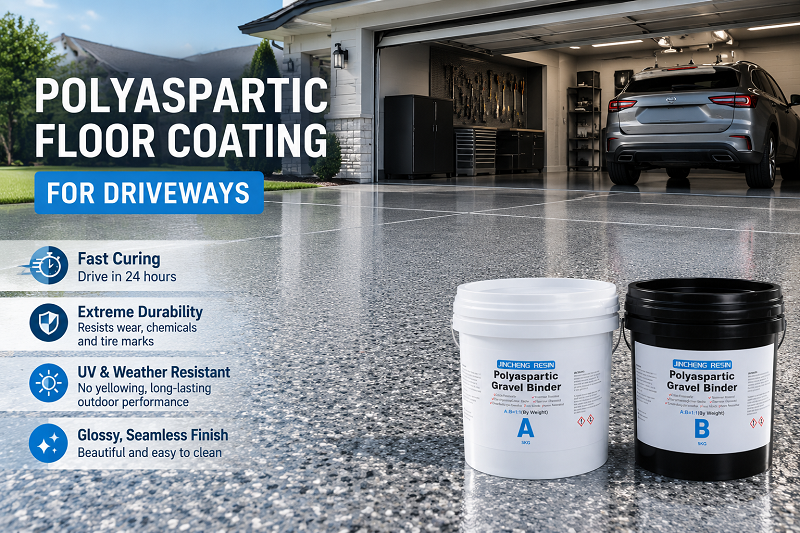
Polyaspartic floor coating operates on a different timescale entirely. Most products are tack-free in 30 minutes to 2 hours, and drivable within 4-6 hours — multiple coats can go down in a single day. A garage floor job that would stretch epoxy across a full week can be wrapped up in one day with polyaspartic. For contractors running a garage coating business, turnaround time is cash flow. A job that can be finished in a day shouldn’t drag into a week just because the material demands it.
Polyurethane sits somewhere in between, but it generally still lags behind polyaspartic systems — and that gap widens further in cold weather.
Outdoor UV Stability: Epoxy’s Built-In Flaw
Epoxy resin’s chemistry makes it highly sensitive to UV light. On driveways and patios exposed to constant sun, standard epoxy coatings will typically yellow, chalk, or lose gloss within a year or two — not because of poor workmanship, but because of the material itself. That’s why many epoxy floor manufacturers add a polyurethane topcoat as a workaround — which is really just an admission that epoxy can’t handle outdoor UV on its own.
Polyaspartic floor coating is chemically built for UV resistance — color and gloss hold up under long-term sun exposure without needing an extra topcoat. That’s a big reason polyaspartic is overtaking traditional epoxy in high-sun markets like the US and Australia for driveway and garage floor applications.
Polyurethane usually beats plain epoxy on UV stability, but polyaspartic tends to offer a better overall balance of abrasion resistance and impact strength.
Application Window and Temperature Tolerance
Epoxy coatings are picky about temperature and humidity. Cure too cold and it slows to a crawl or never fully hardens; too humid and you get blushing or fogging on the surface. That’s exactly why epoxy floor jobs get squeezed on scheduling in winter or in humid climates.
One of the real practical advantages of polyaspartic floor coating is its wider cure range — some formulations cure properly from as low as -18°C up through much warmer temperatures — with far better humidity tolerance. For export customers spread across different climate zones — from harsh North American winters to humid Southeast Asian conditions — that flexibility often determines whether a project stays on schedule at all.
Abrasion, Chemical Resistance, and Long-Term Performance
Garage and driveway floors take a real beating: vehicle traffic, oil drips, road salt. That’s the true test of a coating’s abrasion resistance and chemical resistance.
- Standard epoxy: high hardness, decent abrasion resistance, but brittle — prone to cracking where temperatures swing widely.
- Polyurethane: more flexible, strong scratch and abrasion resistance, but weaker chemical and compressive resistance when used alone.
- Polyaspartic floor coating: combines epoxy’s hardness with polyurethane’s flexibility, plus stronger resistance to chemical attack — particularly against gasoline, motor oil, and antifreeze, the everyday contaminants in any garage. Long-term cracking and peeling rates are noticeably lower.
That’s why more contractors building complete garage floor systems now layer polyaspartic as the topcoat over an epoxy primer — epoxy for the bonding base layer, polyaspartic for the weather- and wear-resistant top layer. The two complement each other.
VOC Content and Environmental Compliance
Many traditional epoxy and polyurethane formulations still rely heavily on solvent-based components, and VOC emissions face increasingly tight regulation in US and European markets.
Most polyaspartic floor coating formulations are 100% solids or ultra-low VOC — better for the environment, and with far less odor on site. That matters a lot when the job is happening inside a store that’s still open, or affecting workers on-site. It’s also why, in our OEM manufacturing work, more overseas clients are now specifically requesting polyaspartic formulations over traditional epoxy.
Total Cost: Don’t Just Look at Price Per Square Meter
Compare raw material cost per square meter, and polyaspartic floor coating usually comes out pricier than epoxy. But that number doesn’t tell the whole story:
- Faster cure means shorter labor hours and faster project turnover.
- Better outdoor durability stretches the recoat cycle from epoxy’s typical 2-3 years to 8-10+ years with polyaspartic.
- Stronger stain and chemical resistance cuts down on maintenance and rework costs down the line.
Add it all up, and the total cost of ownership for polyaspartic floor coating usually comes out lower for most garage and driveway applications. That’s a major reason polyaspartic’s market share has been growing faster than traditional epoxy in mature floor-refinishing markets like North America and Australia over the past few years.
Which One Fits Your Project
- Outdoor driveways exposed to direct sun: go with polyaspartic floor coating — UV stability is non-negotiable here.
- Tight timelines, commercial spaces that can’t stay closed long: polyaspartic’s fast cure is the deciding factor.
- Tight budget, indoor basement garage with no UV exposure: standard epoxy is still a reasonable value option.
- Floors with slight structural movement risk, needing flexibility and crack resistance: polyurethane, or an epoxy + polyaspartic hybrid system, is the safer bet.
Bottom Line
No single material wins every scenario. But for garages and driveways — long-term outdoor exposure, fast turnaround required — polyaspartic floor coating now clearly outperforms traditional epoxy and single-system polyurethane on cure speed, UV stability, chemical resistance, and environmental compliance. For contractors and OEM suppliers in the floor coating business, adding polyaspartic to the product line isn’t really a question of “if” anymore — it’s a question of “when.”