


Most floor coating projects ask you to clear the space, stay off the floor for three to five days, and plan around a week of disruption. For a homeowner, that means the car sits in the driveway for a week. For a commercial facility, it can mean days of lost operations.
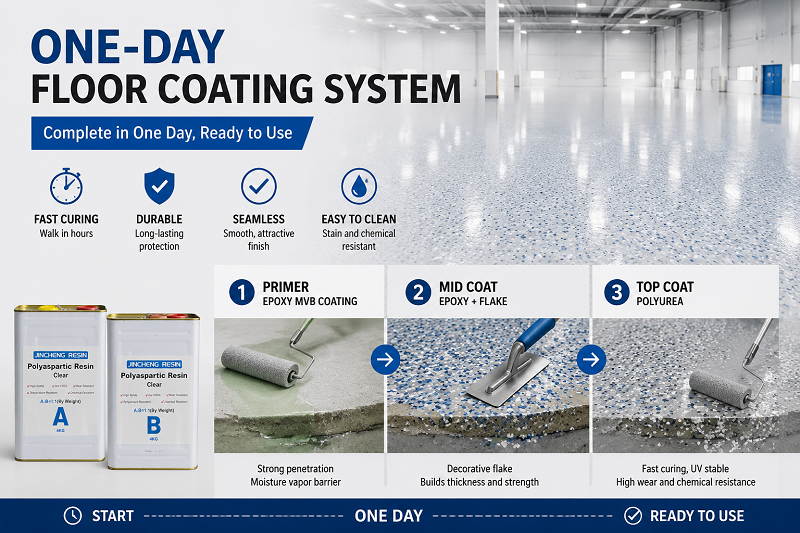
The Jincheng One Day Floor Coating System was built around a different premise: a complete, professional-grade multi-layer system — moisture vapor barrier primer, epoxy base with full composite flake broadcast, polyurea topcoat — that goes from bare concrete to full vehicle traffic in 14 to 16 hours. One crew, one day, ready the next morning.
This isn’t a thin-coat shortcut or a single-product application. It’s a three-layer system engineered so each layer cures fast enough to receive the next, and the final topcoat brings the kind of hardness that lets a car roll in before the crew is back for their second coffee.
Who This System Is For
Homeowners who want a garage or basement floor that looks and performs like a professional install — without giving up the space for a week. The one-day window means your car is back inside overnight.
Commercial facilities — showrooms, restaurants, warehouses, fitness studios — where floor downtime costs money. A space that shuts down Monday morning and reopens Tuesday is manageable. A space offline for five to seven days is a different conversation.
Contractors and B2B buyers looking for a complete system that differentiates their offering. A one-day floor coating system is a genuine competitive advantage when bidding against installers still quoting five-day projects.
The System: Three Layers, One Day
Layer 1 — Epoxy MVB Moisture Vapor Barrier Primer
Layer 2 — Epoxy Rsein coating Base Coat with Full Composite Flake Broadcast
Layer 3 — Fast-Cure polyaspartic Topcoat
Each layer has a specific job. The primer seals the slab. The base coat creates the decorative surface. The polyurea closes everything with a hard, chemical-resistant finish that cures fast enough to allow vehicle traffic by the following morning.
The Installation Timeline
8:00 AM — Surface Preparation
Every successful floor coating starts here, and this system is no exception. The concrete is mechanically ground using dust-controlled equipment — diamond tooling that opens the concrete’s pore structure to a CSP 2–3 profile and removes any existing sealers, surface contamination, or failed coatings.
This step isn’t negotiable. No primer bonds reliably to a polished or sealed surface. The grinding creates the mechanical profile that the MVB primer penetrates and locks into. Cracks and divots are repaired with epoxy patching compound and allowed to set before any coating goes down.
Dust-controlled grinding also matters practically: it means the space doesn’t require extensive cleaning after prep, and the crew can move directly to priming without waiting for airborne debris to settle.
10:30 AM — Epoxy MVB Moisture Vapor Barrier Primer
The first coat is the one most people never think about — and the one that determines whether the whole system holds long-term.
The Jincheng MVB primer is a two-component, 100% solids, zero-VOC epoxy formulated specifically for high-moisture concrete substrates. It penetrates the mechanically opened pore structure and chemically bonds to the slab, creating a sealed interface that blocks moisture vapor transmission before it can reach the coating layers above.
Why this matters: concrete slabs — particularly below-grade garage floors and basements — pull moisture vapor upward from the ground continuously. An impermeable coating applied without a vapor barrier traps that vapor pressure beneath it. Over time, that pressure finds the weakest adhesion point and the coating lifts. This is why most premature floor coating failures originate at the concrete interface, not at the surface.
The MVB primer solves this from the first coat. Key performance characteristics:
- Two-component, 100% solids epoxy — zero carrier evaporation, minimal VOC load during application
- Zero-VOC formulation — safe for enclosed spaces including basements and interior commercial floors without requiring additional ventilation beyond normal airflow
- Low-temperature cure capability — bonds and cures reliably at room temperature and in below-grade environments where ambient conditions run cooler than ground-level spaces
- Rated to control vapor emission up to 20 lbs/24hr/1,000 sq ft (ASTM F1869) — covers the overwhelming majority of residential and commercial concrete substrates
By 10:30 AM the primer is applied and beginning to develop its bond. The system clock is running.
1:00 PM — Color Epoxy Base Coat + Full Composite Flake Broadcast
With the primer tacked off, the base coat goes down: a 100% solids color epoxy in the specified finish color, applied at the correct coverage rate for the surface area.
Immediately after the base coat is applied — while it’s still fully wet — composite flakes are broadcast by hand until the surface reaches full saturation. This is the “broadcast to rejection” technique: flakes are thrown until the wet epoxy can’t accept any more, creating complete coverage of the base coat color underneath.
The composite flake system adds several layers of performance beyond appearance:
Texture and grip. A fully broadcast flake surface provides measurable slip resistance without added aggregate — the irregular flake surfaces create directional texture in every plane. In wet conditions, this performs significantly better than a smooth topcoat alone.
Visual depth. The multi-layer flake surface reads differently from different angles and under different light conditions. The depth effect comes from the base coat color showing through the flake matrix in specific areas — a characteristic of a properly saturated broadcast that thinner applications can’t replicate.
Concealment. Minor surface variations, patched cracks, and concrete imperfections disappear under a full flake broadcast. The floor reads as uniform and intentional rather than revealing the substrate history underneath it.
Durability buffer. The flake layer adds physical thickness at the mid-coat level, distributing point-load stress from equipment feet and vehicle tires across a larger area of the epoxy matrix rather than concentrating it at the surface.
4:00 PM — Flake Recovery and Surface Prep
Once the base coat has reached initial set — firm enough that the flakes are locked in but still slightly tacky on the surface — the loose overbroadcast is swept and vacuumed from the floor. This is a critical step that affects the finish quality of the topcoat.
Excess unbound flakes sitting on the surface would create an irregular, high-spot texture under the final coat. After collection, the surface is lightly scraped and smoothed to knock down any standing flake edges. What remains is a uniform, fully textured surface with the composite flake locked into the epoxy matrix beneath it, ready to receive the topcoat.
5:30 PM — Polyurea Topcoat
The final layer is where the system’s one-day performance claim is earned.
Standard epoxy topcoats cure slowly — walk-on at 12 to 24 hours, vehicle traffic at 48 to 72 hours minimum. Polyurethane is faster but still requires 24 to 48 hours before full service. Neither is compatible with a genuine one-day system.
Polyurea cures on an entirely different timeline. The Jincheng One Day system uses a fast-cure aliphatic polyurea as the finish coat — a chemistry that reaches full hardness within hours of application rather than days.
What the polyurea topcoat brings to the system:
Hardness above epoxy. Polyurea’s impact and abrasion resistance runs approximately four times that of standard epoxy. Under vehicle tires, loaded equipment, and daily foot traffic, this translates to a surface that holds its appearance significantly longer than an epoxy-topped floor.
Chemical resistance. Automotive fluids, degreasers, disinfectants, hot tire compounds — polyurea’s chemical resistance profile covers the full range of what a working garage or commercial floor encounters.
UV stability. The aliphatic formulation means no yellowing under sustained UV exposure. For spaces with significant natural light — garages with open doors, showrooms with skylights, studios — this is the difference between a floor that looks the same in year five and one that’s visibly aged.
Flexibility. Polyurea’s elongation at break exceeds 300% — the coating moves with the slab through thermal expansion and contraction rather than cracking at stress points. In climates with significant temperature variation or on slabs that experience seasonal ground movement, this resilience directly extends the coating’s service life.
Fast cure to service. Applied by 5:30 PM, the polyurea topcoat is developing hardness through the evening. By the following morning — 14 to 16 hours after topcoat application — the floor is ready for full traffic.
Next Day, 8:00 AM — Delivery
14 to 16 hours after the polyurea goes down, the floor is fully open to pedestrian and vehicle traffic. The project that started with bare concrete yesterday morning is a finished, professional-grade floor system this morning.
For homeowners, this means the garage is functional again before the workday starts. For commercial operators, it means a facility that went offline Monday morning is operational again Tuesday. For contractors, it’s a project timeline that fits within a standard working day with no site babysitting, no extended access requirements, and no explaining to clients why the floor still can’t be touched on day four.
System Performance Summary
| Property | Performance |
|---|---|
| Total installation time | ~9.5 hours (8:00 AM – 5:30 PM) |
| Return to pedestrian traffic | 14–16 hours after topcoat |
| Return to vehicle traffic | 14–16 hours after topcoat |
| Full chemical cure | 24–48 hours |
| Moisture vapor control | Up to 20 lbs/24hr/1,000 sq ft (MVB primer) |
| VOC profile | Zero-VOC (primer + base system) |
| UV stability | Excellent — aliphatic polyurea topcoat |
| Topcoat impact resistance | ~4x standard epoxy |
| Expected service life | 15–20 years (residential/commercial) |
Where the Jincheng One Day System Is Specified
Residential garages and basements — the primary residential application. Homeowners get a floor that looks and performs like a commercial install without the week-long disruption.
Commercial showrooms and retail — spaces that need to look sharp and can’t afford extended downtime. The decorative flake system in the base coat and the hard polyurea topcoat make the floor look intentional and hold that appearance under daily traffic.
Restaurants and food service — the zero-VOC primer and base system make enclosed space installation practical, and the polyurea topcoat provides the chemical resistance that food service environments require. (Specific food service applications should confirm NSF-compliant topcoat specifications.)
Industrial and warehouse facilities — the polyurea topcoat’s impact resistance and chemical resistance profile matches heavy-use industrial requirements. The one-day installation window makes scheduled maintenance recoating operationally viable.
Fitness facilities — hard surface, easy to clean, no odor retention in the final topcoat, and fast enough installation to reopen before the next morning’s classes.
Frequently Asked Questions
Can the system be installed in cold or below-grade environments? Yes. The MVB primer is specifically engineered to cure at room temperature and low ambient temperatures — a practical advantage in basements and below-grade commercial spaces where standard epoxy primers often require controlled temperature conditions.
What if my floor has significant moisture issues? The MVB primer handles vapor emission up to 20 lbs/24hr/1,000 sq ft. Active water intrusion through cracks or wall interfaces needs to be addressed structurally before any coating system is applied — the primer manages vapor transmission, not standing water entry.
Is the system suitable for outdoor surfaces? The aliphatic polyurea topcoat is UV-stable and suited for outdoor use. Full outdoor exposure specifications should be confirmed with the jinchengresin technical team based on the specific application.
What maintenance does the system require? Routine cleaning with pH-neutral cleaners. The polyurea topcoat is non-porous and doesn’t require sealing. Depending on traffic levels, a topcoat refresh every 8–12 years extends the system’s service life at a fraction of a full reinstallation cost.
Talk to the Jincheng Team
The Jincheng One Day Floor Coating System is available for residential projects, commercial installations, and OEM/private label supply. Contact the jinchengresin team for technical specifications, coverage rates, product data sheets, and contractor pricing.