



If you have been looking for floor coatings recently, whether for garages, warehouses, basements or other applications, these two floor coatings, Polyaspartic Floor Coating and Polyurethane Floor Coating, must be on your list. Both are high-performance floor materials with a high overlap in application scenarios, and it can be really confusing to figure out which one to choose.
Today, jincheng will analyze their performance in key aspects such as durability, curing time, cost, and the most suitable applications for each, hoping to help you choose the most suitable floor material.
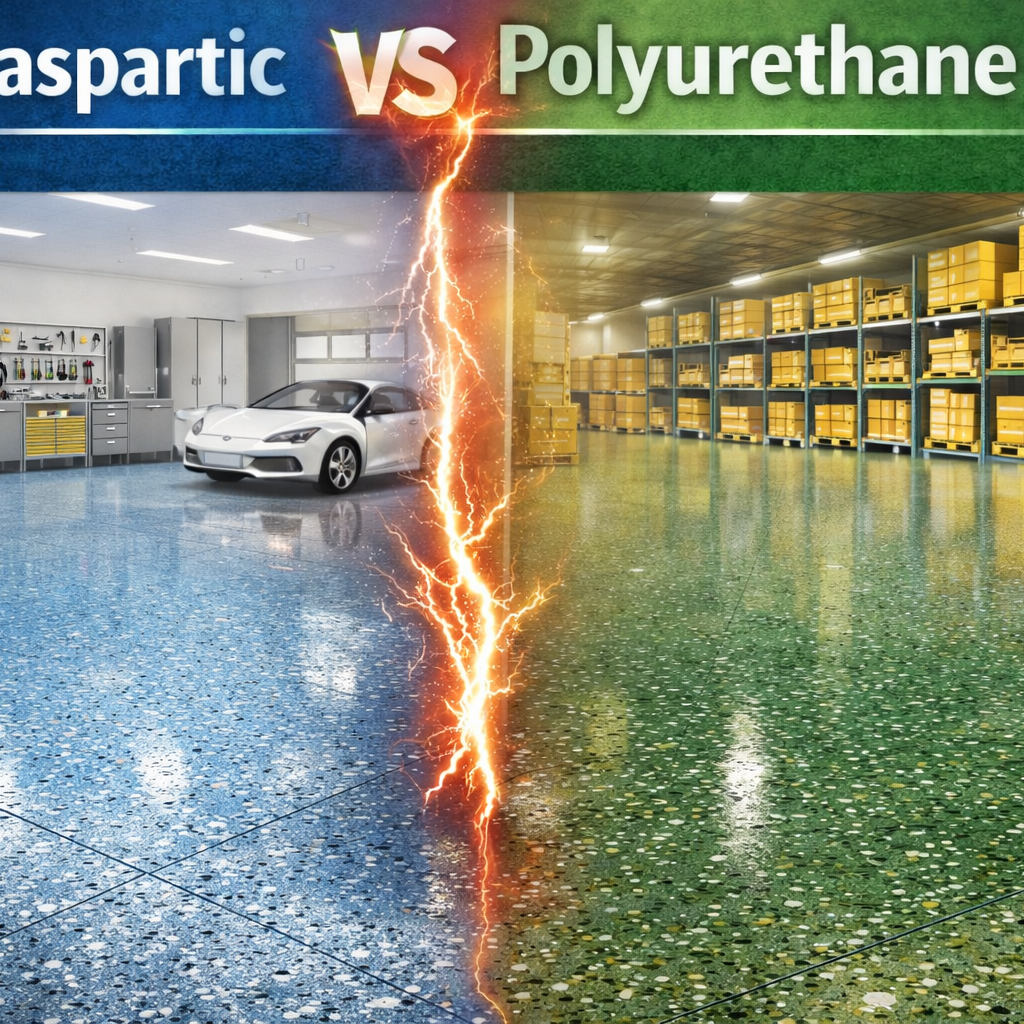
First, let’s briefly introduce these two materials. Both polyaspartic and polyurethane are protective coatings for concrete floors (and sometimes wood floors), but their chemical compositions are different. Polyaspartic belongs to the polyurea family and is the most popular floor material in recent years, which has become the first choice for many people now. Polyurethane, on the other hand, is a very traditional industrial floor material, a well-known and reliable option that many people have been using for years.
To briefly summarize the differences between Polyaspartic and Polyurethane floor coating, we can look at several key points.
Drying speed: If you have ever waited for days for floor coatings to cure, you know how frustrating it can be—especially when you need to use the space urgently. Polyaspartic Floor Coating is definitely a game-changer in this regard. It cures in hours, not days. The construction is completed today and the floor can be put into use the next day. Some high-quality polyaspartic coatings even allow you to apply two coats on the same day, and the entire project can be finished within 24 hours.
What about Polyurethane Floor Coating? It is not that fast. It dries slowly—it takes 24 to 48 hours for light traffic and 2 to 3 days to fully cure (longer in humid weather). This means if you coat your garage, you have to park your car elsewhere for days, which is very troublesome. For some application scenarios that require quick use, this may be an unacceptable disadvantage.
Next is durability. To be honest, no one wants to renovate or repair the floor every few years. Both coatings are durable, but they have advantages in different fields. Polyaspartic is designed for heavy use. It has extremely high hardness, resistance to scratches and abrasion, and can even prevent hot tire pick-up (the annoying situation where hot car tires peel off the coating). It also has sufficient flexibility to cope with slight deformation of concrete, so it will not crack even if your floor shifts a little—very suitable for places like garages or basements where concrete may settle over time.
Polyurethane is certainly very durable as well, and it is more flexible than polyaspartic. This flexibility is great for wood floors or areas where the surface may move frequently, but it is not as good as Polyaspartic Floor Coating in resisting strong impacts or scratches from sharp objects. It is still a good choice, but more suitable for areas with light traffic.
Another important aspect: UV resistance. Many people ignore this issue, but it is actually very important. Polyaspartic has excellent UV resistance and is not easy to turn yellow even after long-term outdoor sun exposure; ordinary polyurethane has average UV resistance and may slightly discolor when used outdoors. So for outdoor floors or application scenarios exposed to sunlight for a long time, Polyaspartic Floor Coating is undoubtedly a more suitable choice.
Let’s talk about construction difficulty. If you do it yourself, polyurethane may be easier to handle. It is more forgiving because of the long curing time, which leaves you a very long operating window. You can apply it slowly without leaving streaks or uneven marks due to too fast drying.
Polyaspartic is relatively difficult to construct because it cures very quickly, and you have to operate fast—if you are inexperienced, you may end up with a messy result. Therefore, we generally recommend hiring professionals to construct polyaspartic floor coatings. Although this will increase your cost, it is well worth it to get a smooth and professional finish.
Finally, we have to discuss the cost of the two, which is an important factor for most people. Polyaspartic coatings are more expensive, and plus you hire professionals for construction, the labor cost will add extra. Polyurethane is relatively cheaper, maybe only half of polyaspartic. If you are on a tight budget, it will be a better choice.
But here is a key point: polyaspartic has a longer service life—with proper maintenance, it can last 10 to 15 years, while polyurethane usually only lasts 8 to 10 years. So although polyaspartic has a higher upfront cost, it may save you money in the long run because you do not need to renovate as frequently. It is like buying a pair of high-quality shoes—you spend more, but they are much more durable than cheap ones that break in a year.
If you are still struggling between these two floor coatings and don’t know which one to choose, you can refer to the following questions:
Does the project require fast construction? If quick delivery is needed, Polyaspartic is more suitable.
Will the floor be exposed to sunlight for a long time? If it is an outdoor area or garage entrance, Polyaspartic has better UV resistance.
Is a more flexible material needed? If the floor has large temperature differences, Polyurethane will be more stable.
Is the budget limited? If the budget is tight, Polyurethane may be more economical.
Ultimately, both polyaspartic and polyurethane are good choices—they just meet different needs. The key is to figure out what you value most: speed, durability, cost, or construction difficulty. If you are still unsure, you can consult Jincheng—we have served thousands of floor companies, and we will evaluate your space and usage conditions, and give suggestions based on your specific needs.