



For decades, solvent-borne floor finishes held an uncontested grip on commercial and industrial construction. Contractors valued them for a simple reason: the chemistry worked. Deep gloss, punishing chemical resistance, long pot life — these systems delivered on every front. The compromise was invisible, at least initially. That compromise was VOCs.
The physics are straightforward. Solvent-borne epoxy floor coating keeps its polymer chains fluid by suspending them in volatile chemical carriers. When the material cures and those chains lock together, the carriers have nowhere to go but up — into the breathing zones of installation crews, into HVAC returns, into the surrounding neighborhood via exhaust fans.
What That Actually Costs Facilities
The liability isn’t abstract. Installation workers report headaches and dizziness within hours of starting a job; neurologists have documented more serious long-term damage from repeated solvent exposure over a career. Step outside the building, and the problem compounds: those evaporated compounds react with sunlight and nitrogen oxides at street level, feeding the photochemical chain reaction behind urban smog.
For facility managers, the most immediate pain is operational. A solvent-laden application in a food processing wing or an active hospital ward isn’t just uncomfortable — it’s a shutdown event. The odor alone disqualifies the space from use while curing runs its course. Depending on the square footage and ventilation, that interruption can stretch from days into weeks, with revenue losses that dwarf the original flooring budget.
The Pivot to Waterborne Chemistry
This is precisely where waterborne epoxy floor coating entered the conversation — and where early skepticism gave way to a more honest technical assessment. Earlier water-dispersed formulations did underperform. Contractors who tried them in the 1990s and early 2000s encountered slower build, sensitivity to humidity during cure, and adhesion that fell short of solvent benchmarks. Those critiques were fair at the time.
The formulations in use today are a different product category in the same name. Advances in dispersion particle size, crosslinker efficiency, and co-solvent reduction have closed the performance gap to the point where “waterborne vs. solvent-borne” is no longer a straightforward trade-off question. For a growing range of industrial applications — healthcare flooring, logistics facilities, food-grade environments — waterborne systems have become the baseline specification, not the alternative one.
With modern watchdogs like the EPA and Europe’s REACH rolling out ultra-strict caps on chemical emissions, relying on old-school solvent systems is quickly becoming a major legal and financial liability.
The Breakthrough of Water-Dispersible Chemistry
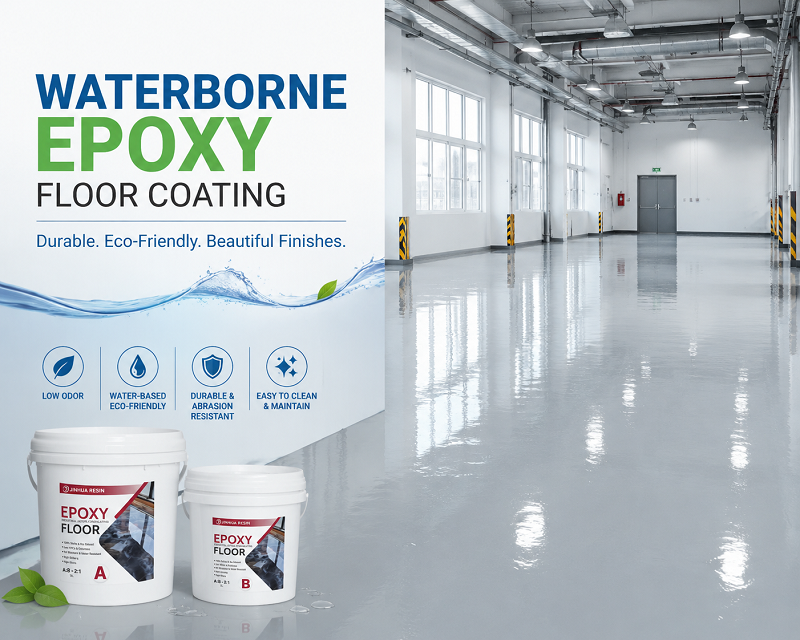
This is where advanced waterborne epoxy floor coating changes the game. Instead of gambling with toxic chemical thinners, these modern systems use everyday water to suspend the resin particles and curing agents. Once applied to the subfloor, the water safely evaporates into the room as basic vapor, leaving behind a tightly locked, incredibly rugged polymer shield.
[Solvent Systems] -> Evaporates Chemicals -> Spreads Hazardous Odors & VOCs
[Waterborne Tech] -> Evaporates Water     -> Produces Clean Vapor & Low Odor
Admittedly, early versions of water-based coatings struggled with a bit of a reputation issue. Installers complained about water spots, weak chemical resistance, and thin, brittle coats. However, recent breakthroughs in polymer synthesis have completely rewritten that old narrative.
Today’s industrial-tier epoxy floor coating setups utilize cutting-edge emulsifiers that allow them to match—and frequently beat—the wear-and-tear resistance of older, solvent-heavy options.
Proven Perks: Why Operations are Shifting to Waterborne Systems
This industry-wide migration toward water-based tech isn’t just about dodging fines; it is fueled by genuine practical, financial, and safety advantages on the job site.
1. Odorless Classrooms and Clean Workspaces
The most immediate benefit of picking a waterborne epoxy floor coating is its clean, near-zero VOC footprint. Because the formula relies on water, there is no choking chemical smell during or after the roll-out. This makes it a perfect fit for “live environments”—buildings that need to keep running during a remodel. Supermarkets, schools, and medical labs can upgrade their floors without sending everyone home or risking stock contamination.
2. Moisture Vapor Management
Traditional solvent-based options or 100% solids formulas share a common weakness: subfloor moisture pressure. When water vapor rises naturally through a concrete slab, it gets trapped under an airtight solvent layer, leading to ugly bubbles, blisters, and total adhesion failure.
Waterborne epoxy floor coating solves this with a micro-porous, “breathable” structure. It allows tiny amounts of underlying moisture to pass straight through the cured film without breaking the bond with the concrete, radically lowering the risk of floor failure on damp slabs.
3. Rapid Bonding to Green Concrete
Because these systems are formulated with water, they are inherently compatible with damp or recently poured concrete. Traditional options demand a bone-dry substrate, which often stalls tight construction timelines. Waterborne choices bypass this delay, letting crews get to work much faster.
4. Zero-Fuss Cleanup
Cleaning up after a solvent job requires aggressive wash-liquids like xylene or acetone, introducing more fire hazards and toxic waste to the site. A waterborne epoxy floor coating, on the other hand, cleans up easily with regular soap and water before it hardens. This slashes hazardous waste disposal fees and makes the job site fundamentally safer.
Debunking the “Eco-Friendly Means Weak” Myth
A common misconception among old-school contractors is that green alternatives lack real-world muscle. While that might have held true twenty years ago, modern chemical engineering has thoroughly disproven it.
Current industrial-grade waterborne epoxy floor coating solutions consistently deliver:
- Rugged Abrasion Defenses: Built to withstand constant foot traffic, heavy forklift wheels, and dragging pallets.
- Chemical Immunity: Easily resists spills from mild acids, harsh industrial detergents, and automotive fluids.
- Tailored Aesthetics: Available in everything from muted satin to high-gloss finishes, with full support for decorative color flakes or anti-slip aggregates.
While ultra-thick 100% solids formulas still hold the crown for extreme-impact heavy manufacturing zones, waterborne options have effectively captured the commercial, institutional, and standard industrial markets.
The Real Numbers: Shifting the Cost Conversation
Smart procurement managers know that looking only at the price tag per gallon is a mistake. The true cost of a flooring project must factor in labor, downtime, and long-term compliance.
| Operational Factor | Solvent-Based Epoxies | Waterborne Epoxy Floor Coating |
| Upfront Material Cost | Moderate | Highly Competitive |
| Business Interruption | Severe (Requires empty building) | Minimal (Allows for localized, live application) |
| Air Handling Needs | High (Requires heavy-duty isolation) | Standard, passive ventilation |
| Cleanup Liabilities | High (Hazmat disposal fees for solvents) | Negligible (Simple water cleanup) |
| Future Proofing | Low (Risk of violating future emissions caps) | Absolute (Well within green building codes) |
When you tally up the savings from avoided shutdowns, the lack of specialized ventilation gear, and lower workplace liability risks, waterborne epoxy floor coating options prove to be the smarter financial investment over the life of the building.
Final Thoughts: Leading the Green Transition
The VOC dilemma is no longer an issue the construction world can put on the back burner. As green initiatives like LEED certification move from niche design choices to mandatory building baselines, eco-conscious materials are the new standard.
Choosing a waterborne epoxy floor coating bridges the gap between environmental care and heavy-duty durability. By swapping out toxic solvents for water, it eliminates health risks without forcing project managers to lower their standards for style or strength. The future of commercial design belongs to clean engineering—and waterborne epoxies are paving the way.