



In the world of electronics manufacturing, micro-precision dictates failure or success. As microchips and semiconductors shrink in size while ramping up in speed, they become incredibly fragile. Enter Electrostatic Discharge (ESD)—the invisible gremlin of the cleanroom that can ruin a production batch without warning.
To safeguard these hyper-sensitive components, standard factory floor coating simply won’t cut it. Your floor is literally the foundation of your static control strategy. Here is a deep dive into why ESD floor coatings are essential, and which specific systems fit the bill for tech manufacturing.
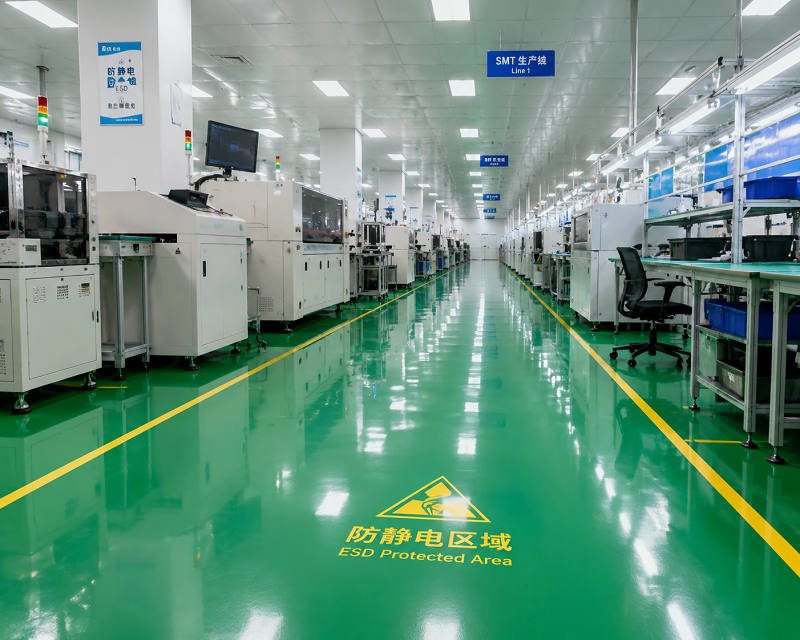
1. What’s the Big Deal with ESD?
Simply put, ESD is that sudden, unwanted spike of electricity jumping between two objects. Think about walking across a standard vinyl floor; that friction generates thousands of volts of static charge via triboelectric charging.
While you won’t even feel a static shock unless it tops 3,000 volts, advanced electronics are a different story. A tiny zap of 10 to 100 volts can instantly fry a micro-component or degrade its internal circuitry.
The True Cost of Static Failures
Static damage hits manufacturing margins in two ways:
- Immediate Failures: The component dies on the line. It hurts your yield, but at least your quality control team catches it before shipping.
- Latent Defects (The Silent Killer): The component takes partial damage but manages to pass factory testing. Months later, it fails unexpectedly in the hands of your customer. This triggers expensive warranty claims and tanks your brand reputation.
Because of this, managing static isn’t a safety checkbox—it’s a bottom-line financial strategy.
2. How ESD Flooring Protects the Plant
Relying solely on wrist straps and anti-static smocks is a trap. Operators move around, and the moment they unclip from a workstation, your protection drops.
An ESD floor coating acts as a reliable, passive grounding net that works 24/7 by doing two things simultaneously:
- Stopping Charge Before It Starts: It prevents static buildup when shoes, carts, or heavy automated guided vehicles (AGVs) roll across the room.
- Draining Existing Volts: If a worker walks into the zone carrying a charge, the floor safely bleeds that voltage into the ground in milliseconds.
To meet strict global baselines like ANSI/ESD S20.20, a facility’s floor system must keep electrical resistance tightly regulated—usually well below $1.0 \times 10^9$ ohms.
3. Top Flooring Systems Designed for Tech Manufacturing
You can’t just slap a basic coat of gray paint on the concrete and call it a day. Tech plants need flooring that merges static dissipation with cleanroom-grade durability.
Here are the top three industry-proven options:
A. ESD Epoxy Coatings (The Go-To Choice)
This seamless resin system mixes conductive elements—like carbon fibers—directly into the epoxy fluid, which cures over the concrete base.
- Why it works: It creates a completely seamless barrier. No grout lines mean no places for dust, moisture, or micro-contaminants to hide, making it a perfect fit for ISO-rated cleanrooms. Plus, it stands up to harsh chemicals, fluxes, and heavy wheeled traffic.
- Electrical Range: Available in Dissipative ($1.0 \times 10^6$ to $1.0 \times 10^9 \text{ ohms}$) or Conductive ($2.5 \times 10^4$ to $1.0 \times 10^6 \text{ ohms}$) variants.
B. Polyaspartic & Polyurethane ESD Systems (Speed & Toughness)
These are advanced elastomeric coatings frequently deployed as high-performance topcoats or heavy-duty mortars.
- Why it works: Polyurethane has superior flex and handles vibration or thermal shocks better than rigid epoxy. Meanwhile, polyaspartics offer ultra-fast cure times (hours instead of days), meaning you can overhaul a factory floor over a standard weekend without bleeding money on downtime.
C. ESD Vinyl Tiles or Sheets (Resilient Flooring)
While resin fluids dominate new builds, interlocking ESD vinyl tile is a popular retrofitting choice for server hubs and light assembly lines.
- Why it works: It provides great underfoot comfort for workers standing all day.
- The Catch: Vinyl floors have seams. Over time, those joints can collect debris or peel up, potentially compromising your cleanroom integrity.
4. Quick Comparison: Resin vs. Tiles
| Metric | ESD Epoxy | ESD Polyurethane / Polyaspartic | ESD Vinyl |
| Cleanroom Fit | Seamless/Excellent | Seamless/Excellent | Moderate (Seams) |
| Turnaround Time | 5-7days | 12-24 hours (Ultra-Fast) | Fast (Glue dependent) |
| Heavy Traffic | Great | Exceptional | Moderate (Scuffs easily) |
| UV Stability | Tends to yellow | Highly stable | Highly stable |
5. Execution Matters: The Anatomy of an ESD Floor
An ESD coating fails if the prep work is sloppy. A functional system requires a meticulous multi-tier buildup:
- Shot-Blasting: Open up the concrete pores mechanically and check for vapor transmission.
- Primer: Seal the porous slab completely.
- Copper Grid: Layout conductive copper tapes hooked directly into the facility’s main electrical ground.
- Conductive Primer: Apply a carbon-loaded layer to spread electrical conductivity laterally across the floor plate.
- ESD Topcoat: Put down the final wear layer that delivers your desired look while maintaining the vertical paths needed to guide static down to the copper grid.
6. Final Thoughts
In high-stakes electronics manufacturing, maximizing your pass rate is everything. Static electricity is a persistent hazard that you cannot afford to leave to chance.
Opting for a professional ESD resin floor coating is an investment that pays for itself by lowering defect rates, satisfying strict compliance audits, and protecting your brand’s hard-earned market reputation.