


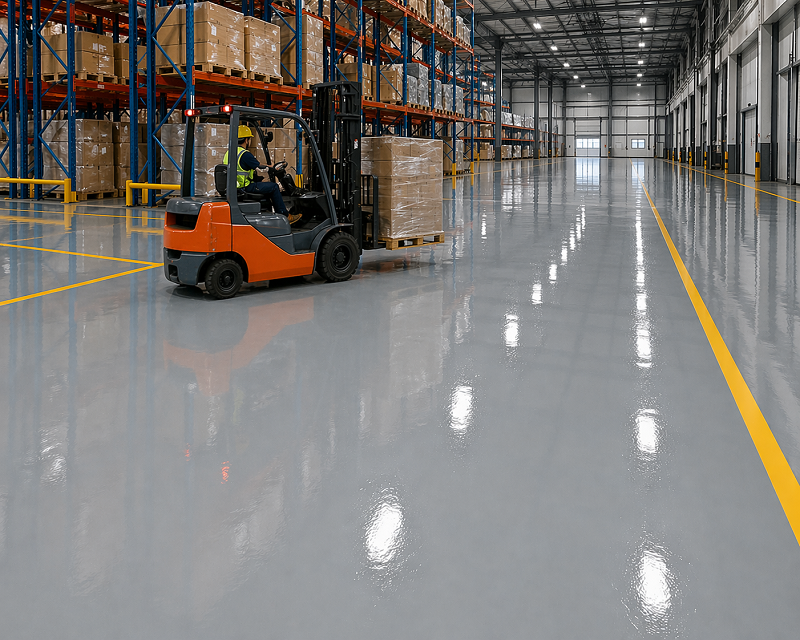
Warehouses are heavy-duty, high-intensity use scenarios with constant forklift traffic, heavy pallet loads, oil spillage, and continuous operations. Therefore, installing a durable, safe, and easy-to-maintain floor coating for warehouses is a necessary investment.
Below, Jincheng will provide a detailed comparison of mainstream flooring coating options, their advantages, disadvantages, and applicable scenarios, to help you select the most suitable solution for your warehouse.
Industrial Epoxy Floor Coating (The Most Common Flooring Coating)
Epoxy floor coating is a two-component system consisting of resin and hardener. After curing, it forms a thick, seamless, and rigid surface that bonds tightly to concrete, creating an excellent protective layer. Epoxy remains the most widely used floor coating in warehouses and industrial applications due to its extremely high cost-performance ratio.
Core Advantages of Epoxy Floor Coating:
Excellent impact and abrasion resistance, good chemical resistance (to oils, acids, solvents), easy application, compatibility with various aggregates to create different finishes (such as quartz sand, colored sand, decorative flakes), and outstanding cost-effectiveness (costs much lower than polyaspartic and polyurethane coatings).
Disadvantages:
Poor UV resistance (prolonged exposure to sunlight may cause yellowing, fading, and chalking; UV-resistant topcoat is required for exterior areas); long curing time (foot traffic allowed after 24–72 hours, heavy load-bearing capacity achieved after more than 7 days, making it less suitable for fast-track projects); under extreme heavy-duty and chemical exposure conditions, performance is inferior to polyaspartic and polyurethane coatings.
Applicable Scenarios:
Indoor warehouses with high forklift traffic, production areas, food storage, and other light to medium-load environments.
Polyaspartic Floor Coating (The Representative of High Performance)
Polyaspartic has become one of the most popular floor coatings in recent years. It is typically a two-component material: Component A – aliphatic isocyanate hardener, Component B – polyaspartic ester resin. It is rarely used as a standalone coating and is usually applied as a topcoat over a primer system.
Core Advantages of Polyaspartic Coating:
Rapid curing (surface dry within hours, fully cured in 1–2 days, ideal for projects requiring fast return to service); excellent UV resistance (suitable for outdoor applications); high abrasion and chemical resistance (for heavy-duty and chemical-exposed environments); long service life (significantly longer than epoxy).
Disadvantages:
High cost (several times that of epoxy); requires professional installation (short application window due to fast curing, demanding experienced applicators); relatively weak adhesion when applied directly to concrete (epoxy primer is generally required).
Applicable Scenarios:
Outdoor warehouses, heavy-duty areas, environments with chemical spills, and projects requiring quick operational recovery.
Polyurethane Floor Coating
Polyurethane is a highly versatile polymer material with adjustable properties, renowned in flooring and industrial coatings for its abrasion resistance, flexibility, and weatherability. It can be used as a topcoat or a standalone coating.
Core Advantages:
Excellent weather and UV resistance – suitable for loading docks, exposed warehouse areas, or well-lit spaces; good flexibility and thermal shock resistance – adapts to temperature changes, heavy impacts, and substrate movement without cracking, ideal for cold storage or frequently washed areas; good chemical and abrasion resistance – resistant to oils, solvents, and heavy traffic, though slightly lower hardness than epoxy.
Disadvantages:
Relatively thin film thickness (typically applied thinner than epoxy, with lower impact resistance for ultra-heavy loads);
higher cost than epoxy; mostly used as a topcoat over epoxy primer rather than a standalone main coating.
Applicable Scenarios:
Cold storage warehouses, loading docks, and areas exposed to UV radiation or frequent temperature fluctuations.
Optimal Warehouse Floor Coating Solution: Multi-Material Composite System
In practical applications, floor coatings rarely consist of a single material. Instead, they are usually composite systems such as epoxy primer and midcoat with polyaspartic or polyurethane topcoat. This combination ensures strong concrete bonding from the epoxy layer while enhancing abrasion, weather, and chemical resistance through the topcoat.
It achieves the best balance among cost, performance, and service life, making it the mainstream optimal comprehensive solution in the market.