


If you oversee a warehouse, factory, garage, or any space with heavy use and high traffic, selecting a proper coating for your concrete floor is a smart choice. It does not only protect the floor itself but also represents a valuable long-term investment. Heavy-duty coatings guard concrete against harsh environments, prolong its service life, cut maintenance expenses, and keep your facility safe and functional for years.
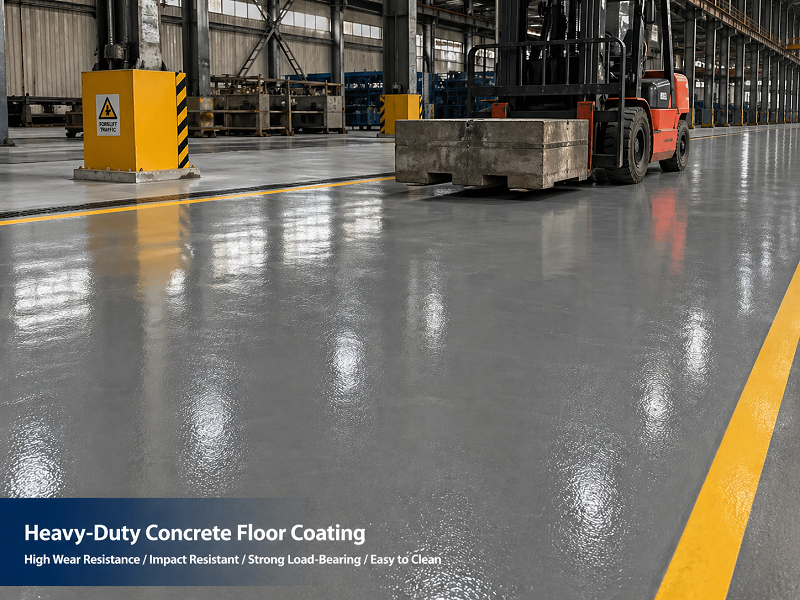
Many people believe concrete floors are strong and indestructible. Yet under heavy loads, concrete is surprisingly fragile. It absorbs oil, chemicals, and moisture easily, leading to discoloration, erosion, surface degradation, and cracking. As concrete wears, it produces dust that can damage machinery, irritate skin, and create safety hazards. A heavy-duty coating forms a thick, tough layer that bonds firmly with the concrete base, creating a seamless and watertight barrier. It resists abrasion, impact, chemical spills, and moisture, providing powerful protection for the entire floor.
Below, Jincheng introduces three common types of heavy-duty floor coatings, each with unique strengths and ideal applications.
Epoxy Floor Coating
Epoxy is the most common and widely used industrial flooring solution. It is a two-component material that cures into a hard, seamless surface with excellent wear resistance, chemical tolerance, and strong adhesion to concrete.
Standard epoxy may not perform well under extreme loads. To improve durability, aggregates such as colored sand, flakes, and quartz are often added, greatly enhancing load-bearing capacity. Since epoxy is not UV-resistant, it is mainly used indoors, such as in distribution centers, manufacturing facilities, and parking garages.
Polyaspartic Floor Coating
Polyaspartic coating is a newer high-performance option valued for fast curing and exceptional durability.
It delivers impressive abrasion resistance, especially when strengthened with sand, mortar, or other aggregates. It easily withstands constant foot traffic and heavy machinery. One major benefit is fast curing: the floor can return to use within just one to two days after application. It also has excellent UV stability, so it will not yellow or crack under long-term sunlight. This makes polyaspartic ideal for heavy-use outdoor areas including logistics parks, ports, and open warehouses.
Polyurethane Floor Coating
Polyurethane has long been a reliable choice in industrial flooring. It offers better flexibility than epoxy and polyaspartic, making it suitable for areas where concrete may shift or expand, such as cold storage facilities. It performs well in sunlight without fading or yellowing and provides strong resistance to chemicals and oil spills. Polyurethane is often used as a top coat over epoxy to add an extra protective layer. It works especially well in environments with large temperature differences, like cold rooms and food processing plants.
How to Choose the Right Heavy-Duty Coating
Start by evaluating your working environment: Is the area in continuous operation? Will it be exposed to chemicals? Is it under direct sunlight? Are there significant temperature changes? How heavy is the daily load?
- Light to medium indoor loads: Epoxy is recommended for its lower cost.
- Heavy loading conditions: Polyurethane or polyaspartic.
- Chemical exposure: Polyurethane is the best option.
- Sunlight or UV exposure: Polyurethane or polyaspartic.
- Best temperature resistance: Polyurethane.
- Fast return to service: Polyaspartic.
Conclusion
For most businesses, installing a safe, dust-free, and durable floor coating is highly necessary. It protects concrete, reduces maintenance costs, improves safety, and extends the floor’s lifespan—saving time and money in the long run.
Contact Jincheng to choose a heavy-duty concrete floor coating customized for your space. Enjoy a long-lasting, reliable floor that supports smooth and efficient daily operations.