



Spent twenty minutes getting quotes online and walked away more confused than when you started? You’re not alone. Pricing for epoxy floor coating jobs varies wildly — and most of what you’ll find online either lowballs the number to pull you in or buries the real costs in fine print.
So let’s cut through it. This guide breaks down what you’ll actually spend on materials, what labor runs in 2026, and where the hidden costs tend to sneak up on people.
The Short Version (If You Just Want the Numbers)
| Installation Type | Per Square Foot | Typical 2-Car Garage (500 sq ft) |
|---|---|---|
| DIY (materials only) | $2 – $5 | $1,000 – $2,500 |
| Professional (standard epoxy) | $3 – $12 | $1,500 – $6,000 |
| Professional (polyaspartic/polyurea) | $7 – $16 | $3,500 – $8,000 |
For most homeowners getting a standard epoxy floor coating professionally installed, the all-in number lands somewhere between $2,500 and $4,000 for a two-car garage — roughly $5 to $8 per square foot at 2026 rates.
Now let’s look at where that money actually goes.
Material Costs: What You’re Paying For
Materials eat up about 30–40% of your total budget. A full epoxy system isn’t just one product — there are several layers involved, and each one costs something.
Primer
Think of primer as the foundation. It soaks into the concrete and gives the epoxy something to grip. Skip it, and you’re setting up for peeling down the road.
- Runs about $0.30 – $0.95 per square foot
The Epoxy Layer Itself
This is where the price range really opens up. The coating type you pick drives material cost more than anything else:
| Coating Type | Material Cost (per sq ft) | Expected Lifespan | Where It Makes Sense |
|---|---|---|---|
| Water-based epoxy | $0.37 – $1.40 | 3–5 years | Weekend DIY, light-use garage |
| Solvent-based epoxy | $1.50 – $3.00 | 5–8 years | Mid-tier residential work |
| 100% solids epoxy | $3.00 – $7.00 | 10–20 years | Anything you want to last |
| Polyaspartic / polyurea | $4.00 – $9.00 | 15–25 years | Fast cure, outdoor exposure |
If you want a floor that holds up for a decade-plus, the 100% solids epoxy is what professional contractors actually use. The water-based stuff is tempting on price — just know you’ll likely be redoing it sooner.
Color Flakes, Metallic Finishes, and Other Add-Ons
These are popular for good reason — they hide dirt, add texture, and look sharp. But they do push the material bill up:
- Color chip / flake broadcast: +$0.50 – $1.50/sq ft
- Metallic pigment system: +$2.00 – $5.00/sq ft
- Quartz anti-slip blend: +$1.00 – $3.00/sq ft
Topcoat
The topcoat is what protects everything underneath — UV exposure, hot tires sitting on the surface, chemical drips. A polyurethane or polyaspartic finish coat is non-negotiable if you want the floor to age well.
- Expect $0.50 – $2.00 per square foot
If You’re Going DIY: Full Material Budget (500 sq ft)
- Entry-level water-based kit: $200 – $600
- Professional-grade 100% solids kit: $800 – $2,000
- Ancillary supplies (grinder rental, patching compound, acid wash, rollers): $100 – $300
Labor Costs: Where Most of the Money Goes
Here’s something that surprises a lot of people: on a professionally installed epoxy floor coating job, labor accounts for 60–70% of the total invoice. Understanding what that labor actually involves makes the pricing a lot easier to accept — or negotiate.
Phase 1: Surface Prep
Hands down the most important part of the whole project. A floor that lasts 15 years versus one that starts peeling at 18 months comes down almost entirely to how well this step was done.
What’s involved:
- Diamond grinding — Opens up the concrete’s surface texture so the epoxy bonds mechanically, not just chemically. Requires real equipment.
- Acid etching — A less aggressive option for clean, uncoated slabs. Cheaper, but not suitable for every situation.
- Crack and divot repair — Any damage gets filled before anything else goes down.
- Moisture testing — Concrete that’s pulling moisture up from below will cause delamination. Has to be checked.
Prep work alone typically represents 30–50% of your total labor cost. If a quote seems too low, this is usually the step that got cut. Push back on it.
Surface prep labor: $1.00 – $3.50 per square foot
Phase 2: Application
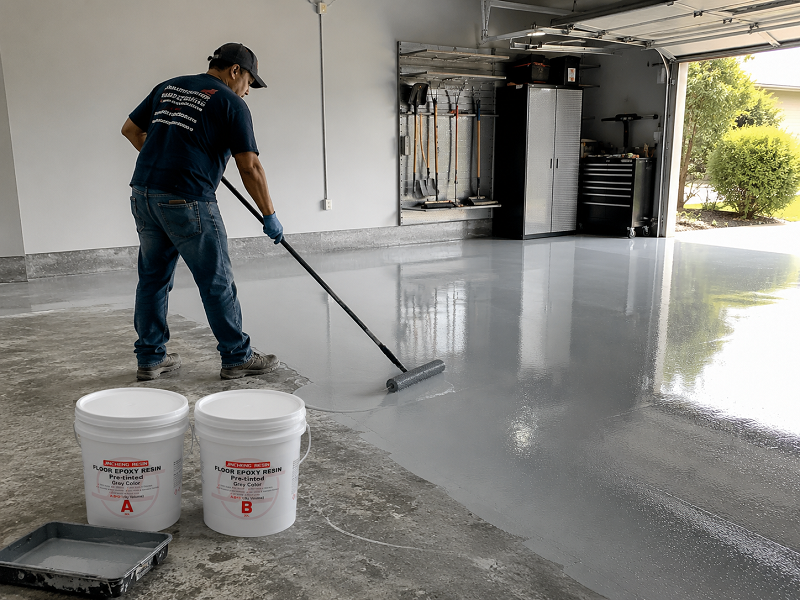
Once the slab is ready, the crew rolls on primer, applies the base coat, broadcasts any decorative chips or quartz, and finishes with the topcoat. Depending on the system and how many layers are involved, this usually takes one to three days.
Application labor: $1.50 – $5.50 per square foot
What Total Labor Looks Like by Garage Size
| Garage | Labor Cost |
|---|---|
| 1-car (~250 sq ft) | $500 – $1,500 |
| 2-car (~500 sq ft) | $1,000 – $3,000 |
| 3-car (~750 sq ft) | $1,500 – $4,500 |
Geography matters too. Contractors in dense metros charge 20–30% more than the national average. Smaller markets and rural areas generally run lower.
Full Project Cost by Garage Size
| Garage | Square Footage | Total (Professionally Installed) |
|---|---|---|
| 1-car | 200 – 300 sq ft | $900 – $3,600 |
| 2-car | 400 – 600 sq ft | $2,000 – $7,200 |
| 3-car | 600 – 900 sq ft | $3,000 – $10,800 |
Things That Can Push the Number Higher
Most quotes start reasonable and then climb once someone actually looks at your floor. Here’s what tends to move the needle:
- Damaged concrete — Significant cracking, oil soaking, or moisture problems mean more prep time and materials. Add $0.50 – $2.00/sq ft.
- An existing coating — If there’s old paint or a failed epoxy floor coating already down, it has to come off completely before anything new can go on. That’s extra grinding time.
- Obstacles and oddities — Floor drains, step transitions, load posts, and uneven sections all slow a crew down.
- General contractor involvement — If a GC is coordinating the project, their overhead typically adds 13–22% on top.
- Where you live — Regional pricing swings can push costs up or down by roughly 20%.
DIY vs. Hiring a Pro: An Honest Take
Neither option is universally better — it really depends on your situation.
DIY tends to work well when:
- The slab is clean, flat, and crack-free
- You’ve done hands-on projects before and aren’t intimidated by multi-step processes
- Saving money is the main goal — you can realistically cut 50–70% off the labor portion
- You’re okay with a water-based or mid-grade system and a 3–5 day project window
Bring in a professional when:
- You want a 100% solids or polyaspartic epoxy floor coating backed by a warranty of 10 years or more
- The concrete is in rough shape and needs real repair work
- You’re after a decorative finish — metallic, full-flake, or anything custom
- You want it done right and done fast, without tying up your weekend
One thing worth noting: the single biggest DIY failure point is surface prep. Most people under-grind or skip moisture testing. If you go DIY, rent the right grinder and don’t rush that step.
Is the Investment Actually Worth It?
For most garages — yes, by a reasonable margin.
A well-installed epoxy floor coating holds up against tire heat, spilled chemicals, road salt tracked in on boots, and daily traffic for ten to twenty years. That’s a very different story from bare concrete (which stains and degrades) or standard floor paint (which typically starts peeling within a couple of years).
Run the numbers on a two-car garage and you’re often looking at $0.30 – $0.60 per square foot per year across the life of the coating. Repaint or resurface every two years and that cost climbs fast.
Bottom Line
In 2026, a typical garage epoxy floor coating project runs:
- ~$1,500 for a solid DIY job using quality materials
- ~$2,500 – $4,000 for professional installation on a standard two-car garage
- $6,000+ for high-end systems like polyaspartic with full decorative broadcast
Before signing anything, ask every contractor for a line-item breakdown of materials and labor — and specifically ask what their surface prep process includes. The quote that comes in $500 cheaper is often the one skipping the step that matters most.
Want to learn more? Feel free to contact our staff; we will provide you with the most professional service.