



A forklift running the same route forty times a day puts a different kind of demand on a floor than a car sitting in a garage overnight. Industrial facilities don’t just need a floor coating that looks good — they need one that holds up under concentrated point loads, resists whatever chemicals are present in that specific environment, and can be installed without shutting down production for a week.
Get that decision wrong and you’re not just redoing the floor. You’re managing downtime, potential safety incidents, and a second round of project costs.
This guide lays out the four most widely used industrial floor coating systems side by side — what each one does, what it costs, where it outperforms the alternatives, and where it falls short.
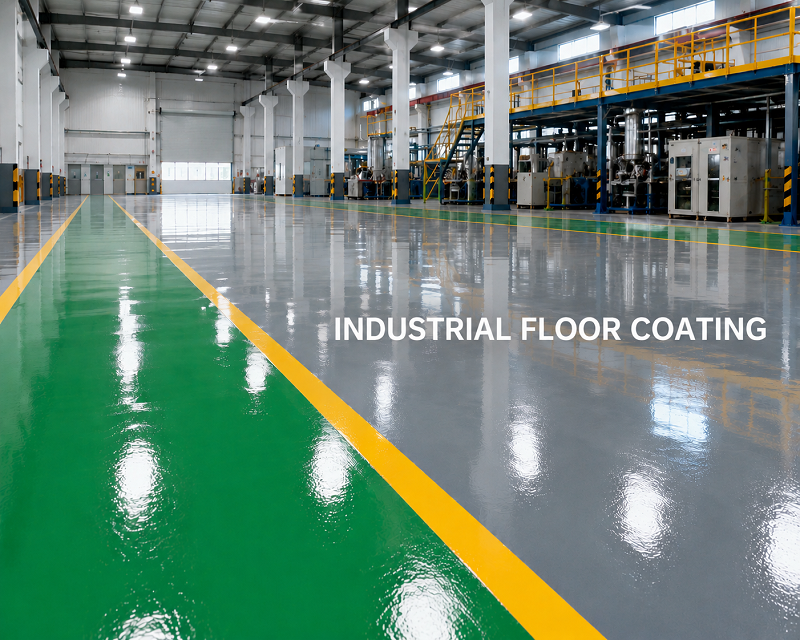
Industrial vs. Residential: Why the Requirements Are Completely Different
It’s worth being direct about this, because people sometimes assume a good garage coating will translate to a warehouse. It usually won’t.
Load capacity. A residential slab is typically rated for 200–300 lbs per square foot. A loaded forklift concentrates 10,000–30,000 lbs across four small contact patches. The localized pressure on those contact points is enormous, and a coating that isn’t built for it will delaminate or crack at those stress concentrations first.
Chemical exposure. Motor oil and gasoline are one thing. Industrial facilities deal with hydraulic fluid, concentrated acids and alkalis, industrial solvents, and process chemicals that vary widely by industry. A floor coating that handles a car garage will not necessarily handle a chemical plant.
Cure time and downtime. A garage can sit idle for three days. A production line that goes down for a day might cost more than the entire flooring project. Cure speed isn’t a convenience factor in industrial settings — it’s often a deciding variable.
Compliance. OSHA has specific slip-resistance requirements for industrial floors. Food processing, pharmaceutical, and other regulated industries require floor coating systems that meet FDA or GMP standards. Not every product qualifies.
The Four Main Industrial Floor Coating Options
Option 1: Standard Industrial Epoxy
Still the most widely installed industrial floor coating by volume, and for good reason — on a straightforward cost-to-performance basis, nothing else competes.
100% solids epoxy builds at 8–15 mils per coat, creating a hard, seamless surface with strong chemical resistance against oils, fuels, and most common industrial solvents. It handles routine forklift traffic and the static load of heavy equipment without issue. For general-purpose warehouses, automotive service facilities, and light manufacturing environments, it covers the brief without requiring the premium budget of more specialized systems.
Best fit: General logistics warehouses, light manufacturing, auto service shops, machine shops — anywhere chemical exposure stays in the mid-range and cure time flexibility exists.
Where it struggles: Two inherent limitations follow standard aromatic epoxy everywhere. First, UV instability — prolonged sun exposure causes yellowing and surface degradation. Not a concern in enclosed facilities, but relevant in open-bay or partially outdoor environments. Second, cold-temperature cure limitations — quality drops noticeably below 50°F (10°C), and some formulations won’t cure reliably below that threshold at all.
| Epoxy System Type | Installed Cost (per sq ft) |
|---|---|
| Standard industrial epoxy | $5 – $8 |
| Quartz anti-slip broadcast system | $6 – $10 |
| Multi-coat heavy-build epoxy | $8 – $12 |
Durability: 5–10 years under heavy industrial use; 10–15 years in lighter conditions
Option 2: Novolac Epoxy — When Chemical Resistance Is the Priority
Standard epoxy handles common industrial chemicals reasonably well. Novolac epoxy handles the ones that would destroy standard epoxy.
Novolac is formulated with a higher cross-link density than conventional epoxy resin, which is what gives it dramatically better resistance to concentrated acids, strong alkalis, and aggressive solvents. It also handles sustained heat exposure up to 300°F (149°C) — a threshold most other floor coating systems don’t come close to.
The tradeoff is real: Novolac materials cost 30–50% more than standard epoxy, and the installation requires faster, more precise application because the working window is tighter. You need an experienced crew, not a general contractor who installs epoxy occasionally.
Best fit: Chemical manufacturing facilities, electroplating shops, battery production lines, laboratories, and any environment where concentrated acids or alkalis are routinely present on the floor.
Cost: $8–$12 per sq ft installed Durability: 8–12 years under heavy chemical exposure, with correct chemical compatibility matching
Option 3: Polyurea / Polyaspartic Floor Coating
Polyurea is the fastest-growing segment of the industrial floor coating market in 2026 — and the performance data makes it easy to see why.
It cures fast. Walk-on time is typically 1–4 hours after application; forklift traffic can resume within 24 hours. For 24-hour operations or facilities with tight maintenance windows, that speed changes the entire calculus of what’s installable without disrupting production.
Beyond speed, polyurea brings a different structural profile than epoxy. Its elongation at break exceeds 300% — the coating flexes with the concrete rather than resisting its movement. In facilities with significant temperature swings (cold storage, outdoor-adjacent areas, facilities in climates with hard winters), that flexibility prevents the micro-cracking that eventually undermines rigid epoxy systems. Impact resistance runs roughly four times that of standard epoxy, and chemical resistance covers a wider range of aggressive compounds.
Best fit:
- Heavy logistics centers and distribution hubs where forklifts run constantly and downtime is expensive
- Cold storage and refrigerated facilities where temperature differentials would crack rigid coatings
- High-throughput manufacturing plants where the maintenance window is measured in hours, not days
- Secondary containment areas in chemical facilities
| Polyurea System | Installed Cost (per sq ft) |
|---|---|
| Standard polyurea | $7 – $12 |
| Polyaspartic | $8 – $14 |
| Heavy-build polyurea with aggregate | $10 – $16 |
Durability: 10–15 years under heavy industrial use; 15–20 years in moderate conditions
Option 4: Polyurethane Floor Coating
Polyurethane sits in a different position than the systems above — it’s the versatile performer that handles a wide range of industrial conditions without requiring the specialized budget of Novolac or polyurea.
Compared to epoxy, polyurethane floor coating is more flexible (elongation at break of 100–300%), which means it accommodates minor concrete movement without cracking. In facilities that experience noticeable temperature variation or where the slab isn’t perfectly stable, that flexibility is a meaningful practical advantage over rigid epoxy.
Two formulations matter here:
Aromatic polyurethane costs less and outperforms standard epoxy on abrasion resistance, making it the right call for interior industrial environments with no significant UV exposure. Some color shift occurs with prolonged sun exposure, though the physical properties remain intact.
Aliphatic polyurethane is UV-stable — no yellowing, no chalking under sustained sun exposure. It’s the preferred floor coating finish for parking structures, open-bay facilities, outdoor-adjacent areas, and any industrial environment where color retention matters over the coating’s lifespan. Taber abrasion test data shows aliphatic polyurethane outperforming standard epoxy by up to 4x in wear resistance under high-traffic conditions — which is why most professional multi-coat industrial systems use it as the topcoat over an epoxy base.
Best fit:
- Parking structures and high-traffic vehicle lanes (high abrasion demand, UV exposure)
- Open-bay or semi-exposed industrial facilities
- Warehouses and distribution centers where temperature variation requires some coating flexibility
- As a performance topcoat over epoxy base coat to extend full system lifespan
Cost: $4–$8 per sq ft as a standalone system; $3–$6 per sq ft as a topcoat layer over an epoxy base Durability: 8–12 years standalone; extends a full epoxy system past 15 years as a topcoat
Cost Comparison at a Glance
| System | Installed Cost (per sq ft) | Industrial Lifespan | Best Suited For |
|---|---|---|---|
| Standard industrial epoxy | $5 – $10 | 5–10 years | General warehouse, light manufacturing |
| Novolac epoxy | $8 – $12 | 8–12 years | Chemical plants, strong acid/alkali exposure |
| Polyurea / polyaspartic | $7 – $16 | 10–15 years | Heavy logistics, fast return to service |
| Polyurethane floor coating | $4 – $8 | 8–15 years | Parking, open facilities, UV-exposed areas |
Five Things That Move the Number on Any Industrial Quote
1. Existing slab condition Surface prep failures account for close to 80% of all industrial floor coating failures. Stripping old coatings, repairing large cracks, and removing deep oil contamination all add to the prep cost — and none of it can be skipped.
2. Total square footage Industrial projects typically run 5,000 sq ft and above. Scale works in your favor: larger areas usually price 15–25% lower per square foot than smaller installations because mobilization and equipment costs get spread across more surface.
3. Coating thickness and coat count High-load forklift traffic zones warrant thicker Novolac or polyaspartic systems. Each additional coat adds proportionally to material and labor costs. Specifying dry film thickness (DFT) per coat in the contract protects you from a contractor applying thinner coverage to reduce material cost.
4. Downtime constraints Projects requiring fast return to service — typically polyurea — carry a 15–30% labor premium over standard epoxy installs because of equipment requirements and application precision. That premium is usually worth it when the cost of extended downtime is factored in.
5. Regional labor rates Industrial-dense areas — port cities, manufacturing centers — typically run 20–30% above national average for skilled flooring labor. Factor this into any benchmark pricing you’re using to evaluate quotes.
Three Questions to Answer Before You Pick a System
What does your floor deal with daily? Forklift traffic volume, chemical types present, whether hot water washdowns happen, and minimum ambient temperature — these four factors narrow the field faster than any other information. Most systems are designed around a specific combination of those conditions.
How much downtime can you actually absorb? A facility that can go dark for 72 hours has options. One where the maintenance window is 12 hours doesn’t — polyurea is essentially the only viable path. Be honest about this before evaluating cost, not after.
Are you pricing upfront cost or total cost of ownership? Epoxy is the cheapest entry point. In a heavy industrial environment, it may need to be replaced in 5–8 years. Polyurea or aliphatic polyurethane runs 40–80% higher upfront, but over a 10–15 year horizon, the total cost of ownership often reverses. Run the math specific to your facility’s conditions before defaulting to the lowest per-square-foot quote.
What to Check Before Signing a Quote
- Surface prep method specified: Diamond grinding is the industrial standard. Acid etch alone isn’t sufficient
- Dry film thickness (DFT) per coat: Get this in writing. It’s the number that determines whether you’re getting what you’re paying for
- Product data sheet (TDS) reviewed: Confirm chemical resistance ratings match your actual facility conditions
- Warranty terms: Reputable industrial floor coating contractors provide 3–5 year installation warranties. Shorter than that warrants questions
- Cure timeline and return-to-service dates: Every phase of the project should have a defined timeline in the contract
The Bottom Line
There’s no universal answer in industrial floor coating — polyurea costs more than epoxy upfront, but in a high-traffic warehouse where it reduces maintenance cycles and extends years between replacements, the five-year total cost often runs lower than the cheaper alternative. Match the system to the operating conditions, not the line-item price, and the floor earns its cost.