


The short answer is: it depends entirely on what you mean by “epoxy” and what kind of outdoor exposure the surface gets.
Standard aromatic epoxy — the most common type, the one in most garage floor kits — does not work outdoors. Not for long, anyway. Epoxy floor coating lacks the durability needed to withstand UV exposure, temperature swings, moisture, and outdoor traffic, which causes it to yellow, crack, peel, and degrade rapidly. The chemistry behind that failure is specific and predictable, and it’s not a quality issue — it’s a fundamental limitation of how aromatic epoxy responds to sunlight.
But “epoxy” as a category is broader than one product type. There are scenarios where epoxy-based systems work outdoors, and there are alternatives built specifically for surfaces that live outside. Understanding the difference is what determines whether your patio, pool deck, or driveway is still looking good in five years.
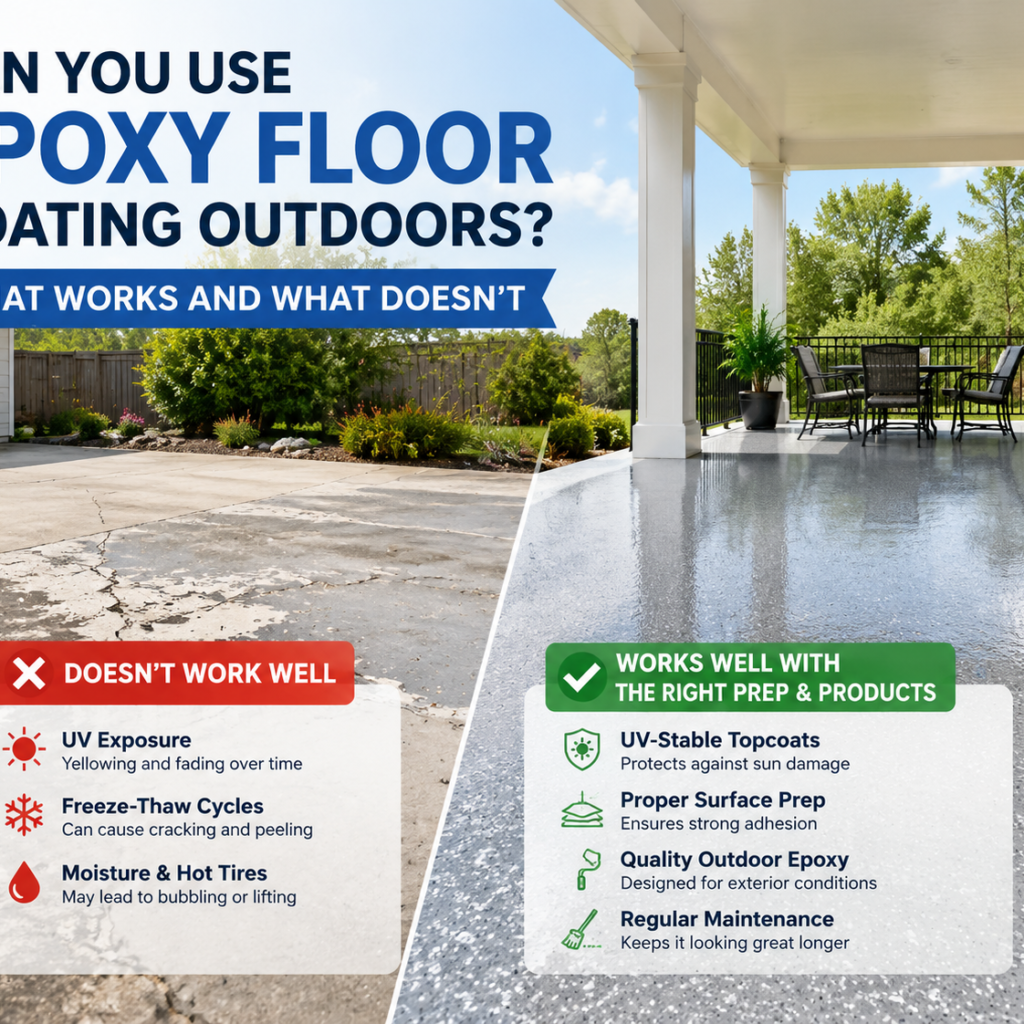
Why Standard Epoxy Fails Outdoors
Standard epoxy resin yellows when exposed to sunlight over time and eventually develops a chalky appearance as UV radiation breaks down the epoxy molecules. This is a fundamental chemistry limitation, not a quality problem. Even the highest-grade epoxy will yellow under direct UV exposure.
The specific issue is aromatic chemistry. Most epoxy resins are aromatic — meaning they contain benzene ring structures in the polymer chain that are inherently unstable under UV radiation. When sunlight hits an aromatic epoxy, photons break those bonds, and the byproducts are yellow and brown chromophores. The floor doesn’t just look bad — the coating itself is structurally degrading.
But UV is only one part of the outdoor problem. Temperature fluctuations cause standard epoxy to crack or delaminate. Moisture exposure from rain, humidity, and other forms of moisture can compromise epoxy adhesion, leading to peeling or bubbling.
Here’s how each failure mode plays out in practice:
UV degradation: Yellowing starts within months on a south-facing surface. Most epoxies only survive 3–5 years outdoors before moisture causes them to peel away. In climates with intense sun, that timeline shortens further.
Thermal cycling: Outdoor concrete moves — expanding in heat, contracting in cold. In cold climates, freeze-thaw cycles can be especially damaging. Rigid epoxy doesn’t move with it. Over time, the stress concentrates at the coating-concrete interface and the coating cracks or delaminates at those stress points.
Moisture: If not applied correctly, moisture can get trapped under the epoxy, leading to bubbling or peeling of the floor coating. Outdoor slabs are exposed to rain, ground moisture, and freeze-thaw pressure from below — all of which push against a non-permeable coating from the underside.
Slip risk: When wet, epoxy surfaces can become very slick. This is a real risk for areas with heavy foot traffic. A high-gloss epoxy on a rain-exposed patio or pool deck creates a safety issue that aggregate additives can partially address, but don’t fully eliminate.
Where Epoxy Can Still Work Outdoors (With Conditions)
Don’t use epoxy on outdoor surfaces with direct UV exposure, concrete with active moisture intrusion, structurally damaged slabs that haven’t been repaired, surfaces requiring same-day return to service, or sealed concrete that hasn’t been ground first.
That list of exclusions is long — but it also implies that epoxy can work outdoors when those conditions aren’t present.
Covered or shaded outdoor surfaces are the most viable case. A covered patio, a carport, a covered loading dock, or any surface that’s protected from direct sun and rain significantly extends epoxy’s useful life. If UV is the primary failure mechanism and UV is largely absent, the chemistry problem goes away. Many covered outdoor spaces with epoxy floors perform similarly to indoor garages.
Epoxy as a base coat with UV-stable topcoat is the more sophisticated answer. Polyaspartics and advanced polyurethane coatings provide exceptional color retention and gloss longevity. These systems can be layered over epoxy primers for combined structural and UV performance. An epoxy base coat provides thickness, adhesion, and structural build — a polyaspartic or aliphatic polyurethane topcoat provides the UV barrier. This is how many professional outdoor floor systems are actually built: the epoxy never sees the sun because something better is sitting on top of it.
Topcoat technology provides a protective shield that enhances UV stability in epoxy. The base coat does the structural work. The topcoat handles the environment.
What Actually Works Outdoors
Polyaspartic Floor Coating
Polyaspartic coatings offer everything homeowners need outdoors: incredible UV stability (no yellowing in sunlight), installation in just one day, and remarkable flexibility that handles temperature swings.
The key differences from standard epoxy:
Aliphatic chemistry: Polyaspartic is aliphatic — the polymer backbone doesn’t contain the UV-sensitive benzene rings that make aromatic epoxy yellow. Polyaspartic coatings are 100% UV stable and will never yellow, fade, or suffer from hot tire pickup.
Flexibility: The flexibility of polyaspartic coatings allows them to expand and contract with temperature changes, preventing the cracking and delamination that plague rigid epoxy systems. This is directly relevant to outdoor concrete, which moves significantly more than indoor slabs due to temperature and moisture variation.
Moisture resistance: Unlike standard epoxy, polyaspartic bonds hold up under the moisture vapor transmission that outdoor slabs experience. The coating doesn’t trap moisture the same way.
Slip resistance: Polyaspartic systems can incorporate aggregate — quartz, aluminum oxide, anti-slip broadcast — more effectively than many epoxy systems, and the aggregate stays locked in a harder final surface.
Polyaspartic coatings typically last 15–20 years with basic maintenance on outdoor surfaces — roughly triple the outdoor lifespan of standard epoxy.
Aliphatic Polyurethane
Aliphatic polyurethane shares the UV-stable chemistry of polyaspartic and is most commonly used as a topcoat over an epoxy or polyurea base coat. This unique non-yellowing coating remains non-chalking and has superior UV resistance. It offers performance characteristics typical of high-quality, solvent-based, aliphatic urethane coatings but provides excellent durability and UV stability.
As a standalone outdoor system, aliphatic polyurethane delivers:
- UV stability equivalent to polyaspartic
- Better abrasion resistance than standard epoxy
- Flexibility that accommodates thermal movement
- Chemical resistance to oils, fuel, and cleaning agents
It’s particularly worth considering for surfaces that see vehicle traffic — driveways, parking areas, vehicle access ramps — where the combination of UV exposure and mechanical wear pushes standard epoxy toward failure quickly.
Polyurea
Polyurea offers good chemical resistance, decent UV stability, and some flexibility for temperature changes. With a faster cure time and a 10–15 year lifespan, it’s better than epoxy for outdoor use.
Polyurea cures faster than almost anything else — walk-on time in hours rather than days. In outdoor applications where weather windows are tight (rain in the forecast, temperature dropping in the afternoon), that cure speed is operationally significant. The flexibility is also genuine: polyurea’s elongation at break exceeds 300%, far better than epoxy’s near-zero flexibility, which matters in outdoor slabs experiencing freeze-thaw cycling.
The limitation is cost — polyurea runs higher per square foot than polyaspartic in most markets.
Epoxy + Polyaspartic Hybrid
The professional standard for outdoor floors that need both the structural build of epoxy and the outdoor performance of polyaspartic. Epoxy base coat for thickness and adhesion; polyaspartic topcoat as the UV barrier and wear surface.
For fully outdoor surfaces in direct sun all day, choose a polyaspartic system or polyurea system. For partial exposure UV exposure, these same systems still apply.
The hybrid gives you more flexibility in budget — epoxy base at lower material cost, polyaspartic only where the performance is actually needed (the topcoat layer that sees the weather). Most pool decks, patios, and outdoor commercial surfaces installed by experienced contractors use this approach.
Outdoor Application by Surface Type
| Surface | Recommended System | Standard Epoxy? |
|---|---|---|
| Covered patio (no direct sun) | Epoxy or epoxy + polyurethane topcoat | Usable with UV topcoat |
| Open patio (direct sun) | Polyaspartic or epoxy + polyaspartic topcoat | Not recommended |
| Pool deck | Polyaspartic with anti-slip aggregate | Not recommended |
| Driveway | Polyaspartic or aliphatic polyurethane | Not recommended |
| Carport | Epoxy + UV-stable topcoat | Acceptable with topcoat |
| Commercial outdoor walkway | Polyurea or polyaspartic | Not recommended |
Surface Preparation for Outdoor Floors
The prep requirements outdoors are more demanding than indoors, not less — and this is where many outdoor projects fail regardless of the coating chemistry chosen.
Diamond grinding is mandatory. Epoxy will not bond to concrete that is sealed, contaminated with oil or grease, actively wet, or smooth without mechanical profile. Outdoor slabs frequently have sealers applied at some point. Those have to come off completely before any coating system will bond.
Moisture testing matters more outside. Outdoor slabs are exposed to ground moisture from below and rain from above. Test moisture vapor emission before coating. A moisture vapor barrier primer on slabs with elevated readings is essential — the coating doesn’t fail from the top down; it fails from the bottom up when vapor pressure builds behind a sealed surface.
Crack repair before coating. Outdoor concrete cracks. Thermal cycling, tree root pressure, settling — outdoor slabs move more than indoor ones. Active cracks must be filled with a flexible repair compound, not rigid epoxy filler, because the crack will keep moving with the seasons.
Slope and drainage. Outdoor surfaces need adequate slope to drain — typically 1:50 to 1:100 toward a drainage point. Standing water on an outdoor floor coating accelerates wear and creates slip risk. If the existing slab doesn’t drain properly, this has to be addressed before coating.
The Common Mistakes
Applying standard garage epoxy to an open patio. The most frequent error. The same product that works in a covered garage fails within 12–18 months on a south-facing patio. Putting epoxy outdoors is like sending a snowman to the beach.
Skipping the UV topcoat to save money. An epoxy base coat without a UV-stable topcoat on any sun-exposed surface is a short-term solution. The topcoat is the least expensive part of the system and the most important for outdoor longevity.
Not accounting for freeze-thaw in cold climates. A coating applied in late fall, before the first freeze, to a slab that still has elevated moisture content is likely to fail at the first thaw. Coat in spring or summer when slab moisture is lowest and cure temperatures are stable.
Using acid etch as the only prep method. Outdoor slabs often have sealers, efflorescence, or contamination that acid etching doesn’t fully address. Diamond grinding is the reliable baseline for outdoor surfaces.
The Short Version
Standard aromatic epoxy outdoors: works for months, fails within years. UV kills it first, then moisture and thermal cycling finish the job.
What works:
- Covered surfaces with UV topcoat: epoxy base + aliphatic polyurethane or polyaspartic topcoat
- Open sun exposure: polyaspartic or epoxy + polyaspartic topcoat
- High-traffic outdoor surfaces: polyurea or polyaspartic with anti-slip aggregate
- Anywhere cold with freeze-thaw cycles: flexible polyaspartic or polyurea — not rigid epoxy
The chemistry exists to do outdoor floors correctly. It just isn’t the cheapest option at the hardware store.