



You spent real money on your garage floor. It looked sharp for a few months — glossy, clean, like something out of a dealership. Then you noticed it: patches of coating lifting right where the tires sit. Some of it stuck to the tires and came off in strips. The concrete underneath is now exposed in exactly the spots that see the most use.
That’s hot tire pickup. It’s the most common failure mode in garage floor coating, it’s almost entirely preventable, and in most cases the floor that failed wasn’t bad luck — it was the wrong product applied to an inadequately prepared surface.
Here’s what’s actually happening, which coatings are vulnerable, which ones aren’t, and how to make sure you don’t end up in the same situation twice.
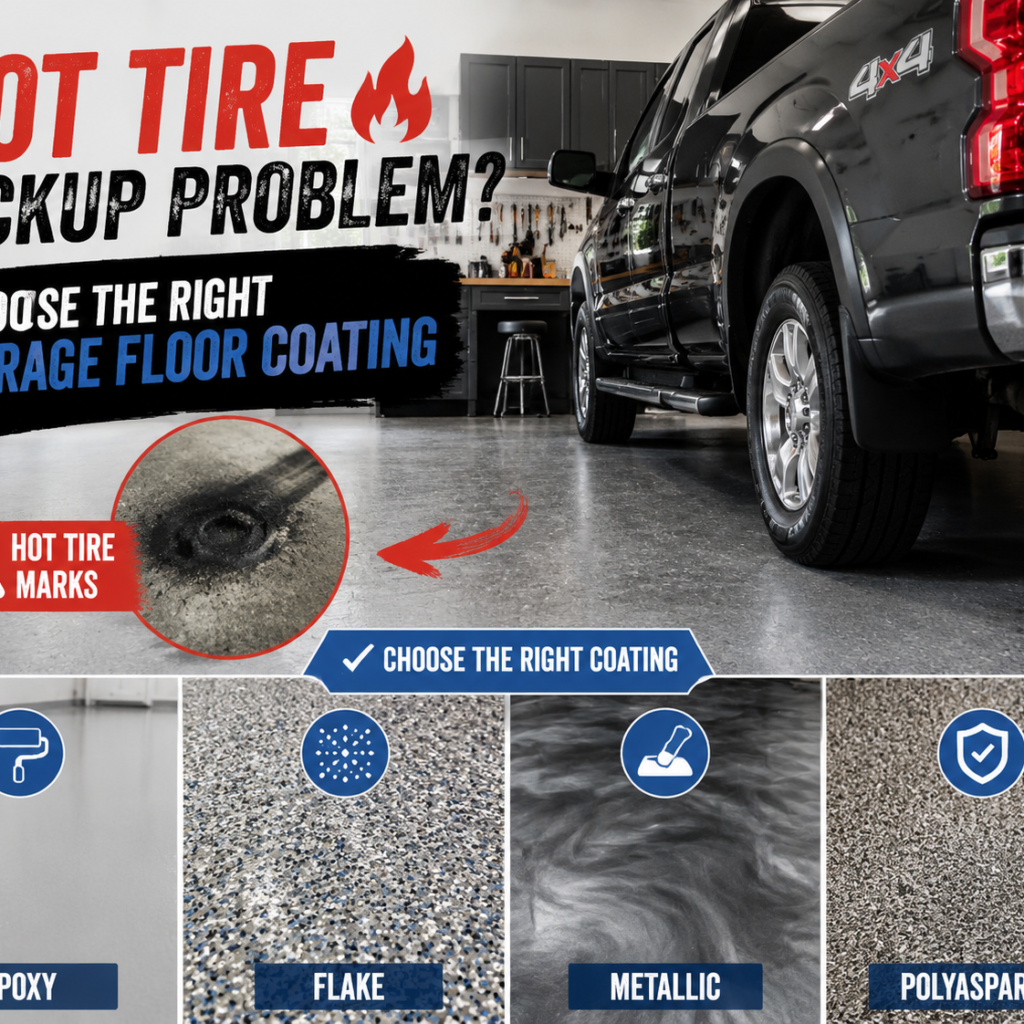
What Hot Tire Pickup Actually Is
When you’ve been driving — especially at highway speeds — the internal temperature of your tires rises significantly. Once you park, that heat transfers into the coating underneath. As the tire cools, the footprint contracts slightly, causing the tread to grab and pull at the surface of the coating. The result is delamination: patches lifting and peeling exactly where the tires sit.
There’s a second mechanism running alongside the heat problem. Car tires contain plasticizers — chemical softening agents that keep rubber flexible. As tires heat up, these migrate toward the surface. Once the car is parked, those plasticizers can transfer into the coating below, causing tackiness, discoloration, or outright bond failure over time.
So hot tire pickup is really two problems at once: thermal softening of the coating bond, and chemical plasticizer migration degrading the surface. A coating that addresses only one of these still has a vulnerability.
Why Cheap Coatings Fail Here
Hot tire pickup is almost exclusively a problem with thin DIY kits and low-grade one-day coatings — not with properly installed professional systems. The failure traces back to two things: product chemistry and surface preparation, and usually both at once.
The product side: Most hardware store and big-box coatings are water-based or low-solids epoxy paint. Not a true coating system. These products don’t have the cross-link density or heat tolerance to stay bonded under a hot tire repeatedly cycling heat into the surface. They might hold for a few months — longer in climates that don’t get hot summers — but the failure mode is built in from application day.
The preparation side: Acid etching opens the concrete surface chemically. It doesn’t create the mechanical tooth that diamond grinding does. Without grinding, the coating bonds to the surface dust and laitance sitting on top of the concrete rather than the concrete itself. A hot tire peels that thin film right off. Diamond grinding removes the top layer entirely, exposes fresh substrate, and creates a rough profile that gives the coating millions of anchor points. A coating bonded into a properly ground slab has something real to hold onto — which is why hot tire pickup almost never happens on professionally installed floors.
The combination of low-grade chemistry on inadequately prepared concrete is exactly why this is the most common garage floor failure the industry sees.
Which Coatings Are Vulnerable — and Which Aren’t
Standard Epoxy
Epoxy is where most hot tire pickup stories begin. The standard failure mode: heat softens the epoxy bond, the tire cools and contracts, the coating comes with it.
That’s not the full picture though. Properly formulated 100% solids epoxy — professionally installed over a diamond-ground slab — handles hot tires significantly better than the low-solids version rolled onto an acid-etched floor. The product and the prep both matter.
The problem is that most residential epoxy installs, especially DIY, are the second scenario. And even high-quality epoxy has less inherent heat resistance than the alternatives below, which means it’s working with less margin.
Polyaspartic
The chemistry most commonly specified to solve this problem. Polyaspartic is aliphatic — meaning UV-stable — and it cures harder than standard epoxy at the molecular level, which is what gives it the heat resistance that interrupts the tire-softening cycle.
The catch is that not all polyaspartic products are equal. “1-day” polyaspartic systems that use thin, less-than-100%-solids formulations don’t deliver the same protection as a properly built multi-coat system. Cross-link density is what creates heat resistance, and a thin single coat cuts corners on exactly that.
What works: 100% solids polyaspartic applied in two topcoats over a proper base coat. Dual layers of fully cross-linked aliphatic topcoat create a dense wear surface that handles heat, pressure, chemical exposure, and tire plasticizer transfer without giving way.
Polyurethane
Less talked about in the hot tire conversation than polyaspartic, but worth knowing. Aliphatic polyurethane has high resistance to both heat and tire plasticizer transfer, plus superior abrasion resistance compared to standard epoxy. It also handles UV without yellowing.
The most common application in 2026 is as a topcoat over an epoxy base — the epoxy provides thickness and build at a lower material cost, the polyurethane provides the performance layer that actually contacts the tires. This hybrid approach addresses hot tire pickup at the surface that matters while keeping the overall system cost reasonable.
Polyurethane is also worth considering as a repair option when hot tire pickup has hit parts of an existing epoxy floor — a properly applied polyurethane topcoat over abraded, still-adhered epoxy can extend the floor’s useful life without a full replacement.
Epoxy Base + Polyaspartic or Polyurethane Topcoat
What most experienced professional installers actually specify. Epoxy for the foundation — bonds aggressively to ground concrete, builds thickness efficiently. Aliphatic polyaspartic or polyurethane as the wear surface — handles everything that contacts the tire without the heat vulnerability of bare epoxy.
This system solves the hot tire problem at the layer that actually sees the tires, while keeping costs lower than a full polyaspartic system throughout. It’s also significantly more UV-stable than epoxy-only, which matters in garages that see sunlight.
The Coating Comparison
| System | Hot Tire Resistance | UV Stability | Notes |
|---|---|---|---|
| Water-based / paint-grade epoxy | Poor | Poor | Fails early in most residential garages |
| 100% solids epoxy (single clear coat) | Moderate | Poor | Better prep helps; still vulnerable |
| Polyaspartic (100% solids, 2-coat) | Excellent | Excellent | Premium standalone option |
| Aliphatic polyurethane topcoat + epoxy base | Excellent | Excellent | Best cost-to-performance hybrid |
| Epoxy + polyaspartic topcoat | Excellent | Excellent | Professional standard system |
Surface Preparation: The Variable That Changes Everything
The honest take on this: the prep matters as much as the coating chemistry. Any quality coating bonded to a properly ground slab resists hot tire pickup. A premium coating on a poorly prepared slab is still going to fail — just slightly later.
Diamond grinding is non-negotiable for a system that’s expected to last. Acid etching is adequate for some applications; it is not adequate for a residential garage floor that parks hot vehicles daily.
For recoating a floor that’s already had hot tire pickup, the failed sections have to come off before anything new goes down. Grinding back to bare concrete, re-profiling the surface, applying a moisture-blocking primer if needed, then rebuilding from a fresh base — that’s what makes a repair permanent. Applying new product over delaminated areas without removing the failure is a patch that buys weeks, not years.
Can You Patch It Without Redoing the Whole Floor?
Depends entirely on how much has failed.
If delamination is limited to the tire contact zones and the surrounding coating is still firmly adhered, those areas can be ground back, primed, and recoated. The repair won’t be seamless with the existing floor, but it stops the damage from spreading.
If pickup has spread across a larger area, or if the base coat has lost adhesion beyond just the tire spots, a full recoat is the more defensible choice. Patching on top of a floor that failed due to inadequate prep — without addressing the prep — restarts the same failure cycle on a shorter timeline.
One practical consideration: if the existing floor was acid-etched and a low-solids product, patching the tire areas while leaving the rest intact means the whole floor is still sitting on an inadequately prepared surface. Eventually the failure mode continues outward from the patched zones.
Questions to Ask a Contractor
“What’s your prep method?” Diamond grinding. If the answer is acid etch only, that’s the setup for the same problem to repeat.
“What’s the solids content of the topcoat?” 100% solids. Anything less has lower cross-link density and less heat resistance baked into the chemistry.
“How many coats of topcoat?” Two is the professional standard for a system expected to handle daily vehicle traffic. One coat is the minimum and leaves less margin.
“Aliphatic or aromatic topcoat?” Aliphatic means UV-stable, no yellowing. Aromatic is cheaper and yellows over time. A contractor who doesn’t know the answer to this is telling you something.
The Short Version
Hot tire pickup is a solved problem when you use the right system over a properly prepared surface. You shouldn’t be putting carpet scraps under your tires to protect your floor.
The system that holds: 100% solids polyaspartic or aliphatic polyurethane topcoat, applied in two coats, over a base that was ground — not just etched. That combination handles daily residential garage use for ten years or more without the seasonal disappointment of finding your coating on the underside of your tires.