



Flip through a color sample book for flake epoxy floor coating and you’ll hit a wall fast. Warm blends, cool blends, dark chips, multi-color mixes — dozens of combinations, zero obvious starting point. Most people spend more time staring at samples than they expected and still aren’t confident when they finally pick one.
This guide skips the preamble. You’ll find out how to read a space before choosing a color, which flake sizes actually perform in a garage, what blend rules hold up in real installs, and which color directions are moving in 2026.
What Are Flakes, and Why Do They Matter Beyond Looks?
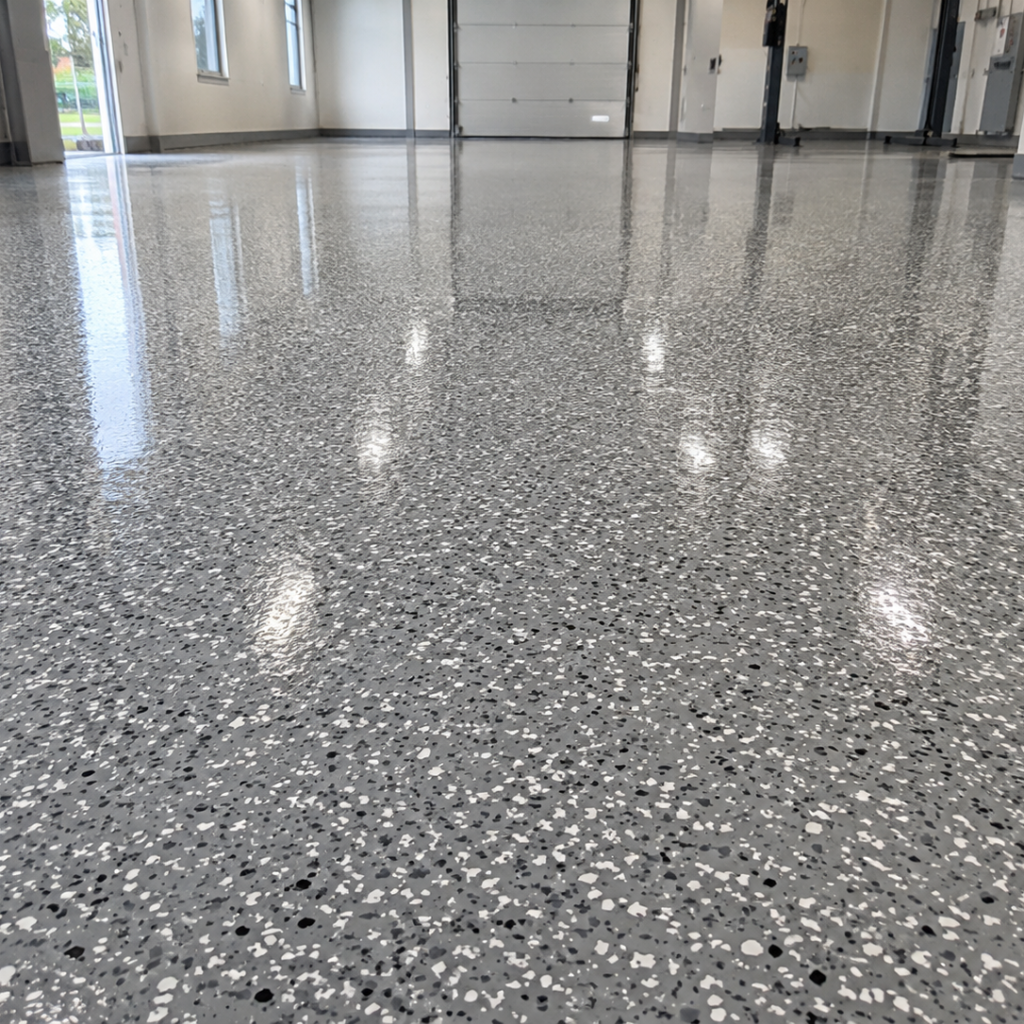
Color flakes — also called vinyl chips or decorative chips — are small polymer paint fragments broadcast by hand into a wet epoxy base coat, then locked in with a clear topcoat. The final surface is sealed, seamless, and far more durable than bare concrete or standard floor paint.
But flakes aren’t just a cosmetic upgrade. They do real work:
- Hide surface flaws — minor cracks, patched spots, uneven concrete color all disappear under a full broadcast
- Add grip — the denser the chip coverage, the more texture underfoot
- Create visual depth — multi-color blends read like natural stone, not painted concrete
- Stay cleaner longer — dust, tire marks, and scuffs don’t show on a mixed-color surface the way they do on solid or metallic finishes
That combination of looks and function is why flake epoxy floor coating consistently outranks every other finish type in residential garage installs. It’s not even close.
Step One: Lock In the Space’s Direction Before You Touch a Color Card
The most common mistake people make is falling for a color before thinking about context. They see a granite gray blend they like, order it, and then realize it clashes with their tan walls or disappears visually against their gray cabinets.
Work in this order: space style → wall and door color → floor color. The floor comes last, not first.
Modern or Minimalist Garage
Clean lines, white or light gray walls, simple storage. Neutral chip blends work best here — gray, white, and black mixed together, or a cool quartz-tone blend. Anything too warm or too saturated tends to look out of place. The floor should feel like it belongs, not like it’s competing.
Industrial or Warehouse-Inspired
Dark is the obvious call, but the specifics matter. Charcoal-dominant blends with hints of blue or brown read more sophisticated than straight black. Pair with a satin or matte topcoat — high-gloss on a dark floor can actually undercut the industrial feel you’re going for. This aesthetic also dominates in commercial flake epoxy floor coating installs right now.
Traditional or Craftsman Style
Brick, wood beams, warm-toned furniture — the floor should echo that warmth, not fight it. Saddle tan, autumn leaf, sand, and earth-toned blends sit naturally alongside organic materials without drawing too much attention to themselves.
Showcase Garage or Multipurpose Space
If the garage doubles as a gym, a workshop, or a place where you actually want people to notice the floor — you’ve got more room to be bold. Dark base blends with blue or teal accent chips have been a popular move in higher-end builds lately. Strong visual presence without being flashy.
Four Color Rules That Hold Up in Real Installs
Go Multi-Color, Not Single
Single-color chip blends exist. Essentially nobody picks them. Four or five colors mixed together create the kind of depth you’d see in granite or terrazzo — it’s more interesting to look at and it ages better. Single-color reads flat and shows inconsistencies in the surface.
Contrast Your Base Coat Against Your Chips
The base coat color underneath the chips bleeds through, especially on lighter chip coverage. Dark base coat with lighter chips — sharp contrast, strong depth. Light base coat with darker chips — same result. What doesn’t work is matching them too closely. Similar base and chip tones flatten everything out and make the floor look gray and dull rather than layered.
Go Darker Than You Think in a Working Garage
Light and white chip blends photograph beautifully. In an actual garage, they’re high-maintenance. Tire marks show within a week, oil drips become a project to clean, and any tracked-in dirt is immediately visible. Use lighter chips as accents in a darker blend — you get the contrast without the cleanup headache.
Always Look at Samples in Your Actual Space
Same chip blend, fluorescent shop light versus afternoon sun through the garage door — it can look like two completely different products. Get physical samples, not digital swatches, and hold them in your garage under the light conditions you’ll actually live with. This one step prevents a lot of regret.
Step Two: Pick the Right Flake Size
Get the color right and the size wrong, and the floor still won’t look the way you pictured. Flakes come in six standard sizes — 1″, 1/2″, 1/4″, 1/8″, 1/16″, and 1/32″ — and each one changes the feel of the finished floor.
1/16″ Micro Flakes
Tightest pattern, closest to polished granite in appearance. Works well in small spaces (under 200 sq ft) or projects leaning toward a sleek, minimal look. The trade-off: any unevenness in the slab gets highlighted, not hidden. This size demands a very flat, well-prepped surface, and it’s harder to keep clean than larger chips. Not the go-to for a heavily used garage.
1/8″ Small Flakes
The most widely used size in residential work, and for good reason. Fine texture, natural color blending, versatile enough to work in almost any garage style. If you’re unsure where to start, this is the safe call — in the best sense of the word.
1/4″ Standard Flakes
Maximum concealment. Cracks, old stains, surface inconsistencies — this size covers them better than anything smaller. The visual result reads closest to terrazzo, with visible pattern and genuine depth. Most professional flake epoxy floor coating installers default to 1/4″ on standard two-car garage jobs. It performs reliably and looks good in a wide range of spaces.
1/2″ – 1″ Large Flakes
Big visual impact, best suited to large footprints (800+ sq ft) or spaces where the floor is meant to be a design statement. High color contrast, strong texture, and a result that’s genuinely hard to ignore. The application is more demanding — large chips need to be broadcast carefully for even distribution and require thicker topcoat coverage to properly encapsulate them.
One thing worth knowing: many experienced contractors don’t stick to one size. Blending 1/4″ as the primary chip with a smaller percentage of 1/8″ and some 1/2″ creates a more irregular, organic pattern — closer to natural stone than any single-size broadcast can achieve on its own.
Color Directions Moving in 2026
Trends in flake epoxy floor coating don’t shift overnight, but there are clear directions this year worth knowing before you commit.
Charcoal with Blue Accent Chips This is the combination that’s been displacing the plain granite gray that saturated the market between 2020 and 2024. A dark charcoal base blend with subtle blue or teal accent chips has enough visual interest to stand out while staying dark enough to hide everything a garage throws at a floor. It’s the current default for higher-end residential installs.
Warm Neutrals (Saddle Tan, Autumn, Desert Earth) The market shifted heavily toward cool grays post-2020. That’s reversing now. Warm-toned blends — brown, tan, amber, earth — are seeing a clear uptick, particularly in traditional-style homes and from homeowners who want the garage to feel like an extension of the house rather than a utility space.
Midnight Black with White or Silver Accents A deep black base with white and silver chip accents reads like dark marble or a night sky under a gloss topcoat. It’s the showpiece floor choice — high impact, distinctive, and more popular in display-oriented garages than in everyday use spaces.
Coastal Blend (Light Blue, White, Warm Gray) A lighter direction — best where natural light is strong and the surrounding aesthetic leans coastal or Mediterranean. Gets washed out in dark garages, looks genuinely sharp in bright, open spaces.
Broadcast Density: Light, Medium, or Full?
How densely the chips are scattered changes the look as much as the color itself.
- Light broadcast — chips spread thin, base coat still visible in places, a quieter, more subtle result
- Medium broadcast — a balance between base coat and chip coverage, good middle ground for both look and texture
- Full broadcast (broadcast to rejection) — chips are thrown until the wet epoxy can’t take any more, completely hiding the base coat, maximum texture and dirt resistance
For garages, full broadcast is the practical answer. It takes more material and requires two topcoat applications to properly seal all the chips, but the result is the most durable surface, the best grip, and the easiest floor to maintain day-to-day.
The Topcoat Finish Affects Color More Than People Expect
Pick your chips and then ignore the topcoat finish choice — and you might be surprised by the result. The finish level changes how the color reads in real light.
- Gloss — colors appear richer and more saturated, the floor reflects light and makes the space feel larger
- Satin — a middle ground that has some sheen without the mirror effect, the most common residential choice in 2026
- Matte — subdued, close to polished concrete in feel, well suited to industrial or low-key aesthetics
One more thing on topcoats: if your garage gets direct sun exposure through the door, epoxy topcoats will amber over time. That yellowing shifts the apparent color of your chips — warmer, older-looking. Polyaspartic or polyurethane topcoats handle UV significantly better and keep the color truer for longer. Worth specifying upfront.
Three Things to Do Before You Commit to a Color
Get physical samples — not photos. On-screen and in-brochure colors are optimized to look good, not to accurately represent what your floor will look like. Pull a few blends you’re interested in, hold them in your garage under both daylight and artificial light. You’ll make a better decision with thirty seconds of that than with thirty minutes of looking at a website.
Ask for photos from completed local installs. Different climates, slab conditions, and lighting environments change the final result. Photos from your contractor’s actual nearby projects give you a more accurate preview than catalog shots.
Factor in everything else in the garage. Your car’s color, cabinet finish, wall paint — none of these need to match the floor exactly, but they should at least coexist. A floor color that works in isolation can feel wrong once everything is back in the space.
One Last Thing
Flake epoxy floor coating gives you a genuinely wide range of choices, which is great — but it also means there’s more room to go wrong. Most people who end up unhappy with their floor picked too light a color, didn’t check samples in real lighting, or didn’t think about how flake size would affect the overall look.
Get those three things right, and you’ve got a floor that holds up for fifteen years and still looks good on day one of year ten.