

Walk into any flooring showroom in 2026 and you’ll hear three names repeated constantly: epoxy, Polyaspartic, and polyurethane. Every contractor seems to have a favorite. Every product page claims theirs lasts longest. And somewhere in the middle of it all, you’re trying to figure out what actually goes on your floor.
This isn’t a manufacturer comparison. It’s a breakdown of how these three coatings actually perform — on hardness, lifespan, chemical resistance, UV stability, and cure time — with real numbers where the data exists.
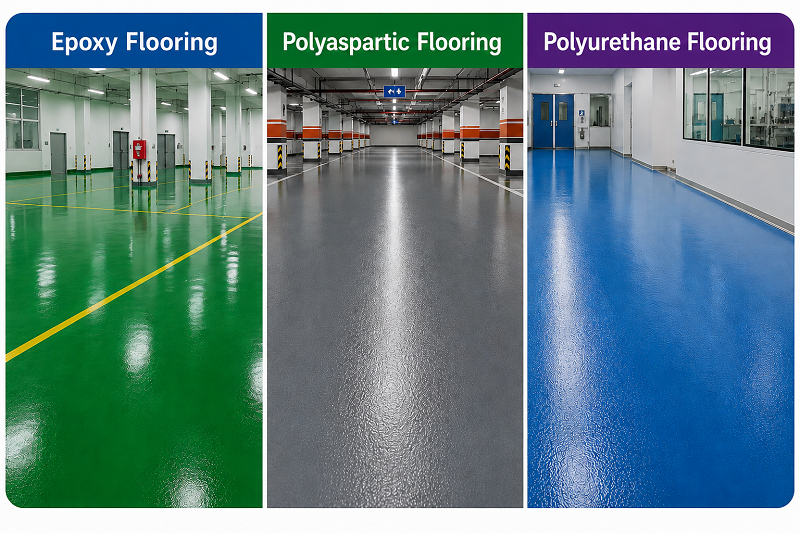
First, What Are These Coatings Actually Made Of?
Before getting into performance numbers, it helps to understand what separates these materials chemically. The differences aren’t just marketing.
Epoxy is a two-part thermoset system — resin plus hardener — that cures into a rigid, chemically bonded layer on top of concrete. It’s been the dominant floor coating in garages and industrial spaces for decades. 100% solids epoxy (the professional-grade version) builds at 8–15 mils per coat, thick enough to self-level and fill minor surface flaws.
Polyaspartic is technically a subclass of polyurethane chemistry, but it behaves very differently in practice. It’s formed by the reaction of an isocyanate component with an amine-based resin blend. The result is an elastomeric coating — meaning it flexes rather than staying rigid. It cures extraordinarily fast (minutes to hours, not days) and builds strong molecular bonds even in humid or cold conditions that would compromise epoxy.
Polyurethane (specifically aliphatic polyurethane, the flooring-grade version) sits between the two. It applies in thinner layers than epoxy (typically 2–3 mils), has more flexibility, and handles UV and chemical exposure better than standard epoxy. Most often used as a topcoat over an epoxy base, though it can function as a standalone system in the right applications.
The Data Comparison: How They Stack Up
Hardness and Compressive Strength
Hardness is the most misunderstood metric in floor coating comparisons. Harder isn’t always better — a coating that’s too rigid can crack when the concrete beneath it flexes or settles.
| Coating | Compressive Strength | Shore D Hardness | Elongation at Break |
| Epoxy (100% solids) | Up to 12,000 psi | 80–90 | 2–5% |
| Polyaspartic | 4,000–8,000 psi | 40–80 (varies by formulation) | 300%+ |
| Polyurethane | 3,000–6,000 psi | 50–75 | 100–300% |
Epoxy wins on raw compressive strength — it’s the hardest of the three. That’s why it’s preferred under heavy static loads, like machinery that sits in one place. But that rigidity is also its weakness: epoxy has almost no elongation, meaning it doesn’t bend. Concrete shifts with temperature and seasonal movement. A rigid coating sitting on a moving substrate eventually cracks.
Polyurea’s elongation of 300%+ means it can stretch and return without cracking or delaminating — a meaningful advantage in climates with significant temperature swings or on slabs that aren’t perfectly stable.
Lifespan Under Real Conditions
| Coating | Residential Garage | High-Traffic Commercial | Industrial/Heavy Use |
| Epoxy | 10–15 years | 5–8 years | 3–5 years |
| Polyurea | 15–20+ years | 10–15 years | 7–12 years |
| Polyurethane | 8–12 years (standalone) | 6–10 years | 4–7 years |
A few things worth noting here.Polyaspartic lifespan numbers assume proper installation — specifically, adequate surface preparation and a quality primer coat. Rushed single-day installs that cut corners on prep can cut that lifespan significantly. Epoxy’s numbers assume an indoor, UV-protected environment. Outdoor or sun-exposed epoxy degrades faster.
Polyurethane used as a standalone system has a shorter lifespan than either, but as a topcoat over an epoxy base, it meaningfully extends the overall system’s performance and UV resistance.
Abrasion Resistance
This is where the conversation gets more nuanced than most product pages admit.
Epoxy is hard, but hardness and abrasion resistance aren’t the same thing. A harder surface can chip and fracture under impact, while a slightly softer, more flexible surface absorbs the blow and stays intact.
Industry Taber abrasion test data consistently shows polyurethane outperforming standard epoxy on wear resistance — one study cited polyurethane floors lasting up to four times longer than uncoated epoxy floors in high-traffic conditions. Polyaspartic resistance to abrasion is rated at roughly 2–3x that of standard epoxy in heavy-duty applications.
That said, in low-to-moderate traffic residential garages, the difference between a quality epoxy and Polyaspartic on day-to-day abrasion is marginal. You’d need a decade of heavy traffic to see it clearly.
Chemical Resistance
| Chemical Type | Epoxy | Polyaspartic | Polyurethane |
| Motor oil / gasoline | Excellent | Excellent | Very Good |
| Brake fluid | Good | Excellent | Very Good |
| Battery acid | Good | Excellent | Good |
| Solvents (paint stripper, etc.) | Moderate | Excellent | Very Good |
| Caustic cleaners | Good | Very Good | Excellent |
| Hot water / steam | Moderate | Good | Excellent |
Epoxy holds up well against the common garage spills — oil, fuel, and most household chemicals. Where it starts to lose ground is against solvents and prolonged exposure to caustic or acidic substances.
Polyaspartic handles the widest range of chemical exposure, including solvents like methylene chloride (the active ingredient in most paint strippers) that will degrade epoxy over time. This is why Polyaspartic dominates in food processing plants, chemical manufacturing facilities, and automotive service bays.
Polyurethane has a particular advantage in environments with hot water or steam exposure — think commercial kitchens or food production lines where frequent high-temperature washdowns are the norm.
UV Stability
This is probably epoxy’s most significant real-world limitation.
Standard epoxy — including most 100% solids garage floor systems — yellows and chalks under sustained UV exposure. It’s not a surface issue; it’s a chemistry issue. Aromatic epoxies (the most common type) break down under UV radiation. The timeline varies, but in a garage that gets significant sun exposure through the door, you might see visible yellowing within 2–3 years.
Polyaspartic and aliphatic polyurethane are both UV-stable. They maintain color and gloss under sun exposure without the yellowing that makes an epoxy floor look old before its time.
| Coating | UV Stability | Outdoor Use |
| Epoxy | Poor — yellows within 2–5 years outdoors | Not recommended |
| Polyaspartic | Excellent — color-stable for lifespan of coating | Suitable |
| Polyurethane (aliphatic) | Excellent — designed for UV exposure | Suitable |
If your garage door is open most of the day or the floor gets direct sun exposure, this matters more than any other metric.
Cure Time and Return to Service
| Coating | Walk-on Time | Drive-on Time | Full Chemical Cure |
| Epoxy | 12–24 hours | 48–72 hours | 5–7 days |
| Polyaspartic | 1–4 hours | 6–24 hours | 24 hours |
| Polyurethane | 4–8 hours | 24–48 hours | 3–5 days |
Polyaspartic cure speed is genuinely striking. Some formulations reach walk-on hardness in under an hour. That’s why it’s the coating of choice for commercial projects where downtime costs money — a warehouse or distribution center can be coated and back in operation within a day.
For residential use, the difference between 24-hour and 72-hour cure is mostly a matter of convenience. But for businesses, it’s a real operational consideration.
Cost Comparison
| Coating | Material Cost (per sq ft) | Professional Install (per sq ft) | Typical 2-Car Garage Total |
| Epoxy (100% solids) | $3 – $7 | $5 – $10 | $2,000 – $5,000 |
| Polyaspartic | $6 – $12 | $7 – $16 | $3,500 – $8,000 |
| Polyurethane (topcoat) | $2 – $5 | $4 – $8 | $1,500 – $4,000 (as topcoat only) |
Epoxy is the most cost-accessible of the three for a complete floor system. Polyaspartic carries a higher upfront cost, though the longer lifespan and lower maintenance needs change the calculus on total cost of ownership over 15–20 years. Polyurethane as a standalone system is cheaper short-term but underperforms over time; as a topcoat layer over epoxy, it’s the most common way to get UV stability and improved abrasion resistance without paying for a full Polyaspartic system.
Head-to-Head Summary
| Performance Factor | Epoxy | Polyaspartic | Polyurethane |
| Compressive Strength | ⭐⭐⭐⭐⭐ | ⭐⭐⭐ | ⭐⭐⭐ |
| Flexibility / Crack Resistance | ⭐⭐ | ⭐⭐⭐⭐⭐ | ⭐⭐⭐⭐ |
| Abrasion Resistance | ⭐⭐⭐ | ⭐⭐⭐⭐⭐ | ⭐⭐⭐⭐ |
| Chemical Resistance | ⭐⭐⭐⭐ | ⭐⭐⭐⭐⭐ | ⭐⭐⭐⭐ |
| UV Stability | ⭐⭐ | ⭐⭐⭐⭐⭐ | ⭐⭐⭐⭐⭐ |
| Cure Speed | ⭐⭐ | ⭐⭐⭐⭐⭐ | ⭐⭐⭐⭐ |
| Upfront Cost | ⭐⭐⭐⭐⭐ | ⭐⭐ | ⭐⭐⭐⭐ |
| Long-Term Value | ⭐⭐⭐⭐ | ⭐⭐⭐⭐⭐ | ⭐⭐⭐ |
So Which One Is Actually the Most Durable?
Measured purely by lifespan, abrasion resistance, flexibility, and chemical range: Polyaspartic wins. It’s not particularly close in high-traffic or chemically demanding environments.
But “most durable” and “best for your project” aren’t always the same thing.
Epoxy is the right call if:
- Budget is a primary constraint and the floor sees moderate residential use
- The garage is indoors with limited UV exposure
- You want a thick, hard surface that handles heavy static loads
- You’re doing a DIY install — epoxy is far more forgiving to apply than Polyaspartic
Polyaspartic makes sense if:
- You want the best long-term performance and are willing to pay a premium upfront
- The floor gets direct sun exposure
- The space is commercial or high-traffic
- Fast return to service is important (business downtime, rental properties, etc.)
- Your slab has minor movement or you’re in a climate with significant temperature shifts
Polyurethane as a topcoat is often the smartest middle ground:
- Pair a quality 100% solids epoxy base with an aliphatic polyurethane topcoat
- You get epoxy’s thickness and hardness as the foundation
- Plus polyurethane’s UV stability, scratch resistance, and chemical range on the surface layer
- Total cost stays closer to a standard epoxy job while addressing most of epoxy’s weaknesses
Most professional floor coating contractors running multi-coat systems are already doing exactly this — epoxy base, polyurethane or polyaspartic topcoat — without always explaining why. Now you know the reasoning behind it.
The Bottom Line
There’s no universal winner. Each coating was built for different conditions, and the marketing noise around all three tends to oversimplify what the actual performance data shows.
If your floor is in a sunny garage that doubles as a workshop, Polyaspartic or an epoxy-polyurethane hybrid is worth the extra cost. If you’ve got a covered indoor garage with light to moderate use, quality epoxy installed over properly prepared concrete will serve you well for ten years or more.
Get the surface prep right regardless of which coating you choose. That single variable affects durability more than the chemistry does.