



A restaurant floor takes more abuse than most owners stop to think about. Grease, boiling water, industrial cleaners, hundreds of customers a day, delivery dollies scraping across the surface — no single floor coating handles all of that the same way. More to the point, a restaurant floor isn’t just a durability question. It’s a food safety issue, a staff safety issue, and a compliance issue that comes into play every time an inspector walks through the door.
Pick the wrong system and you’re dealing with peeling, bacterial growth in cracks, and potentially a written violation notice. This guide covers what regulators actually require, which coating systems perform in commercial kitchen environments, and the installation details that make or break long-term compliance.
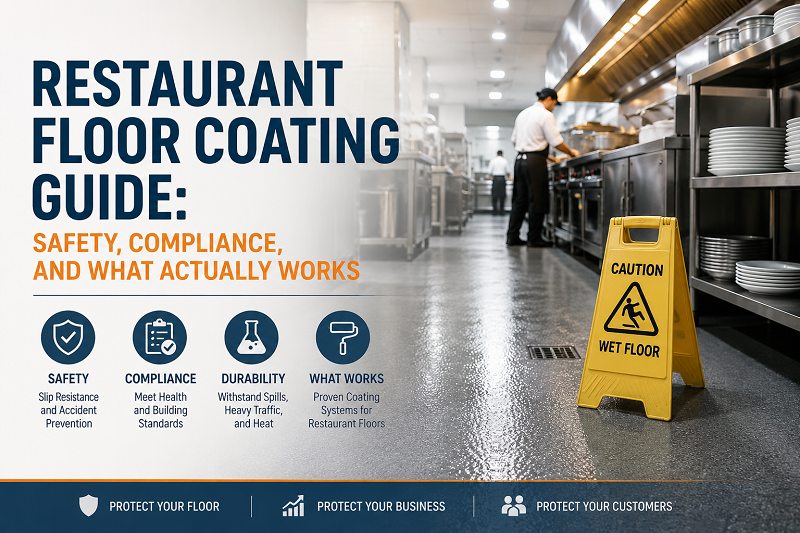
What the Regulations Actually Require — By Market
Regulatory frameworks differ across markets, but the underlying demands are consistent: seamless, non-porous, chemically resistant, slip-resistant, cleanable, and physically maintained. Here’s what that looks like in practice across four major markets.
United States: FDA Food Code + OSHA
The two governing frameworks for US restaurant floors are the FDA Food Code and OSHA workplace safety standards.
Under the FDA Food Code, food preparation area floors must be constructed of smooth, durable, easily cleanable materials and kept in good repair. Section 6-201.14 explicitly prohibits carpet in food preparation and warewashing areas — no exceptions. Section 6-501.11 requires floors to remain free of cracks, chips, and gaps. A compliant material in poor physical condition is still a violation.
One thing worth knowing: the FDA and USDA don’t “approve” specific floor coating brands. Compliance is evaluated based on how the floor performs in your facility, not what the product label says.
NSF/ANSI 51 certification is the most important third-party verification standard for food contact environments in the US — it provides independent confirmation that a floor coating product meets FDA requirements.
United Kingdom: Food Safety Act + HACCP + BRC Standards
UK food service floors fall under the Food Safety Act framework and must comply with HACCP (Hazard Analysis and Critical Control Points) principles.
The Health and Safety Executive (HSE) publishes specific slip resistance guidance for workplace floors. The BRC Global Standard for Food Safety, Section 4.4, sets out detailed requirements for floor maintenance condition, cleanability, and process suitability in food facilities — BRC certification has become the effective industry standard across UK food production and foodservice supply chains.
Key HACCP compliance requirements for floors: easy to clean and disinfect, installation of coving at floor-wall junctions to eliminate right-angle harbourage points, and structural integrity maintained across the full operational life of the facility.
European Union: Regulation EC 852/2004
The EU’s core food hygiene regulation — European Parliament Regulation EC 852/2004 — requires floor surfaces in food handling areas to be easy to clean and, where necessary, disinfect. Materials must be impervious, non-absorbent, washable, and non-toxic.
The EU doesn’t operate an “approved products” mechanism for floor coatings. Instead, floors must satisfy HACCP principles and EFSA (European Food Safety Authority) guidance. Local health authority inspections evaluate actual hygienic performance, not product certifications.
China: GB 14881 General Hygiene Standards for Food Production
In China, food production facilities and restaurants are governed by GB 14881 — General Hygiene Standards for Food Production, alongside local food safety operation guidelines from market supervision authorities.
Core requirements align closely with international standards: floors must use non-toxic, odorless, impermeable, easily cleaned materials and be maintained flat and crack-free. Food processing areas require adequate drainage slope, floor-wall junctions must have coved transitions (curved base treatment), and floor materials must contain no components harmful to human health.
Quick Reference: Compliance Requirements by Market
| Region | Regulatory Framework | Key Standards | Core Requirements |
|---|---|---|---|
| USA | FDA Food Code, OSHA | NSF/ANSI 51 | Seamless, COF ≥ 0.6 (wet), no carpet |
| UK | Food Safety Act, HSE | HACCP, BRC Section 4.4 | Cleanable, coving, slip-resistant |
| EU | EC 852/2004 | HACCP, EFSA guidance | Impervious, non-absorbent, non-toxic, disinfectable |
| China | GB 14881 | Market supervision standards | Crack-free, drainage slope, coved base, non-toxic materials |
Whatever market you’re operating in, the baseline is the same: a seamless, sealed floor coating system that resists daily cleaning chemicals, gives bacteria nowhere to hide, and stays in good physical condition when an inspector shows up.
Different Zones, Different Requirements
A restaurant isn’t one space — front of house, kitchen, prep areas, and warewashing zones each put different demands on a floor coating system.
Front of house (dining area): Aesthetics and abrasion resistance are the primary considerations. Slip resistance requirements are moderate. Matte or satin finishes outperform high-gloss here — a mirror-shine floor in a dining room shows every footprint and scuff within a week of opening.
Commercial kitchen and prep areas: The most demanding compliance zone. Seamless and non-porous is the floor — daily hot water pressure washing and concentrated cleaning chemicals are standard. Slip performance directly affects staff safety.
Warewashing area: Constantly wet, high foot traffic, highest chemical concentration in the building. Requires the strongest chemical resistance and slip resistance of any zone.
Cold storage and dry storage: Low temperatures, occasional condensation. The floor coating system needs to stay stable and well-adhered under cold conditions.
Four Floor Coating Systems That Work in Restaurants
Option 1: Epoxy Floor Coating
The most widely installed floor coating in commercial kitchens, and the cost-performance baseline against which other systems are measured.
100% solids epoxy creates a hard, seamless, non-porous surface that resists most cleaning chemicals and bridges minor surface irregularities. Broadcasted with quartz or aluminum oxide aggregate, slip resistance improves significantly. Color range is wide, which helps with zone marking and kitchen planning.
The real limitations: standard aromatic epoxy has limited hot-water resistance — repeated washdowns above 60°C (140°F) will gradually soften the topcoat. It’s also prone to UV yellowing, which matters in kitchens with skylights or near natural light. In high-frequency hot-wash commercial kitchens, expect a 5–8 year service life before the topcoat needs refreshing.
Best fit: Dining rooms, dry storage, prep areas without heavy thermal cycling Installed cost: $5–$10/sq ft Lifespan: 5–8 years in high-wash kitchens; longer in lower-demand zones
Option 2: Polyurethane Floor Coating
Polyurethane floor coating is the most well-rounded system for restaurant environments — more flexible than epoxy, better abrasion resistance, wider chemical tolerance, and UV-stable in its aliphatic form. Its elongation at break runs 100–300%, meaning it accommodates minor concrete movement without cracking, which matters in kitchens where temperature varies significantly through the day.
Two formulations worth understanding:
Aromatic polyurethane costs less and outperforms standard epoxy on wear resistance. It’s the practical interior choice where UV exposure isn’t a factor. Some color shift occurs under prolonged direct sunlight, though physical properties stay intact.
Aliphatic polyurethane is UV-stable — no yellowing, no chalking under sustained sun exposure. It’s the right call for outdoor dining areas, front-of-house spaces with skylights, and anywhere color consistency matters over time. Taber abrasion test data shows aliphatic polyurethane outperforming standard epoxy topcoats by up to 4x in wear resistance under high-traffic conditions — which is why most professional multi-coat systems use it as the finish layer.
In restaurant environments specifically:
- Handles daily cleaning chemicals, sanitizers, and light degreasers without topcoat degradation
- Available in matte or satin finishes — front-of-house aesthetics without the maintenance burden of high-gloss
- With aluminum oxide or quartz aggregate broadcast, achieves OSHA-compliant wet COF ≥ 0.6
- Most commonly specified as the performance topcoat over an epoxy base coat to extend full system lifespan
Cost: $5–$9/sq ft standalone; $3–$6/sq ft as topcoat over epoxy base Best fit: Dining rooms, naturally lit prep spaces, outdoor or semi-open dining areas, performance topcoat over epoxy systems Lifespan: 8–12 years standalone; extends combined epoxy system to 12–15 years
Option 3: Polyaspartic Floor Coating
Polyaspartic primary advantage in restaurant applications isn’t its chemical resistance or hardness — it’s the speed. Walk-on time runs 1–4 hours after application, with full return to service within 24 hours. For an operating restaurant with a narrow shutdown window, that changes what’s actually installable.
Its elastomeric nature — elongation at break exceeding 300% — makes it significantly more resistant to cracking under thermal cycling than rigid epoxy. Connecting corridors between hot kitchens and cold storage areas, where temperature differentials are pronounced, are a particularly good application. Its wear resistance meets FDA and USDA standards, and it satisfies UL ANSI-NSF 61 requirements for floor coatings that may contact potable water.
Installed cost: $8–$14/sq ft Best fit: Renovation projects requiring fast return to service, cold storage access corridors, loading and receiving areas
Option 4: Epoxy + Polyurethane Hybrid System
For most mid-to-high-end restaurant operations, this is the most cost-effective floor coating solution: epoxy base coat for thickness, build, and adhesion; aliphatic polyurethane topcoat for UV stability, abrasion resistance, and broader chemical tolerance.
The back-of-house and dining room can share the same base coat system while receiving different topcoats — matte polyurethane with aggregate for the kitchen (slip resistance priority) and satin polyurethane for the dining room (aesthetics priority). One installation project, two performance profiles.
Installed cost: $8–$14/sq ft Lifespan: 10–15 years
Slip Resistance: How to Hit the Numbers
OSHA requires wet environment floors to provide adequate Coefficient of Friction. The working thresholds: dry floor COF ≥ 0.5; wet floor COF ≥ 0.6.
Three ways to achieve this in a floor coating system:
Quartz broadcast (20/40 or 30/60 grit) is the standard in commercial kitchens — good slip resistance, durable, manageable cleaning difficulty. Most commonly specified for general kitchen floors.
Aluminum oxide aggregate provides stronger grip than quartz, better suited to heavy grease zones like fry stations. Harder to clean thoroughly, so the tradeoff is deliberate — use it where slip risk is highest and build in cleaning protocols accordingly.
Surface embossing or patterned texture suits front-of-house areas where aesthetics and slip resistance need to coexist. Not appropriate for high-frequency wet cleaning zones.
One caveat: coarser isn’t always safer. Overly aggressive textures trap food particles and grease, which creates bacterial harborage — the opposite of the compliance objective. Match aggregate density and grit size to the actual grease load and cleaning frequency of each zone.
Four Installation Details That Get Overlooked
Cove base at floor-wall junctions The floor-wall transition is where bacteria and debris accumulate fastest — and where inspectors look first. A compliant commercial kitchen floor coating installation extends the coating up the wall at least 4 inches (10 cm) with a curved coved profile, eliminating the right-angle corner that’s impossible to clean properly.
Drain slope Commercial kitchen floors need adequate slope toward drains — typically 1:50 to 1:100 — to ensure washdown water clears completely. Confirm existing slope before installation; correcting it during the coating project is straightforward, but discovering standing water after the floor is down is not.
Drain edge and pipe penetration sealing Every floor drain perimeter and pipe penetration through the slab needs specific treatment to ensure the floor coating seals those transitions. Water infiltrating at those points compromises the bond over time.
Phased installation scheduling Most restaurant shutdowns are short. Specifying polyurea for its fast return-to-service, or phasing the installation zone by zone so part of the operation can keep running, is how experienced flooring contractors minimize the business impact of a recoat or new installation.
Maintenance: Staying Compliant Between Inspections
FDA Food Code Section 6-501.11 requires floors to remain free of cracks, chips, and gaps. A floor that was compliant on install day and is now deteriorating is still a violation.
Day-to-day maintenance:
- Use pH-neutral or mildly alkaline cleaners for routine cleaning — concentrated acids degrade most floor coating topcoats over time
- Address minor chips or point damage promptly; small damage becomes a compliance issue when it spreads
- Inspect the floor condition annually, ideally before your scheduled health inspection cycle
Five Questions to Ask Before Hiring a Contractor
- Do your products carry NSF/ANSI 51 certification or equivalent food safety documentation? Written documentation only — verbal assurances don’t hold up in an inspection
- Does your installation scope include cove base at floor-wall transitions? Non-negotiable for commercial kitchen compliance
- What’s the COF rating of your topcoat system? Ask for test data confirming wet COF ≥ 0.6
- Do you have experience with food service facilities specifically? Residential and general commercial floor coating experience doesn’t transfer to food safety compliance knowledge
- What’s your projected return-to-service timeline? This determines which system is actually viable for your shutdown window
The Bottom Line
Matching the right floor coating system to each zone — slip-resistant and seamless in the kitchen, durable and maintainable in the dining room — is what makes a restaurant floor work both operationally and from a compliance standpoint. Get the system right, find a contractor who understands foodservice facility requirements, and don’t skip the coving and aggregate details. A well-installed floor holds up for 10 or more years and gives you nothing to worry about when the health inspector walks in.