



High-gloss floors had a good run. For the better part of two decades, a mirror-shine finish was the shorthand for luxury — the look that showed up in every renovation show, every real estate listing photo, every showroom. If the floor reflected light, it meant quality.
That calculus has shifted. Across residential, commercial, and industrial applications, matte and low-sheen floor coating are displacing high-gloss as the default. Not because gloss stopped being achievable, but because the reasons people wanted it have changed — and the practical downsides that were always there are harder to ignore now.
This isn’t just an aesthetic preference. The move to matte is being driven by real performance differences, changing design values, and a growing recognition that a floor coating that photographs well in a showroom and a floor that holds up to how people actually live are two different things.
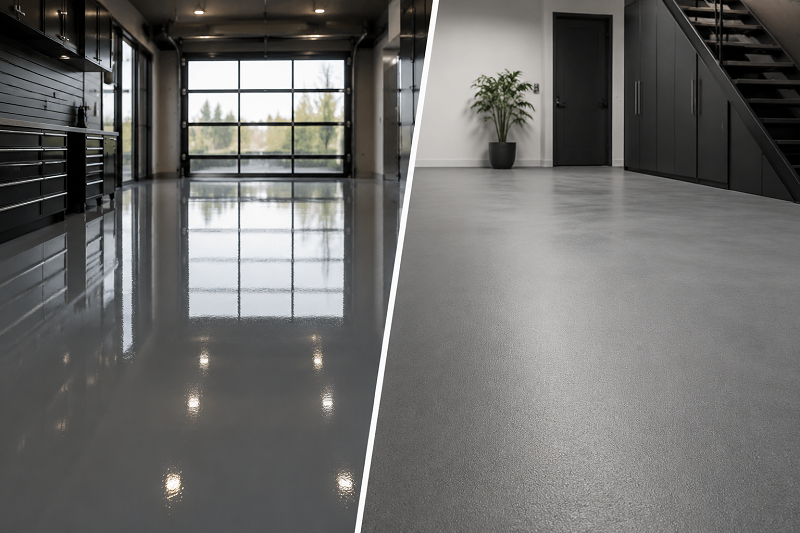
The Problem With High-Gloss That Nobody Talks About
Walk into any space with a high-gloss floor coating and give it a week of real use. The first thing you’ll notice is that the floor starts telling on itself.
Every footprint shows. Every scuff catches the light. Pet paw prints, dust, water spots from a glass left on the counter — all of it becomes visible in a way that it isn’t on a matte or satin surface. As one designer put it bluntly: “Gloss shows every scuff, every water spot, every dog paw.” What looked like a luxury surface in an empty room becomes a maintenance project the moment people start using it.
The reflection itself is part of the problem. High-gloss floor coatings bounce light aggressively — which creates visual noise, particularly in open-plan spaces where the floor is a significant percentage of total surface area. Designer Shelley McIlroy describes it this way: “High-gloss floors can feel overly reflective and commercial. Matte finishes create a quieter architectural foundation. They absorb light, making a space feel grounded and layered rather than overly polished.”
For a long time, that visual intensity read as aspirational. The same reflective gloss that conveyed luxury has started feeling loud — spaces that exhale rather than compete for attention are now what people are after. The aesthetic pendulum has swung, and it’s pulled the market with it.
What’s Actually Driving the Shift in 2026
1. Maintenance Reality
This is the most underrated factor in the gloss-to-matte transition, and for everyday homeowners it might be the most important one.
Matte floors absorb light instead of bouncing it around, so everyday wear — footprints, dust, minor scuffs — simply isn’t as visible. They age more gracefully than glossy surfaces, which show wear conspicuously.
For a floor coating in a garage, basement, or commercial space, this matters practically. A high-gloss epoxy or polyurethane finish in a working environment shows tire marks, oil drips, and foot traffic patterns clearly. A matte floor coating in the same space hides the same level of use — the floor looks cleaner for longer between cleanings, and minor surface wear doesn’t register visually until it’s actually significant.
Matte finishes hide scratches and imperfections better than glossy floors, making them much easier to maintain in busy households and high-traffic spaces.
2. Design Has Moved Toward Texture Over Shine
Home design has been steadily shifting toward finishes that feel grounded, relaxed, and authentic. High-gloss surfaces once dominated, but they’re now being replaced with floors that reflect less light and show more of a material’s natural character.
This shift is visible across every flooring category — hardwood, concrete, tile, and coated surfaces alike. A matte finish lets the material itself be the star. You can see the texture, the grain patterns, and the natural variations in color without a glossy coating reflecting light everywhere.
For floor coatings specifically — epoxy, polyurethane, polyaspartic — matte and satin topcoats reveal the underlying color and texture of the coating system rather than turning the floor into a reflective surface. Metallic floor coatings in matte finish, in particular, show significantly more depth and complexity than the same coating in high-gloss, where the reflection competes with the design.
3. Anti-Slip Performance
High-gloss floor coatings are inherently more slippery than matte or textured finishes, particularly when wet. This isn’t a minor consideration in garages, commercial kitchens, entryways, or any space that sees moisture.
Matte finishes are kinder underfoot, thanks to their anti-slip texture, making them safer for households with children and in environments where wet surfaces are common.
For commercial and industrial applications, matte or textured floor coatings with quartz or aluminum oxide aggregate added to the topcoat provide measurable slip-resistance improvements over high-gloss alternatives — which matters both for occupant safety and for OSHA compliance.
4. Gloss Amplifies Imperfections
This is the one that catches people off-guard. A high-gloss floor coating does the opposite of what most people expect when it comes to surface flaws.
Matte and patterned finishes hide imperfections better than solid high-gloss colors — the floor stays looking good longer. With a high-gloss topcoat, minor surface irregularities in the concrete beneath — small ridges, roller marks from application, minor variations in the base coat — catch light at different angles and become visible. A matte finish diffuses light uniformly, so small variations in the substrate don’t telegraph through to the surface the same way.
For professional floor coating installers, this is well understood. Matte and satin finishes are more forgiving to apply and more forgiving in how they wear, which is part of why they’ve become the default recommendation for most residential and light commercial applications.
Matte vs. Satin vs. High-Gloss: How They Compare on a Floor Coating
| Finish Level | Sheen Level | Hides Wear | Slip Resistance | Maintenance Demand | Best Suited For |
|---|---|---|---|---|---|
| High-Gloss | 70–100 GU | Poor | Low | High | Showrooms, display spaces, low-traffic areas |
| Satin | 35–60 GU | Good | Medium | Low–Medium | Residential garages, commercial spaces |
| Matte | 10–30 GU | Excellent | High | Low | Industrial, high-traffic, residential living |
GU = Gloss Units, measured at 60° angle — the standard measurement for floor coating finish specifications.
Satin occupies the middle ground that many homeowners land on — enough sheen to add some visual interest and make the space feel bright, without the maintenance demand of high-gloss. In 2026, satin finishes remain one of the most popular and versatile options, reflecting just enough light to brighten a room without looking overtly shiny.
Where Matte Floor Coatings Are Showing Up in 2026
Residential Garages
The shift is visible here first. High-gloss epoxy has been around for what seems like forever, but matte and textured finishes are what 2026 is all about for floor coatings. The practical case is straightforward — a garage floor sees tire contact, oil drips, road salt, and foot traffic. Matte floor coatings handle all of that without advertising it.
Commercial and Retail Spaces
Matte finishes don’t create unnecessary glare and reflections — they offer a quiet and restful anchor, allowing other elements in the space to take focus. For retail environments, hospitality spaces, and office interiors, this is increasingly the brief from designers and architects.
Industrial Facilities
The practical argument for matte here is entirely about safety and durability, not aesthetics. Matte and textured floor coatings with broadcast aggregate provide substantially better slip resistance than high-gloss systems, particularly in environments where moisture, oils, or other liquids are regularly present on the floor.
Residential Living Spaces
Basements and garage conversions being finished as living space — home gyms, entertainment rooms, offices — are increasingly using matte polyaspartic or satin polyurethane floor coatings rather than high-gloss epoxy. Matte finishes are ideal for modern, minimalist, and contemporary interiors, and they require less frequent touch-ups compared to shinier finishes.
Does Matte Mean Lower Quality?
This is the question that comes up, and it’s worth answering directly: no.
The finish level of a floor coating — gloss, satin, or matte — is a topcoat characteristic, not a measure of the underlying system’s quality, thickness, or durability. A matte polyaspartic topcoat over a properly installed 100% solids epoxy base is a more durable system than a high-gloss water-based epoxy applied directly to unprepped concrete. The sheen tells you nothing about what’s underneath.
What matte does change is the maintenance profile. A high-gloss finish that shows every mark will look worse than a matte finish over time in any working environment — not because the coating degraded faster, but because the wear is visible sooner. Matte and satin floor coatings age better in daily use, which is why they’re the practical choice for most applications that aren’t specifically trying to create a showroom effect.
What to Specify When Choosing a Matte Floor Coating
If you’re specifying a matte or satin floor coating for a new project:
- Request gloss unit (GU) specifications in writing — “matte” means different things to different contractors; a GU rating of 10–25 at 60° is a true matte, while 35–55 GU is satin
- Confirm the topcoat chemistry — matte polyaspartic holds its finish level longer than matte water-based epoxy under UV exposure and abrasion
- Consider aggregate for high-traffic or wet areas — aluminum oxide or quartz broadcast into the matte topcoat adds measurable slip resistance without changing the finish appearance significantly
- Ask for a physical sample — the same GU reading can look quite different under fluorescent light versus natural light; always check in your actual space before committing
The Bottom Line
High-gloss floor coatings aren’t going away entirely — there are spaces where the mirror finish is still exactly right. But the default has shifted. In 2026, matte and satin finishes dominate residential, commercial, and industrial floor coating projects because they perform better in daily use, fit where design has moved, and look better over time in spaces that get actually used.
The floor you have to maintain every day is more valuable than the floor that photographs well on install day.