


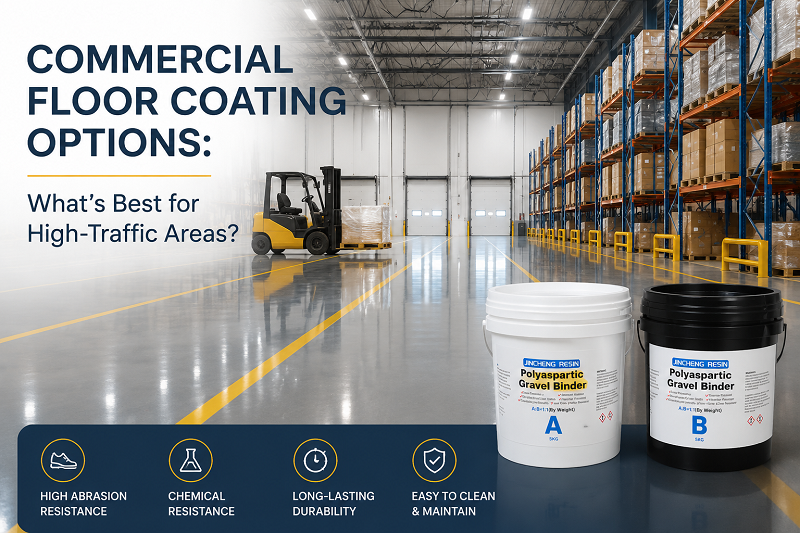
Walk a commercial facility during peak hours and the floor tells you everything about how well the spec was thought through. A distribution center where forklifts are running routes all day. A restaurant with servers moving through the same aisles a hundred times a shift. A retail showroom where hundreds of customers pass through weekly. A pharmaceutical plant where the floor sees daily chemical sanitization.
The phrase “high-traffic” covers a lot of ground, and what the floor actually needs depends on what kind of traffic it’s handling — not just the volume, but the type of load, the chemical exposure, the moisture conditions, and what the regulatory environment requires. A coating that’s right for a showroom is a poor choice for a warehouse; a system built for a food processing facility would be wasteful overkill in a retail corridor.
This guide breaks down which commercial floor coating systems perform in which environments, what the data shows about durability and cost, and the questions worth asking before any spec gets written
What “High-Traffic” Actually Demands from a Floor Coating
Before comparing products, it’s worth being specific about what high-traffic commercial floors actually encounter — because the demands vary significantly by facility type.
Mechanical load. <cite index=”1-1″>A warehouse floor takes a relentless beating from forklifts, pallet jacks, dropped loads, and constant foot traffic.</cite> Foot traffic is the lightest load. Loaded pallet jacks and forklifts concentrate thousands of pounds across small contact patches, creating high localized stress on the coating and the concrete beneath it.
Chemical exposure. <cite index=”2-1″>Epoxy floors provide a smooth, chemical-resistant surface suitable for high-traffic areas, excelling in factories, garages, and laboratories where chemical exposure is common.</cite> But the type of chemical matters enormously — automotive oils are different from food processing cleaners, which are different from pharmaceutical sanitizers, which are different from industrial solvents.
Slip resistance and safety. <cite index=”7-1″>All public and commercial spaces must meet ADA flooring requirements, including slip resistance standards (minimum DCOF of 0.42 for wet areas).</cite> This isn’t optional — it’s a legal baseline. Commercial facilities in food service, healthcare, and retail have additional safety obligations that affect coating specification.
Downtime tolerance. A facility that can shut down for a week to install flooring has different options than one that runs 24 hours. The cure time of a coating system is a practical constraint that often narrows the field before any other variable.
Regulatory compliance. <cite index=”3-1″>Food plants, pharmaceutical facilities, and chemical storage operations are subject to FDA, USDA, OSHA, and local health codes that directly affect product selection.</cite>
The Main Commercial Floor Coating Systems
Epoxy Floor Coating
<cite index=”4-1″>Epoxy bonds directly to concrete, creating a hard, seamless surface with excellent chemical and impact resistance. It’s the go-to for food processing, manufacturing, and commercial kitchens. Epoxy lifespan runs 10 to 20+ years at $3 to $7 per sq ft installed. Strengths include chemical resistance, easy cleaning, and customizable color.</cite>
<cite index=”1-1″>Because the floors are seamless and non-porous, they resist contamination and are straightforward to clean in busy operations.</cite> In commercial environments where sanitation protocols matter — food service, healthcare, labs — the absence of grout lines and surface gaps is a genuine operational advantage, not just an aesthetic one.
Where epoxy runs into its limits in commercial settings:
Cure time. <cite index=”2-1″>The main drawback is the 3 to 7 day curing period that may disrupt operations.</cite> For facilities where downtime is measured in lost revenue per hour, this is a real operational constraint.
Slip risk when wet. <cite index=”4-1″>Weakness: it can become slippery when wet unless anti-slip aggregates are added.</cite> In commercial environments with any moisture — kitchens, locker rooms, entry areas, outdoor-adjacent spaces — aggregate broadcast into the topcoat is essential, not optional.
UV sensitivity. Standard aromatic epoxy yellows under sustained UV exposure — relevant for showrooms with natural light, covered outdoor areas, or any commercial space with significant window exposure.
Best commercial applications: Warehouses, light manufacturing, food processing prep areas, commercial kitchens (with aggregate), laboratories, retail back-of-house.
Cost: $3–$10/sq ft installed depending on system complexity Lifespan: 10–20 years in commercial use
Polyaspartic Floor Coating
<cite index=”6-1″>Polyaspartic coatings are engineered for environments where speed, durability, and aesthetics are non-negotiable. These coatings cure rapidly — often within just one to two hours — allowing floors to return to full use much faster than traditional systems.</cite>
The speed advantage is real and significant in commercial contexts. A retail showroom that closes Friday night and needs to open Monday morning has a roughly 60-hour window. A restaurant that shuts down between lunch and dinner service has a few hours. Polyaspartic systems make both scenarios viable.
Beyond cure speed, polyaspartic brings UV stability — the aliphatic chemistry means no yellowing under sustained sun exposure, which matters in showrooms, retail environments, and any commercial space that gets meaningful natural light. <cite index=”6-1″>Best for: Quick-turnaround retail spaces, automotive showrooms, lobbies, grocery stores, shopping centers, and other high-traffic facilities requiring minimal downtime.</cite>
The hardness of polyaspartic — higher than standard epoxy — also translates to better abrasion resistance under rolling cart traffic, high-heel foot traffic, and the constant surface friction of a busy retail floor.
Best commercial applications: Retail showrooms, auto dealerships, grocery stores, hotel lobbies, fitness facilities, restaurant and hospitality fronts of house, any space requiring same-day or next-day return to service.
Cost: $7–$14/sq ft installed Lifespan: 15–20 years
Polyurethane Floor Coating
Polyurethane occupies a distinct position in the commercial floor coating landscape — more flexible than epoxy, better abrasion resistance, broader chemical tolerance, and UV-stable in its aliphatic form. It’s the system that bridges the gap between standard epoxy and the premium fast-cure options, and in many commercial settings it delivers the right combination of performance and cost without overspecifying.
Two formulations serve different commercial needs:
Aromatic polyurethane is the cost-effective interior option. It outperforms standard epoxy on wear resistance and handles the chemical exposure typical of warehouses, back-of-house service areas, and light manufacturing without UV stability requirements. Some color shift occurs under prolonged direct sunlight — physical properties stay intact, but color changes over time in sun-exposed areas.
Aliphatic polyurethane adds UV stability to the performance profile. No yellowing, no chalking under sustained sun exposure — which makes it the standard topcoat specification for commercial showrooms, retail environments, hotel lobbies, and any high-traffic space that receives significant natural light. Taber abrasion test data consistently shows aliphatic polyurethane outperforming standard epoxy topcoats by up to four times in wear resistance under sustained traffic. That gap is what drives its widespread use as the finish layer in professional multi-coat commercial systems.
The most practical commercial specification: 100% solids epoxy base coat for structural build and concrete adhesion, aliphatic polyurethane as the topcoat. The epoxy does the foundational work at lower material cost; the polyurethane handles the surface conditions that actually degrade coatings in commercial use — UV exposure, abrasion, and chemical contact. Anti-slip aggregate broadcast into the topcoat addresses the slip resistance requirements that wet commercial environments demand.
Best commercial applications: Retail showrooms and auto dealerships needing UV stability, restaurant dining areas and front-of-house hospitality spaces, corporate offices and hotel lobbies with significant natural light, parking structures and vehicle access ramps, any high-traffic commercial interior where the floor needs to look as good in year eight as it did on opening day.
Cost: $5–$9/sq ft standalone; $3–$6/sq ft as topcoat over epoxy base Lifespan: 8–12 years standalone; extends epoxy base system to 12–18 years as topcoat
Epoxy + Polyaspartic or Polyurethane Hybrid System
<cite index=”1-1″>Seamless epoxy, polyaspartic, and polyurea systems are the most common choices, since they resist heavy traffic, chemicals, and abrasion.</cite>
The hybrid approach — epoxy base coat for structural build and adhesion, polyaspartic or aliphatic polyurethane topcoat for surface performance — is what most experienced commercial floor coating contractors actually install. The logic: epoxy provides efficient, cost-effective thickness and concrete adhesion; the topcoat delivers UV stability, harder wear resistance, and improved chemical tolerance at the surface layer that actually takes the traffic.
This combination also addresses the UV limitation of bare epoxy without paying for a full polyaspartic system throughout. In facilities with mixed exposure — partially covered areas, spaces with skylights, showrooms — it’s the most practically balanced specification.
Best commercial applications: Any facility where a full polyaspartic system is cost-prohibitive but bare epoxy has performance gaps; most retail, commercial office, showroom, and mid-range warehouse applications.
Cost: $6–$12/sq ft installed Lifespan: 12–18 years
Polished Concrete
Not a coating in the traditional sense, but worth including because it’s increasingly specified for high-traffic commercial applications where chemical coating systems aren’t required.
<cite index=”2-1″>Polished concrete flooring offers the lowest long-term maintenance cost compared to other hard flooring systems, making it an economically smart choice for budget-conscious facility managers. The elimination of waxing, stripping, and coating replacement saves thousands of dollars annually in large facilities.</cite>
The limitation: polished concrete doesn’t provide the chemical resistance or seamless surface that food service, healthcare, and industrial environments require. It’s the right specification for retail, corporate offices, and commercial spaces where the aesthetic is a feature, but it’s not a substitute for a coating system in regulated or chemically demanding environments.
Best commercial applications: Corporate offices, retail spaces, museums, hospitality, any commercial environment where aesthetics and low maintenance matter more than chemical resistance.
Cost: $3–$8/sq ft installed Lifespan: 25–30 years with periodic maintenance
System Comparison by Commercial Application
| Facility Type | Primary Demands | Recommended System | Cost Range |
|---|---|---|---|
| General warehouse | Forklift loads, abrasion, ease of cleaning | 100% solids epoxy or polyurea | $5–$12/sq ft |
| Heavy manufacturing | Impact, chemicals, vibration | Polyurea or novolac epoxy | $8–$16/sq ft |
| Retail showroom | Aesthetics, UV stability, fast cure | Polyaspartic or epoxy + polyaspartic | $7–$14/sq ft |
| Restaurant / food service | Chemical resistance, slip resistance, sanitation | Epoxy + polyurethane with aggregate | $6–$12/sq ft |
| Cold storage | Thermal cycling, flexibility | Polyaspartic or aliphatic polyurethane | $7–$14/sq ft |
| Healthcare / pharma | Seamless, chemical resistance, compliance | 100% solids epoxy, GreenGuard certified | $6–$12/sq ft |
| Corporate office / retail | Aesthetics, low maintenance | Polished concrete or epoxy + polyaspartic | $4–$10/sq ft |
| Hotel lobby / hospitality | High foot traffic, UV, aesthetics | Polyaspartic or decorative epoxy | $8–$14/sq ft |
What Drives Cost in Commercial Floor Coating Projects
Several variables move the per-square-foot number significantly in commercial projects:
Scale. <cite index=”3-1″>Both systems can be installed across large square footage efficiently.</cite> Commercial projects benefit from scale economics — a 50,000 sq ft warehouse installation typically prices 20–30% lower per square foot than a 2,000 sq ft retail fit-out, because mobilization, equipment, and crew costs spread across more area.
Surface condition. Old coatings, extensive cracking, contamination, or moisture issues all add to the prep cost. A floor that needs significant remediation before coating can add $1–$3/sq ft to the project.
Downtime requirements. Fast-cure systems (polyaspartic, polyurea) typically command a 15–25% premium over standard epoxy installs, partly because of product cost and partly because the application precision and speed required demands more experienced crews.
Regulatory specifications. Meeting NSF, USDA, FDA, or GMP standards sometimes requires specific product certifications and documentation that not every contractor can provide. This narrows the competitive field and typically adds to project cost.
Line marking and zoning. <cite index=”2-1″>The versatility in color and finish options allows you to create designated zones, safety markings, or branded environments without additional materials.</cite> Traffic flow lines, hazard markings, and zone demarcation in warehouses and manufacturing facilities add labor cost but are often required for OSHA compliance.
Questions to Ask Before Specifying a Commercial Floor Coating
What’s the actual traffic loading? Foot traffic, pallet jacks, and loaded forklifts have fundamentally different impacts on coating longevity. Be specific — “warehouse traffic” covers an enormous range.
What chemicals will the floor see? List the actual products, not general categories. Motor oil and hydrochloric acid both fall under “chemicals,” but they require completely different coating chemistries.
What’s the maximum downtime window? This often drives the system selection before any other variable. If the answer is “48 hours,” polyaspartic or polyurea are the only viable options.
Is there a regulatory or certification requirement? NSF, USDA, FDA, LEED, GreenGuard Gold — confirm whether any certification is required for the specific use and build it into the product specification from the start.
What’s the moisture status of the slab? Commercial concrete floors — especially below-grade and ground-level slabs — frequently have elevated moisture vapor emission. Testing before coating and specifying a vapor barrier primer where needed protects the investment from the most common cause of premature commercial floor failure.
The Short Version
Commercial floor coating selection comes down to four variables: what load the floor takes, what chemicals it sees, how much downtime is available, and whether there are regulatory requirements. <cite index=”5-1″>Don’t sacrifice critical performance factors to save on upfront costs. Poor flooring choices lead to frequent replacements, safety issues, and unhappy customers.</cite>
For most commercial applications, the practical answer is a 100% solids epoxy or polyaspartic system — or a hybrid of the two — with anti-slip aggregate in any zone that sees moisture, and fast-cure chemistry where downtime is limited. The specific system is less important than getting those four variables answered honestly before the spec is written.