

Most flooring RFQs that cross a contractor’s desk come down to one question: epoxy or polyurethane? The honest answer is neither system wins outright — they solve different problems. Picking wrong means a recoat in three years instead of ten, or a floor that cracks under a forklift it was never built for.
This guide breaks down where each system actually performs, backed by numbers instead of marketing claims, so distributors and specifiers can match the coating to the job.
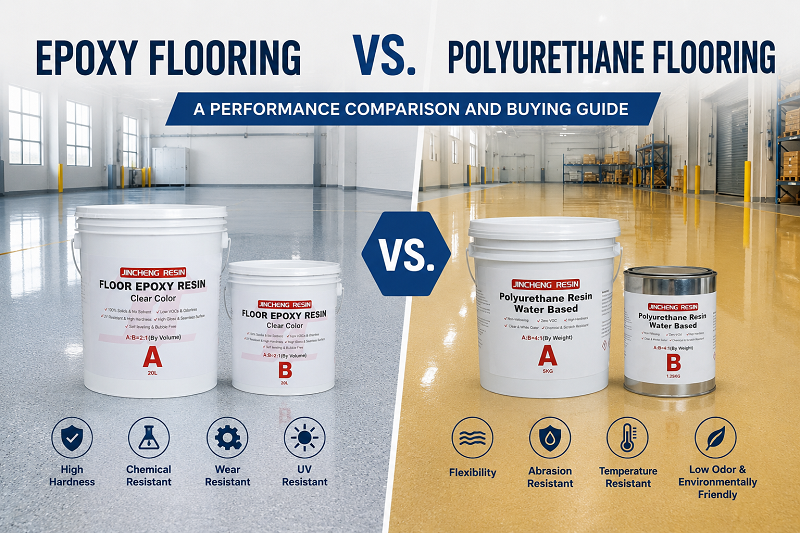
What You’re Actually Comparing
Epoxy floor coating is a two-component thermosetting resin — epoxide reacts with a hardener to form a rigid, densely cross-linked film. Once cured, it’s essentially a plastic laminate bonded to concrete.
Polyurethane floor coating (PU) is also two-component, but the polymer chain is more flexible. Aliphatic PU topcoats in particular resist UV breakdown far better than epoxy, which is why you’ll find PU on the surface even in hybrid systems.
The distinction that matters most for buyers: epoxy is hard and brittle, PU is tougher and more elastic. That single trade-off drives almost every performance difference below.
Performance Comparison, By the Numbers
Compressive strength. Standard epoxy floor systems run 9,000–10,000 psi. Polyurethane systems typically land at 6,000–8,000 psi — lower, but the elasticity compensates in impact-heavy environments.
Abrasion resistance. Epoxy wins on flat, static load — think retail floors, showrooms, warehouses with pallet racking. PU wins where there’s rolling impact — forklift traffic, tow motors, steel-wheeled carts — because it absorbs shock instead of transmitting it straight to the substrate.
Chemical resistance. Both resist oils, mild acids, and cleaning agents well. Epoxy edges ahead against solvents and harsh industrial chemicals. PU edges ahead against organic acids — a real factor for dairy, beverage, and food processing floors where lactic and citric acid exposure is constant.
UV stability. This is where epoxy loses outright. Standard epoxy yellows and chalks within 6–12 months of direct sunlight exposure. Aliphatic PU topcoats hold color for 5+ years outdoors. Any exterior application — loading docks, covered parking, outdoor walkways — should default to a PU topcoat regardless of what’s underneath.
Temperature tolerance. Epoxy becomes brittle below 10°C and can crack under thermal shock — a real problem for cold storage and freezer floors. PU stays flexible from roughly -30°C to 60°C, making it the standard choice for cold chain facilities.
Cure time. Epoxy needs 24–72 hours to walk on and 5–7 days for full chemical cure and vehicle traffic. PU cures faster — often ready for light traffic in 12–24 hours — which matters when a facility can’t afford a week of downtime.
Cost. Epoxy runs lower per square meter — roughly 20–30% cheaper than a comparable PU system, largely due to raw material cost. For buyers on tight margins and static-load environments, that gap is decisive.
Where Epoxy Wins
- Warehouses and distribution centers with pallet racking, minimal thermal cycling
- Retail floors, showrooms, office spaces — where appearance and cost matter more than impact resistance
- Manufacturing floors with heavy chemical exposure but limited rolling traffic
- Any project where budget is the primary constraint
Where Polyurethane Wins
- Cold storage, freezers, and facilities with frequent temperature swings
- Food and beverage plants with organic acid exposure and frequent hot-water washdown
- Parking structures, loading docks, and any exterior or semi-exterior application
- High-traffic areas with forklifts, tow motors, or steel-wheeled equipment
The Hybrid Answer Most Facilities Actually Need
In practice, a large share of commercial and industrial floors don’t need a pure epoxy or pure PU system — they need both, layered. An epoxy primer and build coat handles the structural bond and compressive strength; a PU topcoat handles UV resistance, flexibility, and chemical exposure at the wear surface.
This is the system we run most often for buyers who don’t want to compromise: epoxy base for cost-efficient strength, PU top for durability where the floor actually takes abuse. It also gives distributors a single quoted system instead of forcing a customer to choose between two “good enough” options.
Decision Framework by Facility Type
| Facility Type | Recommended System |
|---|---|
| Dry warehouse, static racking | Epoxy |
| Cold storage / freezer | Polyurethane |
| Food & beverage processing | Polyurethane or epoxy-PU hybrid |
| Parking garage / loading dock | Polyurethane topcoat |
| Retail / showroom | Epoxy |
| Heavy forklift traffic | Polyurethane or hybrid |
| Auto service / workshop | Epoxy-PU hybrid |
Buying It Right the First Time
For distributors and contractors sourcing at volume, the material choice is only half the decision — the other half is who’s supplying it. A supplier that can formulate both epoxy and PU systems in-house, run OEM/private-label programs, and back the product with real technical data sheets saves you from mixing brands or guessing on compatibility between primer and topcoat.
If you’re evaluating suppliers for an upcoming project — or want to test a hybrid epoxy-PU system before committing to a full order — Jincheng Resin formulates both epoxy and polyurethane floor coatings in-house, with OEM and private-label capability for distributors who need their own branding on the can. Reach out for technical data sheets and sample quantities before your next bid.