



Nobody thinks about warehouse floors until one fails. Then it’s forklift downtime, a resurfacing quote nobody budgeted for, and a maintenance manager explaining to ownership why the floor they installed two years ago is already chipping.
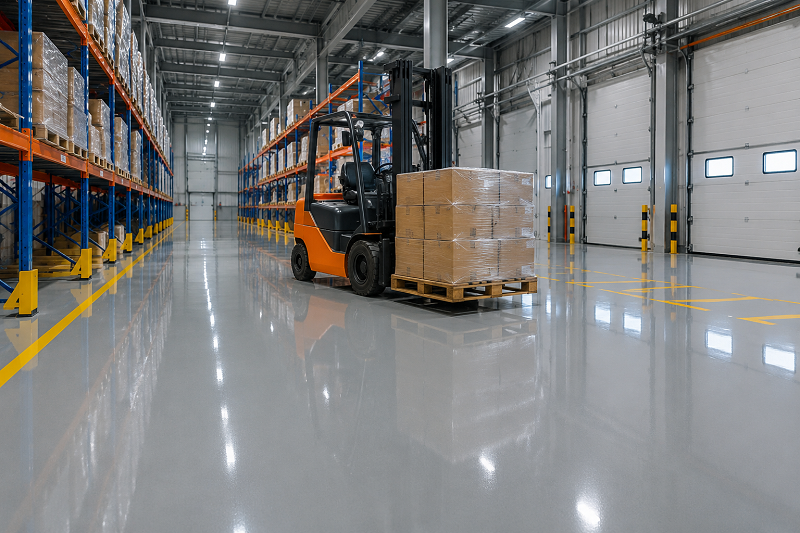
Warehouse floors absorb a level of abuse that’s easy to underestimate from a spec sheet. Forklifts running double shifts. Pallet jacks dragging steel edges across the same six-foot stretch, day after day. Hydraulic fluid spills, de-icing salt tracked in every winter, and temperature swings between a 5°C loading dock and a heated storage zone twenty meters away. Most flooring systems weren’t built to survive that combination. Polyurethane floor coating was.
Where Standard Epoxy Starts to Fail
Epoxy dominates the flooring market for good reason — it’s affordable, easy to install, and it looks sharp on day one. But day one isn’t the test. Month eighteen is, after ten thousand forklift passes and at least one spill someone forgot to clean up.
Epoxy is rigid by nature. It bonds hard to the substrate and stays that way, which works fine under light foot traffic but turns into a liability under constant mechanical load. A rigid coating doesn’t absorb impact — it passes the impact straight down to the bond line. Drop a pallet from a raised fork and you’re not looking at a scuff. You’re looking at a crack that runs through to the concrete. Moisture or chemicals find that crack eventually, delamination follows, and a section you assumed was good for five more years needs recoating instead.
Polyurethane behaves differently because it’s more flexible. It absorbs shock rather than just resisting it, and that one mechanical property explains most of why polyurethane systems outlast epoxy wherever traffic is heavy, loads get dropped, or temperatures swing.
Abrasion Resistance Is Where It Actually Pays Off
Forklift tires generate constant low-level abrasion, and over months that wears through a coating’s surface layer until bare concrete shows underneath. Polyurethane floor coating simply wears slower under this kind of rolling traffic and holds its texture longer.
That translates into a longer stretch between recoats, which matters more than most spec sheets admit — recoating means shutting down a bay, moving inventory around it, and eating the downtime cost on top of the material.
The question we hear most from distributors and OEM buyers is some version of “how long before we’re doing this again.” With a properly prepped substrate, five to seven years under moderate-to-heavy industrial traffic is a realistic number for a polyurethane system. Layer a polyaspartic or polyurethane topcoat over an epoxy primer and that number climbs further — which is increasingly the standard build for warehouses that can’t afford frequent shutdowns.
Chemical and Impact Resistance Under Actual Conditions
Warehouses aren’t clean environments. Battery acid near charging stations, hydraulic leaks, cleaning chemicals, road salt in winter — all of it ends up on the floor sooner or later. A coating that degrades under that exposure isn’t just an eyesore. Chemical attack is usually step one toward substrate failure.
Polyurethane holds up against oils, greases, and most industrial chemicals without the chalking or yellowing that shows up on lower-grade epoxy after a couple years. UV exposure gets overlooked too often in flooring specs, and it shouldn’t — loading docks with open bay doors or skylights get real sun, and standard epoxy will amber within a year or two under that kind of light. Aliphatic polyurethane topcoats resist it, which keeps line markings and safety zones legible instead of fading into the concrete.
Impact resistance matters just as much. Dropped tools, a pallet that shifts wrong, a forklift fork that catches an edge — none of that is rare in a working warehouse. Polyurethane flexes under sudden point-load impact instead of shattering, which avoids the chip-and-crack pattern common with brittle epoxy, especially in cold storage where low temperatures make rigid coatings even more brittle than usual.
Turnaround Time Is the Argument Facility Managers Actually Care About
Material cost gets the attention, but labor and downtime are the real cost of any flooring project. A distribution center can’t shut down a receiving bay for a week and just eat it.
This is where fast-cure polyurethane and polyaspartic-modified systems change the math. Modern topcoats can be foot-traffic ready in 24 hours and support vehicle loading within 48 to 72 hours. Standard epoxy needs 5 to 7 days for a full cure. For a facility running multiple shifts, that’s the difference between coating Friday night and being fully operational Monday morning — versus losing an entire week of throughput.
It’s also why polyurethane systems have become the default for phased rollouts, where one bay gets coated at a time while the rest of the facility keeps running instead of shutting the whole floor down at once.
Slip Resistance Isn’t Optional
High-traffic floors need controlled slip resistance, and not just to satisfy an inspector. A forklift losing traction on a wet floor is a liability event, not a maintenance footnote.
Polyurethane systems accept broadcast aggregate, silica sand, or textured additives in the topcoat to hit a specified coefficient of friction without giving up the chemical and abrasion performance underneath. That’s a real advantage over high-gloss epoxy finishes, which can turn genuinely dangerous the moment a hydraulic line lets go on a warm floor. Under OSHA or equivalent workplace safety frameworks, texture and slip rating usually belong in the spec from day one — not added after someone slips.
How Polyurethane Actually Fits Into a Floor System
Worth being precise here: in most real installations, polyurethane doesn’t work alone. The strongest, most cost-effective systems pair an epoxy primer or build coat — which handles adhesion, self-leveling, and cost efficiency well — with a polyurethane or polyaspartic topcoat that adds the abrasion, UV, and impact resistance epoxy can’t provide by itself.
That combination gives facility managers the substrate-bonding strength and economical build thickness of epoxy along with the flexibility, chemical resistance, and fast cure of polyurethane on the wearing surface. For OEM and private label buyers sourcing systems for resale, this layered epoxy-polyurethane build is generally what “industrial-grade” flooring actually means — not one material doing everything, but an engineered system where each layer has a job.
Upfront Cost vs. What You Actually Pay Over Time
Polyurethane costs more per square foot than standard epoxy going in. That’s real, and any honest recommendation has to say so instead of glossing over it.
But installed cost isn’t the number that matters — cost per year of service, including downtime, is. A warehouse recoating an epoxy floor every two to three years under heavy traffic pays for materials, labor, and lost operating time on repeat. A polyurethane-topped system holding up for five to seven years, with less chipping, less staining, less UV fade along the way, usually wins on total cost even with the higher price tag on day one.
For genuinely light traffic — office space, light assembly, low-turnover storage — standard epoxy remains a reasonable, cheaper choice. Polyurethane earns its premium specifically where the stress is constant: forklift aisles, loading docks, staging areas, anywhere mechanical and chemical load is the norm rather than the occasional accident.
What to Ask a Polyurethane Floor Coating Supplier
Not every polyurethane system performs the same, and the gap between a well-formulated product and a cheap one shows up fast under real load. Worth asking before you commit:
- Aliphatic topcoat (UV-stable) or aromatic (will yellow)?
- What’s the actual cure schedule for foot traffic, light vehicle use, and full load-bearing?
- What substrate prep and moisture testing does the system require before application?
- Can they provide batch consistency documentation and third-party performance certification?
- Is OEM or private label formulation available for distributors specifying under their own brand?
A supplier who answers with data instead of marketing copy is usually one worth a longer-term relationship — especially for distributors juggling multiple facility contracts, where consistency across projects matters as much as performance on any single floor.
Bottom Line
High-impact warehouses put more stress on a floor in a month than most commercial spaces see in a decade. Standard epoxy handles light-to-moderate traffic fine, but it shows its limits fast once forklifts, chemical exposure, and repeated impact enter the picture. Polyurethane floor coating — particularly as a topcoat over an epoxy base — closes that gap: better flexibility, faster cure, stronger chemical and UV resistance, and a service life that actually holds up under real operating conditions.
For facility managers weighing upfront cost against downtime and recoat frequency, and for distributors sourcing systems that need to perform across different climates and traffic loads, polyurethane floor coating isn’t the flashy pick. It’s the one that’s still doing its job five years in.