


Concrete shows up in almost every warehouse, factory, workshop, and production plant for good reason — it’s strong, cheap relative to the alternatives, and it can carry heavy equipment without complaint. But a bare slab and a finished industrial floor are not the same thing.
Forklifts roll over the same paths every day. Tools get dropped. Oil pools in corners. Cleaning chemicals sit longer than they should. Add in moisture and temperature swings, and an untreated surface starts to show it — dusting, staining, hairline cracks that widen, patches that get harder to clean no matter how often someone mops them.
A well-chosen concrete floor coating sits between the slab and everything that hits it. Done right, it can improve abrasion resistance, chemical resistance, slip resistance, and general cleanability — but the coating has to match the environment, and that’s where a lot of projects go wrong.
This guide walks through why industrial concrete needs protection, the main coating systems on the market, and how epoxy, polyurethane, and polyaspartic compare when it’s time to actually choose one.
Why Bare Concrete Doesn’t Hold Up
Concrete is strong in compression, but the surface itself is porous. Oils, chemicals, and general grime work their way in, and mechanical traffic wears the top layer down over time.
In a quiet storage room, this might not matter for years. In a working industrial facility, it matters a lot faster.
Abrasion from constant traffic. Forklifts, pallet trucks, carts — they all follow more or less the same routes, day after day. Loading zones and turning points take the worst of it, since the wear concentrates in a small footprint instead of spreading out.
Oil and chemical exposure. Automotive shops, maintenance bays, and general manufacturing floors deal with fuels, solvents, acids, alkalis, detergents — sometimes all in the same week. Bare concrete absorbs what it touches, and staining is often the least of the problem. One thing worth flagging: “chemical resistant” isn’t a fixed spec. It depends on which chemical, at what concentration, for how long, and at what temperature.
Moisture. This is probably the single most underestimated issue in coated concrete. Water vapor moving up through a slab can interfere with adhesion and lead to blistering or delamination later — sometimes months after installation looked perfectly fine. Older buildings, slabs on grade, and basements are the usual suspects, mainly because nobody’s sure what condition the vapor barrier underneath is actually in.
Impact. Dropped tools and metal parts create localized stress that a thin-film coating may not be built to absorb. The system’s thickness needs to match how rough the environment actually is, not how rough it looks on paper.
Cleaning and hygiene. Porous concrete is genuinely hard to keep clean. A seamless coated surface cuts down on dust and makes routine cleaning far less of a chore — which matters more than people expect in food production, labs, commercial kitchens, and similar spaces.
What a Concrete Floor Coating System Actually Is
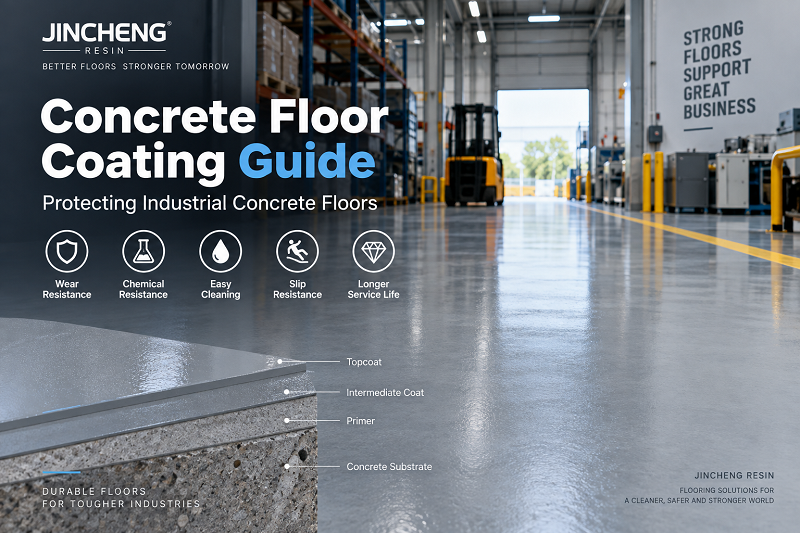
A coating isn’t a single layer of paint rolled onto a slab. Industrial systems are usually built from several layers designed to work together:
Primer → Base Coat → Optional Aggregate or Build Layer → Topcoat
The primer handles adhesion to properly prepared concrete. The base coat does most of the mechanical heavy lifting and builds film thickness. Quartz sand, decorative flakes, or other aggregates get added when the project needs more thickness, texture, decoration, or slip resistance. The topcoat protects everything underneath and can add UV stability, abrasion resistance, or easier cleanability, depending on the formulation.
This is exactly why comparing suppliers by price per kilogram misses the point — buyers should be evaluating the whole system, not one ingredient in it.
The Main Coating Technologies
Epoxy Floor Coating
Epoxy floor coating is still the default choice for a lot of industrial concrete, and there’s a reason it hasn’t been displaced. It bonds well, cures hard, builds thickness easily, and works with most flooring designs — warehouses, manufacturing plants, workshops, production floors, storage rooms, you name it.
It also takes well to quartz aggregate, colored sand, or decorative flakes when a thicker or more decorative finish is the goal.
The catch is UV stability. Standard epoxy formulations tend to yellow with prolonged sun exposure. Indoors, this rarely matters. Near loading docks or partially outdoor spaces, it’s worth thinking about a different finish coat.
Polyurethane Floor Coating
Polyurethane floor coating usually shows up as a topcoat over epoxy rather than as a standalone system. Depending on the formulation, it can add abrasion resistance, flexibility, chemical resistance, and general surface toughness.
An epoxy-plus-polyurethane system gives you epoxy’s build and adhesion combined with polyurethane’s surface performance — which is why the pairing is so common in demanding facilities.
Polyaspartic Floor Coating
Polyaspartic floor coating has picked up momentum where fast turnaround and UV stability actually matter to the project. Compared to conventional epoxy, polyaspartic systems can dramatically cut return-to-service time, and aliphatic formulations hold their color under UV exposure far better than standard epoxy does.
It’s a natural fit for warehouses that can’t afford long shutdowns, garages, showrooms, service bays, sun-exposed areas, and fast-track renovations. It can also function as a topcoat over a compatible epoxy or other base layer.
That speed comes with a tradeoff, though. Fast curing means less working time on-site, so prep work, mixing, crew coordination, and site conditions all need tighter management than a slower-curing system would demand.
Epoxy vs. Polyurethane vs. Polyaspartic
No single technology wins across every category — the right pick depends entirely on the operating environment.
| Requirement | Epoxy | Polyurethane | Polyaspartic |
|---|---|---|---|
| Adhesion to prepared concrete | Excellent | System-dependent | Excellent with suitable system |
| High-build capability | Excellent | Usually used thinner | Moderate, system-dependent |
| Abrasion resistance | Good to excellent | Very good | Very good |
| UV stability | Limited for many formulations | Good | Excellent for aliphatic systems |
| Cure speed | Moderate | Moderate | Fast |
| Decorative systems | Excellent | Good | Excellent |
| Typical role | Primer/base/build coat | Topcoat | Topcoat or complete fast-cure system |
In practice, most industrial flooring systems don’t pick just one of these — they combine them. An epoxy primer and build coat handle adhesion and thickness, while a polyurethane or polyaspartic topcoat carries the final surface performance.
Choosing the Right Coating: Start With the Floor, Not the Chemistry
Traffic level. A quiet storage room and an active warehouse with loaded forklifts running all day are not remotely comparable. Look at foot traffic, forklift frequency, wheel type, vehicle weight, turning zones, loading areas, and how much impact the floor actually takes. Heavier traffic usually means more thickness, aggregate reinforcement, or a tougher topcoat.
Chemical exposure. Don’t settle for “chemical resistant” as a spec. List out what actually touches the floor — motor oil, hydraulic fluid, detergents, acids, alkalis, solvents, salt — and check that list against the manufacturer’s chemical resistance data before committing to anything.
Moisture. Figure out early whether moisture could undermine the system, especially on older concrete or slabs on grade. If vapor transmission is a concern, that likely means additional testing plus a compatible moisture-control primer or vapor barrier. Skipping this step is one of the costliest mistakes in the industry — and it usually shows up months after the project is considered finished.
UV exposure. Indoor warehouses with minimal sunlight can generally run standard epoxy without issue. Loading docks, large doors, exterior entrances, and semi-outdoor spaces see far more UV, and that’s where a UV-stable polyurethane or polyaspartic topcoat earns its keep.
Downtime. Sometimes the cost of being closed outweighs the cost of the flooring material itself. A conventional system may need several application and curing stages before traffic can resume. If the facility can’t afford to be shut for long, fast-curing options like polyaspartic are worth a serious look.
Slip resistance. A high-gloss floor photographs well but may not hold traction once it’s wet or contaminated. Aggregate can adjust surface texture, but there’s a balance to strike — more texture means better grip and a harder floor to clean.
Surface Preparation Matters More Than the Coating Itself
Even a top-tier coating fails on poorly prepared concrete. This step gets skipped or rushed more often than it should, and it’s usually the first thing to blame when a floor starts peeling.
The slab needs to be structurally sound and free of anything that could interfere with adhesion. Depending on the project, that might mean diamond grinding, shot blasting, stripping old coatings, removing oil and contaminants, repairing cracks, treating joints, profiling the surface, or simply removing dust. Mechanical preparation is the industry standard for a reason — it strips away weak surface material and creates a profile the coating can actually grip.
Why Floor Coatings Fail
Most failures aren’t caused by one single mistake — they’re usually a mix of substrate, application, environmental, and product-selection problems layered on top of each other.
Peeling or delamination often traces back to inadequate prep, contamination, moisture, or weak bonding between layers. Bubbles and blisters can come from moisture, air movement through porous concrete, poor application conditions, or gas escaping the slab itself. Uneven curing usually means wrong mixing ratios, poor mixing technique, low temperatures, or materials that were never compatible in the first place. Premature wear points to a coating that was too thin or never designed for the traffic it actually got. And yellowing is the classic sign of conventional epoxy meeting UV exposure it wasn’t built to handle.
How Thick Should the Coating Be?
There’s no universal number here. Thickness depends on traffic, substrate condition, impact exposure, chemical load, and which system you’re using. A light-duty area might need only a thin protective film; a heavy manufacturing or warehouse floor often needs a multi-layer build with considerably more thickness.
Rather than shopping on thickness or price alone, a better question is: what service conditions is this floor actually designed to withstand? That answer tells you far more than a number on a spec sheet.
Where These Systems Get Used
Warehouses need abrasion resistance for forklift and pallet traffic. Manufacturing plants need durability built around mechanical and chemical exposure specific to the process. Automotive workshops need resistance to oils, fluids, tire traffic, and frequent cleaning. Commercial spaces lean toward decorative, low-maintenance finishes where appearance carries weight. Parking facilities need durability plus traction for vehicles. Showrooms want a smooth, high-gloss look. Food and beverage facilities need seamless systems built around strict cleaning protocols.
The point across all of these: match the system to the actual use case, not a generic industry template.
Keeping a Coated Floor Working Long-Term
Even a well-installed floor needs routine maintenance. Dust, sand, and metal particles should be cleared regularly, since abrasive debris under wheel or foot traffic accelerates wear faster than most people expect. Spills need prompt cleanup, especially with harsher chemicals involved, and high-traffic zones deserve periodic inspection so localized wear gets caught before it spreads. A reasonable maintenance program covers routine sweeping, appropriate wet cleaning, fast spill response, crack and joint checks, and renewing the topcoat when it’s due.
Choosing a Manufacturer
For distributors, contractors, and industrial buyers, picking a supplier shouldn’t come down to price alone. A dependable floor coating manufacturer should hand over the technical information needed to judge whether a system actually fits the project — Technical Data Sheet, Safety Data Sheet, recommended thickness, mixing ratio, pot life and working time, cure and recoat windows, substrate prep requirements, chemical resistance data, application temperature range, compatible primer/topcoat pairings, and ideally a sample to test. For larger projects, testing the full system under real site conditions before full-scale installation is worth the extra time.
Building the Right System for Your Floor
Protecting industrial concrete isn’t really about picking epoxy, polyurethane, or polyaspartic in isolation — it’s about understanding the floor first. What traffic will it see? What chemicals will touch it? Is moisture a concern? Will sunlight reach it? How fast does the facility need to be back in operation? How much traction does the job actually require?
Once those answers are clear, the coating system can be built around them. Epoxy still does the heavy lifting as a base and build coat in most projects. Polyurethane adds a durable finish. Polyaspartic earns its place where speed and UV stability matter. And in a lot of real-world projects, the best answer isn’t one resin type — it’s a combination.
For warehouses, factories, workshops, and commercial spaces, a properly specified concrete floor coating system reduces wear, simplifies upkeep, improves appearance, and stretches the life of the concrete underneath it. The real work is treating prep, system compatibility, installation, and maintenance as equally important — not as afterthoughts to the coating choice itself.