


Every epoxy floor coating quote looks the same at first glance — a number per square foot. But two contractors can walk the same warehouse and come back with prices $3 apart, and neither one is lying. The gap lives in what’s underneath the slab, what’s written into the scope, and what gets discovered once grinding starts.
Here’s the real breakdown of epoxy floor coating cost — material, labor, and the line items nobody puts on page one of the quote.
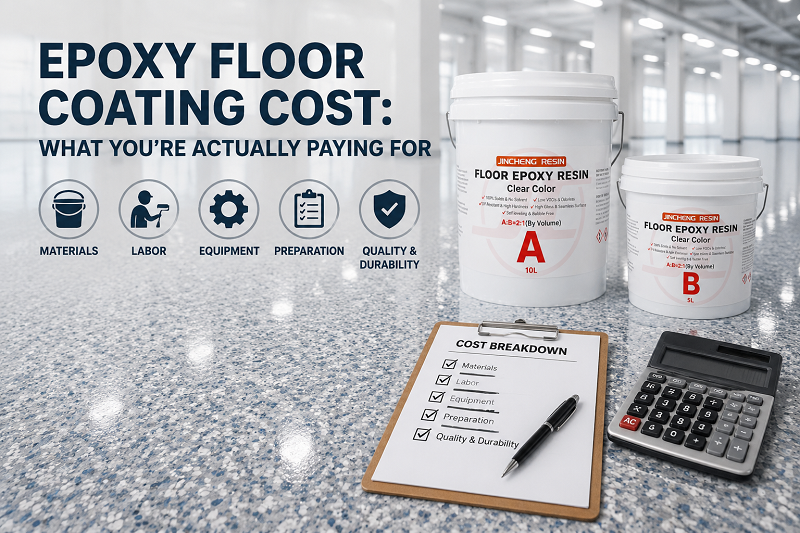
The Baseline: What Most Epoxy Floor Coating Quotes Actually Show
Pricing for a standard 2-3 coat epoxy floor coating system, on a properly prepped concrete floor, typically lands somewhere in these ranges:
- Basic epoxy coating (1-2 coats, no broadcast): $3–$7 per sq ft
- Flake or quartz broadcast system: $5–$12 per sq ft
- Metallic epoxy or decorative systems: $8–$15 per sq ft
- Industrial-grade heavy-duty systems (high-build, chemical-resistant): $7–$14 per sq ft
So a 2,000 sq ft garage or workshop floor can run anywhere from $6,000 to $30,000, and that spread is really the whole problem with shopping by price-per-square-foot alone. The number on its own tells you almost nothing until you know which system it’s attached to.
Material Cost: Where the Resin Formula Actually Matters
Resin isn’t quite the commodity people assume it is. Solids content, filler ratio, and pot life all move the price of an epoxy floor coating — and they move the performance right along with it.
- 100% solids epoxy costs more per gallon than water-based or high-solvent formulas, but it lays down thicker in a single coat and cures harder. You’re effectively paying for fewer coats, not more coating.
- Low-VOC and zero-VOC formulations carry a premium mostly because of regulatory testing and raw material sourcing, not because they outperform standard resin. Facilities operating under EPA or REACH restrictions don’t really get to treat this as optional, so it belongs in the initial budget rather than showing up later as a surprise add-on.
- Moisture vapor barrier primers add roughly $0.50–$1.50 per sq ft. Skip this step on a slab with a known vapor issue, though, and delamination within the first year is close to guaranteed. Specifying it upfront is cheaper than redoing the whole floor.
Distributors and installers buying epoxy floor coating material in bulk rather than at retail see a different math entirely. Sourcing direct from a manufacturer, instead of through a distributor layer, typically cuts material cost by 15-30% — which is roughly the point where OEM and private-label sourcing starts making financial sense at volume.
Labor: The Line Item That Actually Moves the Total
Material rarely blows a budget. Labor does, and prep work eats most of that labor cost.
- Diamond grinding vs. acid etching: grinding runs $1–$3 per sq ft more than etching, but it’s the only prep method that reliably opens up the pore structure on dense or previously sealed concrete. Etching is cheaper — and on the wrong substrate, close to useless. You end up paying for it twice once the coating fails.
- Crack repair and joint filling: figure $3–$8 per linear foot, though nobody actually knows the real number until the old coating or paint has been stripped and the bare slab is visible.
- Multi-day cure windows: systems that need 24-72 hours between coats stretch out labor scheduling, and on commercial jobs where crews bill by the day rather than by the task, that stretch shows up directly on the invoice.
This is usually how a $4/sq ft epoxy floor coating estimate turns into a $9/sq ft invoice — not because anyone inflated the number, but because the slab told a different story once it was opened up.
The Hidden Costs Most Quotes Leave Out
- Moisture testing. A calcium chloride or RH probe test runs $150–$400, and it tells you whether a vapor barrier is needed before you’ve committed to a full system. Skipping it is probably the single most common reason epoxy floor coating jobs fail within the first year.
- Old coating removal. Stripping a failed paint or epoxy layer adds $2–$5 per sq ft on top of standard prep. Renovating an old floor over an unknown substrate almost always ends up costing more than starting from bare slab.
- Downtime. On a working warehouse or production floor, the real expense usually isn’t the coating itself — it’s the days the facility sits idle. A fast-cure polyaspartic topcoat costs more per gallon than standard epoxy, but it can compress downtime from a week down to a single day, and that’s fundamentally a labor argument, not a materials one.
- Climate-driven rework. Install outside the right temperature or humidity window and you get blushing, weak adhesion, or drawn-out cure times. Rework almost always costs more than simply waiting for the right weather window in the first place.
What Actually Sets Your Number
Three factors decide where a given epoxy floor coating project lands within these ranges more than anything else does:
- Substrate condition — a clean, dry slab that’s never been coated is about as cheap as this gets. Nearly everything else adds cost from there.
- Traffic and chemical exposure — a light-traffic showroom floor and a forklift aisle in a chemical plant aren’t the same project, even at identical square footage.
- System complexity — every additional layer, whether primer, body coat, broadcast, or topcoat, adds both material and labor cost. It’s also what buys extra years of service life. A cheap, thin system rarely stays cheap over a five-year horizon.
The Bottom Line for Buyers
When comparing quotes, don’t just compare the per-square-foot figure in isolation. Look at what system it actually buys, what prep is included, and whether moisture testing and repairs are itemized or quietly folded into the total. A $5/sq ft epoxy floor coating quote that skips moisture testing on a slab-on-grade floor isn’t really cheaper than a $7/sq ft quote that includes it — it’s a floor that fails in eighteen months and gets redone at full price anyway.
For distributors and facility buyers sourcing at volume, the real savings on epoxy floor coating cost usually come from working directly with a manufacturer that controls its own resin formulation, rather than reselling a blended, unlabeled product — and doing that without cutting corners on solids content or cure performance.