



Not every floor needs the same epoxy system. A warehouse with light foot traffic and a food processing plant running daily hot-water washdown want completely different things from a coating, and self-leveling epoxy is usually the industry’s answer for the cases that fall somewhere in between — a system that gets mentioned constantly on quotes but rarely gets explained to the people actually paying for it.
Here’s what a self-leveling epoxy flooring system actually is, when it’s worth specifying, and what it costs against the alternatives.
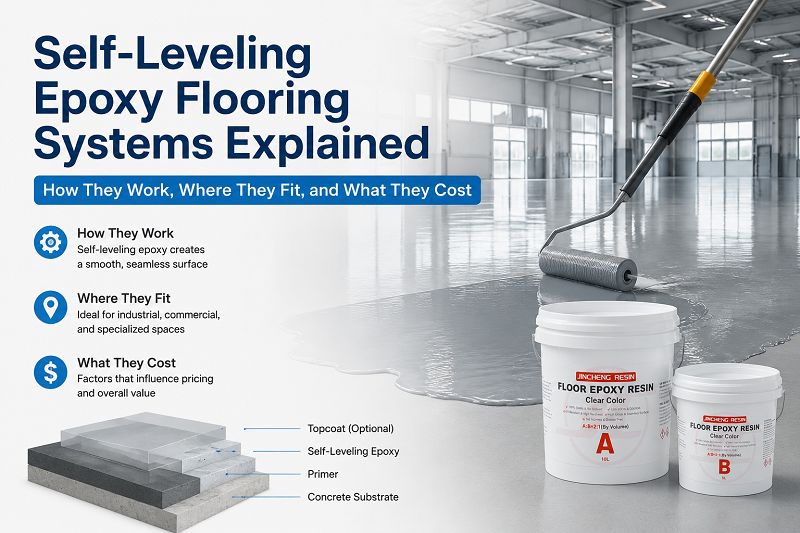
What “Self-Leveling” Actually Means
The name describes what happens during application, not just the finished look. Self-leveling epoxy is formulated at a lower viscosity than standard coating-grade epoxy, so once it’s poured onto the substrate, it spreads out under its own weight and settles into a flat plane — even over minor dips, low spots, and the small irregularities that show up in almost any concrete slab.
A standard roll-applied epoxy coating doesn’t do that. It follows whatever contour is already there. Roll a coating over an uneven slab and the slab is still uneven underneath — just glossier. Self-leveling material corrects for that, within reason. It bridges minor undulations well, but it’s not a stand-in for real substrate repair on a floor with actual structural damage.
Most self-leveling systems get poured at 1.5-3mm, spread with a notched squeegee or gauge rake to hold thickness, then rolled with a spiked roller to work out trapped air before curing starts. What’s left is a seamless, glass-smooth surface without the roller marks or texture variation you’d get from a standard coating.
Where It Actually Earns Its Cost
Load distribution. A flat, monolithic surface spreads point loads more evenly than a rolled coating sitting on an uneven substrate. That matters anywhere with racking, forklift traffic, or heavy equipment on casters, since uneven load-bearing points wear faster and can eventually cause localized problems in the substrate itself.
Hygiene and cleanability. No joints, no pinholes, no texture variation — nowhere for bacteria, moisture, or residue to collect. That’s the main reason self-leveling epoxy shows up so often in food and beverage plants, pharmaceutical manufacturing, and cleanrooms, where hygiene isn’t negotiable.
A more consistent look. In retail, showroom, and office settings, a smooth high-gloss finish just reads as more premium than something textured or marked by a roller. Pigments and metallic additives also spread more evenly in a self-leveling mix, so color and depth stay consistent across large floor areas instead of varying by section.
Chemical and abrasion resistance. Once cured, it holds up about the same as other epoxy systems against chemicals and abrasion — the self-leveling property is about how it’s applied and how it finishes, not a different resin chemistry underneath.
Where It Falls Short
This isn’t the right system everywhere. A few limits worth knowing before it gets specified:
The substrate has to be reasonably sound to begin with. Deep spalling, exposed aggregate, major surface damage — that needs an epoxy mortar screed first. Self-leveling epoxy fills minor imperfections. It doesn’t fix structural ones.
It’s also more sensitive to moisture than some other systems. Because it’s poured to a controlled thickness and flows before it sets, elevated moisture vapor coming up through the slab can cause pinholing or outgassing during cure. Moisture testing before installation isn’t something to skip here.
It uses more material than a standard rolled coating at the same square footage too, since it has to be poured to a consistent minimum thickness across the whole floor rather than rolled thin over high spots. That difference shows up directly in the material cost line.
And without aggregate broadcast into the surface, a self-leveling epoxy finish is naturally slick when wet — worth factoring in for any facility with washdown routines or a real chance of spills.
Self-Leveling vs. Standard Roll-Applied Epoxy
| Factor | Self-Leveling Epoxy | Standard Roll-Applied Epoxy |
|---|---|---|
| Finish | Seamless, flat, high-gloss | Follows substrate contour |
| Typical thickness | 1.5-3mm | 150-300 microns |
| Best for | Hygiene-critical, aesthetic, load distribution | General protective coating, budget-driven |
| Material cost | Higher (more product per sqm) | Lower |
| Substrate tolerance | Needs reasonably sound base | More forgiving of minor imperfections |
| Slip resistance | Low unless aggregate added | Can be textured more easily |
What It Costs, and Why
Self-leveling epoxy usually runs higher per square meter than a standard rolled coating, for two fairly simple reasons: it takes a lot more material per square meter because of the controlled minimum thickness, and it’s harder to install correctly — it needs applicators who know what they’re doing, working within the resin’s pot life to pour, spread, and de-air the material before it starts to set.
Against that higher upfront number, the system tends to last longer in demanding environments, mostly because there’s no seam or joint to fail — which is usually where a standard coating starts breaking down first. In facilities where downtime for recoating is expensive — food processing lines, pharmaceutical plants, cold storage running on tight schedules — the total cost of ownership often still favors self-leveling epoxy, even with the higher install cost.
Where This System Makes the Most Sense
Food and beverage processing facilities, where a seamless, easy-to-sanitize surface is close to a regulatory expectation rather than just a nice feature.
Pharmaceutical and cleanroom environments, where particulate control and surface hygiene rules rule out anything with joints or texture variation.
Warehouses and distribution centers with racking systems, where a flat, level floor cuts down on uneven wear from concentrated point loads.
Showrooms, retail spaces, and commercial lobbies, where the high-gloss, seamless finish is doing as much for the design as it is for function.
Laboratories and light manufacturing, where chemical resistance and an easy-to-clean, monolithic surface both actually matter.
Sourcing a Self-Leveling System
Formulation quality matters more here than with most other coating types, because the resin’s flow characteristics, pot life, and cure profile all have to be tuned correctly — otherwise the product pools, drags, or cures with visible ridges instead of actually self-leveling. A poorly formulated system puts every application flaw on full display.
Jincheng Resin formulates self-leveling epoxy systems for hygiene-critical and high-traffic commercial applications, with OEM and private-label programs available for distributors supplying food processing, pharmaceutical, and industrial clients. Reach out to our team for technical data sheets, pot life and cure specifications, or sample quantities for an upcoming project.