



In industrial production scenarios, the performance of floor coatings directly affects workshop safety, production efficiency, and maintenance costs. With core advantages of wear resistance, compression resistance, dustproofing, and corrosion resistance, epoxy floor coatings have become the preferred material for industrial floors, widely used in factories, warehouses, parking lots, electronics plants, food factories, pharmaceutical workshops, and other places. As different industrial environments have different requirements for floor performance, there are various types of industrial epoxy floor coatings. Below are several common and high-performance industrial epoxy floor systems.
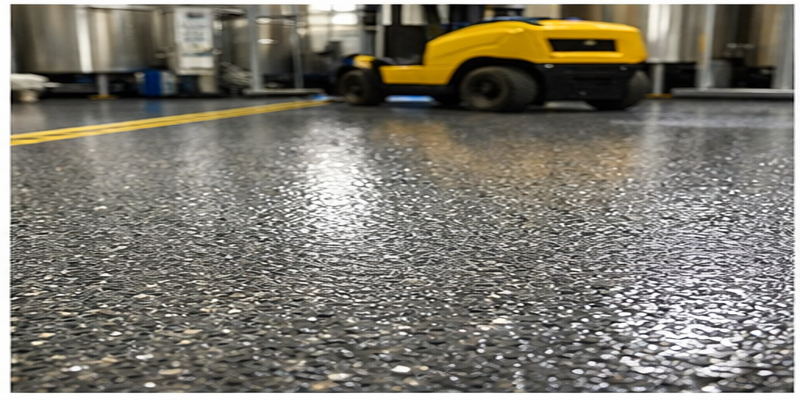
1. Epoxy Colored Quartz Sand Floor Coating
Epoxy mortar flooring is a thick-film floor system made by adding colored quartz sand to epoxy resin, with a total thickness generally ranging from 1–3 mm. Compared with ordinary thin-coat flooring, epoxy mortar flooring has better wear resistance, impact resistance, and load-bearing capacity. It is suitable for machining workshops, logistics warehouses, heavy equipment areas, and places with frequent forklift traffic. The quartz sand reinforces the coating structure, effectively enhancing strength and durability, making it a commonly used floor system in industrial environments.
2. Epoxy Anti-Static Floor Coating
In industries such as electronic manufacturing and precision instrument production, static electricity can severely damage equipment and products, so anti-static epoxy flooring is required. By adding conductive materials, this floor can effectively discharge static electricity to protect electronic components and equipment. In addition to anti-static function, it also inherits the wear-resistant, dustproof, and corrosion-resistant properties of ordinary epoxy flooring, widely used in electronics plants, computer rooms, communication equipment workshops, and other places.
3. Epoxy Anti-Slip Floor Coating
Slip resistance is particularly critical in wet or oily industrial environments. Epoxy anti-slip flooring is made by adding anti-slip particles or quartz sand into the coating to create a slightly rough surface, thus improving slip resistance. This floor is suitable for food processing plants, cold storage, underground parking lots, ramps, and loading/unloading areas. It improves safety and effectively reduces slip-and-fall accidents.
4. Epoxy Thin-Coat Floor Coating
Epoxy thin-coat flooring is the most common type of industrial flooring (low cost, easy construction), usually composed of primer, intermediate coat, and top coat, with a total thickness of about 0.3–0.8 mm. It features simple construction, low cost, good dustproofing, moisture resistance, and decorative effect. With a smooth and level surface that is easy to clean, it is suitable for general industrial plants, warehouses, light industrial workshops, and parking lots. For areas with light load and moderate wear resistance requirements, epoxy thin-coat flooring is a highly cost-effective choice.
5. Summary
When selecting industrial epoxy floor coatings, we must consider the actual environment: heavy load, chemical corrosion, humidity, frequent forklift or heavy equipment traffic, slip resistance, static control, as well as budget and construction period. By balancing performance and practicality to choose the most suitable floor type, we can create a durable, safe, and attractive industrial flooring system.