



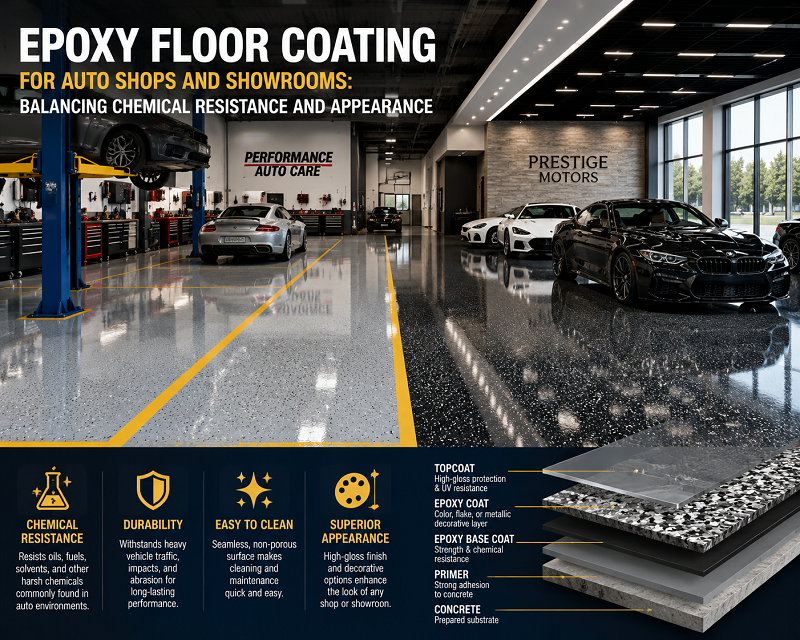
A service bay and a showroom sit at almost opposite ends of what a floor has to do, yet plenty of dealerships and repair chains still want both spaces to feel like they belong to the same brand. That tension — chemical-resistant workhorse on one side, showroom-grade finish on the other — drives most of the epoxy floor coating decisions in this sector. Worth understanding both sides before anything gets specified.
What a Service Bay Actually Has to Survive
Automotive service floors take a chemical beating most commercial spaces never see. Motor oil, brake fluid, transmission fluid, antifreeze, gasoline, various solvents — all of it gets dripped, spilled, and tracked across the floor on a daily basis. Each of those has its own chemical profile, and resisting one doesn’t mean an epoxy floor coating automatically resists the rest.
Standard epoxy holds up fine against oils and a lot of solvents, but brake fluid is a different animal — glycol-based, highly penetrating, and one of the more aggressive substances a shop floor deals with regularly. Left sitting on an underspecified coating, it can soften or discolor the surface within hours. Antifreeze carries a similar risk on lower-grade coatings.
Beyond the chemicals, there’s constant mechanical stress to deal with too — rolling jacks, equipment on casters, dropped tools, vehicles tracking grit and small stones in on their tires every time they pull in. That combination of chemical exposure plus abrasion is exactly why a standard decorative epoxy floor coating, the kind that’s perfectly fine in a retail space, tends to fail early once it’s actually working in a bay.
Temperature swings matter here too, especially in shops with big overhead doors that stay open during the day. A floor near the bay door deals with a much wider daily temperature range than one thirty feet away in a climate-controlled showroom, and the coating needs enough flexibility to handle that without cracking at the transition points.
What a Showroom Needs Instead
A showroom floor’s job is almost the opposite: it’s selling the brand as much as protecting the concrete underneath it. Dealerships especially treat the showroom floor as part of the retail experience — high-gloss, reflective, consistent color across a large open space, because a car sitting on a mediocre floor somehow looks cheaper than it is.
Foot traffic is lighter than a service bay and chemical exposure is minimal, mostly cleaning products rather than anything automotive — which changes what the epoxy floor coating actually needs to do here. But appearance standards run much higher. Color consistency, gloss level, and a genuinely flat surface — self-leveling epoxy shows up a lot here — all matter more than raw chemical resistance ever would.
Metallic epoxy and decorative flake systems get used often in showrooms because they read as premium without the cost of natural stone or polished concrete, and they tie the floor into whatever brand palette the dealership is running.
Where the Two Systems Actually Split
The practical formulation differences between the two epoxy floor coating systems come down to a handful of things.
Chemical resistance profile is the big one. Bays need something formulated specifically for automotive fluids — a chemical-resistant epoxy or novolac epoxy blend handles brake fluid, antifreeze, and solvents noticeably better than a standard decorative epoxy built mostly for foot traffic and light cleaning agents.
Film build and durability differ too. Bay floors generally want a thicker build — often a high-build epoxy or an epoxy-polyurethane hybrid topcoat — to hold up against rolling equipment and mechanical wear. Showroom floors can run thinner, since the loads are lighter and appearance carries more weight than sheer toughness.
Slip resistance versus gloss is another split. Bays usually get some texture or aggregate broadcast into the finish for traction, since oil and coolant spills on a slick floor are a real hazard. Showrooms lean the other way, toward smooth, high-gloss finishes, since conditions stay drier and looks matter more.
Color and UV stability separate them further. Showroom floors near large glass frontage need UV-stable topcoats — usually polyurethane or aliphatic urethane — to avoid yellowing under constant sun. Bays, often more enclosed or shaded, don’t always face the same UV exposure, though anything with large open bay doors should still get specified with that in mind.
Where OEM Formulation Comes In
Plenty of multi-location dealership groups and repair chains want one branded flooring standard across every site — same color, same gloss, same chemical performance — installed by different regional contractors on completely different timelines. That’s the gap OEM and private-label flooring programs fill: the same base formulation goes out under the operator’s own branding and spec sheet, so the floor at one location performs identically to the one three states over, without every site reinventing the specification each time it renovates or opens somewhere new.
This matters more in automotive than in a lot of other commercial sectors, honestly, because brand consistency is part of the customer experience at a dealership. Inconsistent flooring quality between locations is a subtle but real signal that standards aren’t being held the same way everywhere.
A Practical Approach for Mixed-Use Facilities
Most dealerships and larger repair shops aren’t one type of space — they combine a service area, a showroom, often a waiting area or parts counter, all under one roof with completely different flooring needs. A few things that tend to work well:
Match the system to the zone rather than the whole building. Chemical-resistant epoxy-polyurethane hybrid in the bays, self-leveling or flake epoxy in the showroom, tied together with consistent color and a clean threshold transition — that gives each zone what it actually needs instead of over- or under-specifying either one.
Use transition strips or color banding at the zone boundaries. Rather than forcing one system to do two jobs badly, a clear visual and physical break between showroom and service area actually reads as more intentional than a single uniform floor that compromises everywhere.
Specify for the worst-case chemical exposure, not an average day. A shop that occasionally does transmission or diesel work should specify for that, not for routine oil changes — underspecifying to save money upfront usually just means an earlier recoat.
Build in slip resistance anywhere floors get wet or oily, even areas that look mostly dry most days. The liability side of slip-and-fall in service areas is real, and a lightly textured or aggregate-broadcast finish costs very little relative to the risk it manages.
What Epoxy Floor Coating Costs in This Sector
Chemical-resistant systems for bays typically run more per square meter than standard decorative epoxy — mostly because of the specialized resin chemistry (novolac epoxy or epoxy-polyurethane hybrids) needed to handle automotive fluids specifically. Showroom-grade decorative systems — metallic epoxy, flake broadcast, high-gloss self-leveling — carry a premium too, but for different reasons: material cost on decorative additives, plus the labor skill it takes to get a flawless, seamless look.
For operators running multiple locations, sourcing OEM or private-label at volume usually brings the per-unit cost down noticeably compared to buying standard retail-branded product site by site — and it solves the brand consistency issue at the same time.
Sourcing Epoxy Floor Coating for Automotive Applications
Getting both sides right — the industrial performance a bay demands and the retail-grade finish a showroom needs — usually comes down to working with a supplier that formulates across the full range rather than one that only does a single type of system well.
Jincheng Resin formulates chemical-resistant epoxy and epoxy-polyurethane hybrid systems for service bay applications, alongside self-leveling and decorative epoxy systems for showroom and retail spaces, with OEM and private-label programs available for dealership groups and repair chains standardizing flooring across multiple locations. Reach out to our team for technical data sheets, chemical resistance test data, or sample quantities for an upcoming project.