



Sourcing epoxy floor coating from a new supplier is a bigger commitment than it looks like on paper. A bad batch of resin doesn’t just cost the material — it costs the installer’s labor, the customer relationship, and often a warranty claim that lands back on the distributor’s desk months after the invoice was already paid. For anyone buying at volume, vetting a supplier properly up front is a lot cheaper than fixing a bad one later.
Here’s what actually matters when evaluating an epoxy floor coating supplier, beyond whatever number shows up in the first email.
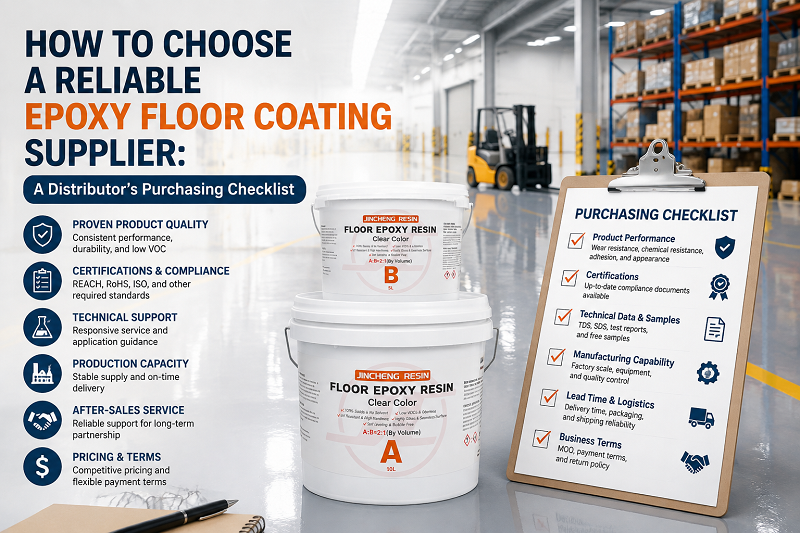
Start With the Paperwork
Ask for real technical data sheets, not marketing brochures. A legitimate supplier can produce a TDS for every product — compressive strength, pot life, cure time, VOC content, recommended film thickness — with actual tested numbers, not vague ranges that read more like guesswork. If a supplier can’t produce this on request, that’s usually the whole conversation right there.
Check for the relevant quality and environmental certifications too. ISO 9001 for quality management and ISO 14001 for environmental management are close to baseline for any serious manufacturer. For export markets specifically, it’s worth asking directly whether products meet destination-market requirements — VOC limits under California’s SCAQMD/CARB rules, REACH compliance for the EU, or the equivalent standards in Australia and the UK.
And ask for third-party test reports, not just whatever data the supplier generated in-house. In-house testing tells you what the manufacturer claims about their own product. Third-party lab verification — compressive strength, abrasion resistance, chemical resistance — tells you whether those claims actually hold up under someone else’s scrutiny. A supplier confident in their own formulation usually won’t hesitate to hand this over.
Look Past the Product Catalog at Actual Manufacturing Capability
Visit the factory if you can, or get an honest video walkthrough if travel isn’t in the cards. A supplier’s real production floor tells you more than any glossy catalog ever will. Look for organized raw material storage, QC lab equipment that’s actually being used, and batch labeling that’s consistent — not just a warehouse stacked with finished drums and not much else.
Ask specifically about production capacity against your real order volume, not a generic figure. A supplier who can turn out a beautiful small sample batch but has never actually run production at your order size is a genuine risk. Get specifics — monthly capacity, how much of that capacity is already committed elsewhere, and what happens if your order volume jumps unexpectedly.
It also helps to understand what they actually manufacture versus what they’re reselling. Some “manufacturers” are really repackaging operations, buying bulk resin from somewhere else and putting their own name on the drum. That’s not automatically a dealbreaker, but you need to know which one you’re actually dealing with — formulation control and batch consistency look very different between the two.
Test for Consistency Before Committing to Real Volume
Order samples from more than one production batch. A single sample that performs well tells you almost nothing about whether the supplier’s process is actually consistent run to run. Ask for product from two or three separate batch runs, spaced a few weeks apart, and test all of them against the same criteria.
Run your own application test rather than trusting a lab data sheet alone. Numbers on paper and how a product actually behaves during application — working time, self-leveling behavior, how it cures in your specific climate — don’t always line up. A real test pour by an actual installer catches things a spec sheet simply won’t show.
Check color and gloss consistency batch to batch as well, especially with decorative epoxy systems. Drift between batches is a common quality issue that’s genuinely hard to catch from a single sample and expensive to discover only after a large order has already shipped.
Get Clear on OEM and Private-Label Capability
Clarify MOQ up front, and ask directly whether it’s negotiable for a first order. Suppliers vary a lot here — some will run a smaller trial batch for a new distributor relationship, others won’t budge below a fixed volume no matter how promising the relationship looks.
Ask specifically what kind of customization is actually available, not just whether they “can do private label.” Can they adjust the formulation for your target market’s climate? Modify VOC content to meet local regulations? Change color, viscosity, or cure speed within a reasonable range? A supplier that only swaps labels on a fixed formulation offers a lot less than one that actually flexes on the formula itself.
Get clarity on lead time for both first orders and reorders — these are rarely the same number, and treating them as one figure leads to scheduling problems. First-order lead time, which includes formulation adjustment and initial production setup, usually runs longer than distributors expect going in. Reorder lead time, once the formulation is locked in, should be noticeably shorter — worth asking for both figures separately rather than one blended estimate.
Understand their packaging and labeling capability too. Can branded packaging be produced in-house, or does that step get outsourced to a third party? Every extra link in the supply chain is another point where delays or quality inconsistency can creep in.
Ask What Happens After the Sale
Confirm that technical support actually exists, not just a friendly sales contact. When an installer in the field runs into an application question or an unexpected cure issue, is there someone on the supplier’s side who can actually answer it in a reasonable amount of time? This tends to get glossed over during the sales conversation and matters enormously the first time something goes sideways on an actual job site.
Ask how warranty claims get handled in practice, and get it in writing before the first order goes out — not after a problem shows up. What’s covered, what isn’t, what documentation gets required, and what the resolution process actually looks like end to end.
Pay attention to communication responsiveness before you’re locked into anything. How fast does the supplier respond to a technical question during the sampling phase? That speed rarely improves once you’re a committed customer — if anything, it’s usually the best preview available of how support will work down the line.
Warning Signs Worth Taking Seriously
Reluctance to hand over real technical data or third-party test reports is a big one. Legitimate suppliers don’t guard basic performance data — that’s exactly the information buyers need to make a purchasing decision in the first place.
Prices well below market average with no clear explanation deserve a second look too. Sometimes it really is genuine cost efficiency. More often it’s a shortcut somewhere — thinner film build than what’s stated, cheaper filler content, resin that won’t actually hold up to the specifications on the sheet.
No consistent point of contact, or communication that routes through a different person every time, is another flag. That usually signals either a disorganized operation or a trading company standing in for an actual manufacturer.
And unwillingness to discuss certifications or compliance for your target export market is worth taking seriously on its own. If a supplier can’t speak clearly to VOC limits, REACH compliance, or whatever regulatory requirements apply at the destination, that gap becomes the distributor’s problem the moment a shipment gets held at customs or a customer’s compliance audit flags it.
Keeping the Relationship Honest After the First Order
Vetting doesn’t really end once the first shipment goes out. A few things worth tracking through the first year with a new supplier:
Whether batch-to-batch consistency holds up once production ramps to full volume, not just during the initial sample and trial orders.
Whether lead times stay accurate as order volume grows, or whether they quietly start slipping once the relationship feels settled.
Whether technical support stays as responsive after the sale as it was during sampling and negotiation, when everyone’s still trying to win the business.
A supplier that holds steady on all three across the first several orders is one worth building a longer-term sourcing relationship with — and honestly worth consolidating more volume behind, since concentrating orders with one reliable partner usually beats splitting them across several unverified sources.
What to Expect From Jincheng Resin
Jincheng Resin manufactures epoxy floor coating systems in-house, backed by documented technical data sheets, third-party tested performance data, and OEM/private-label programs built for distributors sourcing at volume for the US, Australian, Canadian, and UK markets. Get in touch with our team for technical data sheets, sample quantities, or a factory walkthrough before committing to a first order.