



Technically, there is no problem in applying the cement waterproof coating directly to the existing tiles, provided that the substrate is subjected to thorough mechanical surface preparation. Application of waterproofing products directly onto a smooth, glazed tile surface will definitely result in poor adhesion properties, intercoat delamination, and water leakage problems in the long run. The cement-based waterproofing products depend entirely on the porosity of the concrete for achieving good mechanical bonding. Since the water absorption capacity of the vitrified tiles is generally less than 0.5%, the coating will not bond naturally to the substrate. However, proper surface preparation and application of a bonding primer, along with flexible polymer modification, will help in developing a waterproofing layer over the tiled surface.
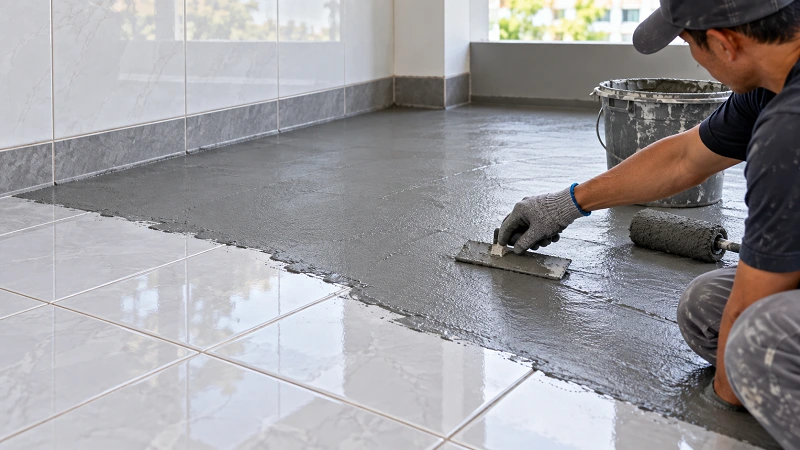
1.Why Does Applying Cement Waterproof Coating Directly Over Tiles Fail?
Absence of Mechanical Keying
Ordinary concrete surfaces are inherently porous and uneven, allowing the cementitious substance to penetrate and easily create a tensile bond strength of over 1.5 MPa. However, high-fired floor and wall tiles have a very dense and non-porous glazing layer. Once the cement waterproof coating is applied over the smooth tiles, the waterproofing will depend entirely on surface tension for holding on. As a result of continuous expansion and contraction, this thin layer will yield to the shearing forces and thus peel off.
Contaminated Grout Lines and Entrapped Moisture
The grout lines of existing tiles may be filled with oil, dirt, soap residues, or moisture. Unless the joints are degreased and completely dry, these contaminants create a barrier film, and the bonding strength of the area can be decreased by more than 80%.
Rigid Stress Fracturing
Tiled floors undergo micro-movements caused by environmental temperature fluctuations. Standard rigid cement mortars lack flexibility, often exhibiting an elongation at break of less than 5%. They cannot absorb substrate stress, which eventually leads to reflective cracking right along the underlying tile grout lines.
2.Four Essential Evaluation Criteria Before Direct Application
Before applying a cement waterproof coating over an existing tiled floor, you must evaluate the substrate against four technical benchmarks:
Hollow Sound Ratio: Total hollow area must be under 5%. Tested by tapping each tile with a hollow sound inspection hammer.
Surface Roughness: Complete removal of glaze to achieve 60-80 grit texture. Tested by mechanical grinding followed by visual and tactile check.
Substrate Moisture: Internal moisture content below 8%. Tested by digital pinless moisture meter testing.
Pull-off Bond Strength: Tile-to-bedding bond strength greater than 1.0 MPa. Tested by cross-cut adhesion or pull-off strength gauge test.
3.Professional 5-Step Application Method Over Tiled Substrates
In order to guarantee that your cement waterproof coating forms effective long-term protection for tiles, you need to follow the 5-stage standard procedure below:
Step 1: Thorough Cleaning and Degreasing
Clean the whole tiled surface with the help of a high-pressure cleaner and an alkaline degreasing agent. All traces of oil, limescale, and mold should be removed from the surfaces of the tiles and grout lines, and the surface needs to be thoroughly dried.
Step 2: Mechanical Profiling and Sanding
Profiling is carried out with the use of an angle grinder or sanding machine fitted with a dust extraction hood. The process of grinding will fully strip off the smooth glazing layer, and the rough ceramic base will become exposed.
Step 3: Application of a Special Bonding Primer
A layer of two-component modified resin primer (epoxy/acrylic emulsion) is evenly applied to the scuffed surface in order to form a strong chemical bond between the tile and the waterproofing layer.
Step 4: Cross-brush Coating Application
Coat two to three layers of cement waterproofing with the cross-brushing technique of applying perpendicular brush strokes. Ensure that each cement waterproof coating layer has a thickness of 0.8 to 1.0 mm, thus ensuring a minimum dry film thickness of 1.5 mm.
Step 5: Joint Strengthening and Drying/Curing
Install an alkali-resistant fiberglass mesh at high-stress areas like joints between walls and floors, around pipes, and open grout lines. Wait for 48 hours of damp curing and then conduct flood testing after 72 hours.
4.Rigid vs Flexible Cement Waterproofing: Which One Suits Tiles?
Selecting the right product type is vital for rigid and non-porous tile substrates. Commercial cement waterproofing products can be broadly classified as either rigid cement-based or flexible JS cement-based products.
Rigid Cement Waterproof Coating
- Properties: Composed mainly of special cements, quartz sand, and active inorganic chemicals. It boasts a compressive strength above 25 MPa, but features extremely low flexural strength and an elongation at break of less than 10%.
- Best Applications: Ideal for unyielding, non-deformable structures like bare cast-in-place concrete walls, underground retaining walls, and water tanks. It is prone to cracking if applied directly over tiled surfaces subject to thermal movement.
Flexible Cement Waterproof Coating
- Properties: Formulated by blending synthetic acrylic polymer emulsions with specialized cement powders. It achieves an impressive elongation at break of 80% to 200% and maintains a stable tensile strength between 1.5 MPa and 2.0 MPa.
- Best Applications: The elastic polymer network effectively bridges micro-cracks and absorbs thermal stress between tile joints, making it the superior choice for overlaying old tiles.
5.Conclusion
It is quite possible and effective to use a cement waterproof coating directly over existing tiles, but it all comes down to having a good process of surface preparation and choosing the right materials. Using hollow tile detection, glazing of the tiles, using a special bonding primer, and a polymer-modified cement waterproofing membrane will help you to create a waterproofing system without the need to remove the tiles.
Do not hesitate to contact JINCHENG for advice or any other information about the appropriate selection of waterproofing membranes and substrates!