



Most commercial flooring jobs don’t fail because the coating isn’t tough enough. They fail because the client can’t afford to shut down for three days while it cures.
A warehouse can’t stop shipping. A retail store loses money every hour the doors stay closed. Auto shops, showrooms, parking structures, restaurants — the floor needs work, but the business still has to run. That single constraint is why a fast-cure floor coating system, built around Polyaspartic Floor Coating, has moved from a niche upgrade to a standard ask on commercial bids.
Polyaspartic systems compress the application and return-to-service schedule well below what conventional multi-day epoxy systems require. Done right, a contractor can move through several coating stages in a fraction of the time a traditional job would take.
So the question buyers ask isn’t just “how durable is this floor” anymore. It’s “how fast do we get our building back.”
Why Installation Time Is Its Own Line Item
Flooring work is unusual because the space itself goes offline while the job happens. Once prep starts, that area is out of commission until the coating is down and cured enough to walk on.
An extra day in a residential garage is an annoyance. An extra day in a commercial facility is a number someone has to explain on a P&L. Customer access, production schedules, shipping and receiving, staff movement, equipment installs — all of it stops when the floor is wet.
That’s the part buyers miss when they compare coatings on price per square foot alone. Downtime is a cost, not a footnote. A cheaper coating that keeps a facility closed three extra days can easily end up the more expensive option once you add up what those days were worth.
What a Fast-Cure Floor Coating System Actually Delivers
“Fast curing” gets thrown around loosely, and it covers several distinct milestones that don’t move at the same rate:
- Pot life — how long the mixed material stays workable
- Tack-free time — when the surface stops being sticky
- Recoat time — when the next layer can go on
- Foot traffic — when people can walk on it
- Vehicle traffic — when it can take cars or forklifts
- Full cure — when it reaches final mechanical properties
A product can hit tack-free in under an hour and still need a full day before you drive a forklift over it. Anyone specifying a system should ask which of these numbers is being quoted, because “fast cure” on a spec sheet without context tells you almost nothing.
Why Conventional Epoxy Jobs Run Long
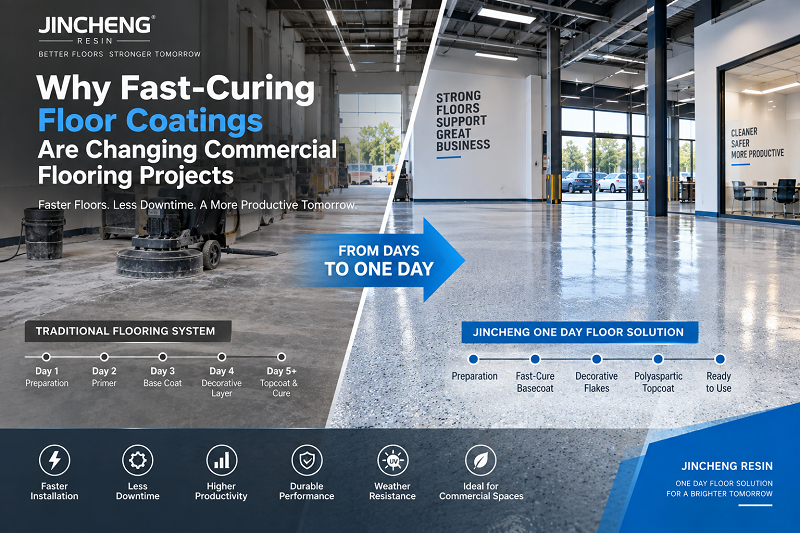
A standard resin floor typically runs through prep, primer, base coat, decorative layer, topcoat, and final cure — each step gated by its own waiting period. Depending on chemistry, temperature, humidity, and coating thickness, those gaps stack up fast.
None of this makes conventional epoxy a bad choice. Its adhesion, hardness, and build capability are hard to beat, and for jobs where shutdown time isn’t the constraint, it’s still often the right call. The tradeoff only matters when the client can’t spare the days epoxy typically needs — and that’s exactly where polyaspartic chemistry earns its premium.
Where Polyaspartic Floor Coating Fits
Polyaspartic coatings are built on polyaspartic ester chemistry, and they’re chosen specifically where rapid cure, toughness, and UV stability all matter at once. Recoat and return-to-service windows can run far shorter than what a comparable epoxy system needs, depending on formulation and site conditions.
That’s what makes them a natural fit for garages, warehouses, auto service centers, retail floors, showrooms, workshops, parking structures, restaurants, and outdoor or semi-outdoor concrete.
UV stability is the other half of the story. Standard epoxy tends to yellow under sustained sunlight — a problem anyone who’s seen a two-year-old epoxy floor near a storefront window has probably noticed. Aliphatic Polyaspartic Floor Coating resists that discoloration, which matters anywhere the floor sits under glass or open sky.
Fast Cure Is Really a Scheduling Advantage
The real win with a fast-cure floor coating system isn’t a single spec number — it’s what it does to project scheduling.
Picture a floor that needs three or four coating stages. With a slower system, that’s a layer today, a wait until tomorrow, another layer, then more curing before the doors reopen. Compress those wait times and the whole job can fit inside an overnight closure, a weekend, or a scheduled production break instead of stretching across a week.
For the business, that’s less disruption. For the contractor, tighter schedules mean crews turn over more jobs in the same stretch of time — which is its own argument for why fast-cure systems have become the default recommendation rather than the upsell.
One-Day Flooring Is a System, Not a Product
“One Day Floor” gets used loosely too. It doesn’t mean swapping in one fast-drying product and calling it done. It means the entire system — prep, base coat, decorative broadcast, topcoat, recoat windows, installation sequence — is engineered to work together on a compressed timeline. Drop a fast topcoat over a slow-curing base and you haven’t built a one-day system; you’ve just created a bottleneck at a different stage.
Jincheng’s One Day Floor Solution
Jincheng built its One Day Floor solution around exactly that principle: a fast-cure polyurea basecoat paired with a Polyaspartic Floor Coating topcoat, so contractors can build a full decorative flooring system on a compressed schedule when site conditions cooperate.
The sequence runs concrete prep → fast-cure basecoat → decorative flake broadcast → polyaspartic clear topcoat. It’s particularly well suited to flake flooring where turnaround matters, and it shows up on garages, workshops, retail floors, showrooms, service centers, corridors, and select warehouse zones.
The polyaspartic topcoat does the heavy lifting on the surface — abrasion resistance, gloss retention, UV stability, a seamless finish — while the goal underneath stays simple: cut the dead time between stages so the floor goes back into service sooner. Actual timelines still depend on temperature, humidity, substrate condition, and thickness, so contractors should work from the technical data sheet rather than a rule of thumb.
Why Polyaspartic Holds Up as a Topcoat
The topcoat takes the daily abuse — foot traffic, vehicles, cleaning chemicals, spills, UV, routine wear — so it’s the layer that decides how the floor looks and performs long after installation day.
A well-formulated Polyaspartic Floor Coating brings fast cure and shorter recoat windows to shrink the install schedule, better UV stability than conventional aromatic or standard epoxy systems, solid abrasion resistance under repeated traffic, and — depending on formulation — resistance to a broad range of chemicals and cleaning agents (always worth checking against the specific substances in the facility). Over decorative flake or similar systems, it also lays down clean and glossy rather than patchy.
Speed Doesn’t Excuse Skipping Prep
Here’s where a lot of “fast” flooring jobs go wrong: fast-curing material doesn’t mean the concrete prep gets to shrink too. A floor installed quickly over badly prepped concrete still fails — it just fails faster, since a rushed job usually skips diamond grinding, shot blasting, old coating removal, oil removal, crack repair, joint treatment, dust removal, or moisture testing to save time.
The right way to think about One Day Flooring is faster coating system plus tighter workflow — not less preparation plus faster application. Preparation is the one thing that shouldn’t get compressed just to hit a one-day target.
Moisture Doesn’t Care How Fast the Coating Cures
Moisture vapor moving up through a slab causes blistering and delamination regardless of how quickly the topcoat sets. This shows up most often in older buildings, slabs on grade, basements, and any concrete without a known vapor barrier or history of moisture problems.
Where vapor transmission is a real risk, that means testing first and a compatible moisture vapor barrier or moisture-control primer before the decorative system goes down — fast cure doesn’t remove the need to evaluate the substrate.
Temperature Matters More With Fast-Cure Systems
Every resin flooring system responds to temperature, but fast-cure chemistry is more sensitive to it. Heat speeds up the reaction and shortens working time; cold slows curing and can change how the material handles during application.
That means application planning needs to account for material temperature, concrete temperature, ambient temperature, crew size, mixing volume, and application speed — all before the first batch gets mixed. Jincheng’s One Day Floor system is built around controlled conditions, with roughly 25°C as the practical reference point for most jobs, though actual requirements should always follow the product’s technical data sheet.
Crew Coordination Becomes Non-Negotiable
A long pot life gives a crew room to mix, spread, and finish without much pressure. Fast-curing systems remove that cushion. Materials need to be staged, tools ready, mixing stations set, application zones mapped, and every person’s role understood before mixing starts — because once the clock starts, there’s no time to figure it out on the fly.
That’s also why training and technical support matter more when a contractor moves from conventional epoxy to polyaspartic systems. The goal was never just faster-curing resin — it’s a workflow built to actually use that speed instead of losing it to confusion on the floor.
Where a Fast-Cure Floor Coating System Earns Its Keep
Not every job needs a one-day turnaround. But in a few environments, downtime translates directly into lost revenue, and that’s where fast-cure systems justify their cost:
Automotive service centers lose daily service capacity for every bay that’s down. Retail stores often need renovation work squeezed outside business hours to avoid scaring off customers. Commercial garages can get upgraded without pulling vehicles out for days at a stretch. Warehouses can renovate one section while the rest keeps running. Showrooms cut the time a display area sits unusable. Restaurants and similar commercial spaces usually work with short renovation windows to begin with, and extended closures aren’t really an option.
In each of these, installation speed stops being a nice-to-have and becomes part of the floor’s actual economic value.
Fast-Cure Polyaspartic vs. Conventional Epoxy
| Project Factor | Conventional Epoxy | Fast-Cure Polyaspartic System |
|---|---|---|
| Cure speed | Moderate | Fast |
| Working time | Generally longer | Shorter |
| UV stability | Limited for many systems | Excellent with suitable aliphatic formulations |
| High-build capability | Excellent | System-dependent |
| Installation flexibility | High | Requires efficient workflow |
| Fast return to service | Moderate | Major advantage |
| Indoor industrial use | Excellent | Excellent when properly specified |
| UV-exposed areas | Usually needs UV-stable topcoat | Well suited with appropriate formulation |
The choice shouldn’t come down to whichever technology markets itself better — it should come down to the project. And in plenty of cases, the smartest system isn’t one chemistry exclusively, but a combination that plays to each material’s strengths.
The Real Economics of a Faster Floor
Buyers tend to anchor on the price of the coating itself. But the actual cost of a flooring job is materials, labor, surface prep, installation time, downtime, and maintenance combined — and downtime is usually the variable that gets ignored.
A system with a lower material cost but several extra days of closure can easily cost more overall than a pricier system that gets the business back open sooner. Once you frame return-to-service time as a real project cost rather than a spec-sheet footnote, the math on fast-cure systems starts looking different.
Questions Worth Asking Before Specifying a Fast-Cure System
Before a contractor commits to a fast-curing commercial floor coating, it’s worth getting straight answers on pot life at the expected application temperature, the recommended recoat window, when the floor accepts foot and vehicle traffic, what surface prep the system requires, whether a primer is needed, whether it’s suitable for moisture-prone concrete, the recommended application thickness, UV stability of the topcoat, chemical resistance, compatibility with decorative flakes or quartz, the recommended installation temperature range, and what training or technical support is actually available.
Those answers separate a system that’s genuinely fit for the project from one that’s just marketed as fast.
Where This Is Heading
Commercial construction keeps pushing toward shorter shutdowns, faster completion, and finishes that hold up without constant upkeep — and fast-curing flooring answers that pressure directly. Polyaspartic Floor Coating in particular lets contractors break away from the traditional multi-day schedule and, on the right jobs, finish in a fraction of the time.
None of that works in isolation, though. A fast-cure floor still depends on correct substrate prep, moisture management, compatible layers, careful mixing, the right environmental conditions, and a crew that knows what it’s doing.
Jincheng’s One Day Floor solution — a fast-cure basecoat paired with a Polyaspartic Floor Coating topcoat — was built around that idea: shorten the installation cycle without giving up the performance a modern commercial floor is expected to deliver. For contractors and distributors, that opens up projects where long shutdowns used to be a dealbreaker.
The question commercial clients used to ask was how long a floor would last. Increasingly, it’s how soon they can use it. A fast-cure floor coating system is what’s letting the industry answer both.