



Most epoxy data sheets list an ideal application window — somewhere around 10-30°C, substrate temperature at least 3°C above dew point, relative humidity under 85%. August blows through all three of those numbers in a lot of places. Warehouse slabs across the southern US regularly hit 35°C by midday. Facilities along the Gulf Coast or in Southeast Asia often see humidity past 80% before lunch.
None of that rules out installing epoxy floor coating in summer. It just means the install has to work around the conditions actually on site that day, not the conditions the data sheet assumes. Get that wrong and the floor doesn’t fail slowly — it usually fails within the first cure cycle.
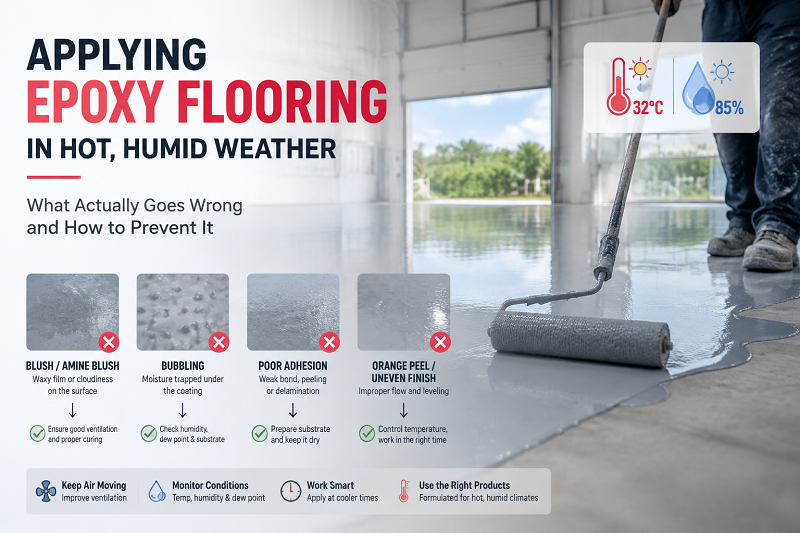
What Heat and Humidity Do to the Cure
Epoxy cures through an exothermic reaction between resin and hardener — it produces its own heat on top of whatever’s already in the air. That combination changes the chemistry in ways that aren’t always obvious while the crew is still on the floor.
Cure speed picks up, sometimes more than anyone wants. Higher temperatures push the resin-hardener reaction faster. A comfortable 30-40 minute pot life at 20°C can shrink to 10-15 minutes once it’s 35°C outside. Crews working at a normal pace suddenly find material setting up in the bucket before it’s even spread, or curing on the floor too fast to self-level properly or let trapped air escape.
Working time shrinks along with it. Less time to spread the coating shows up as lap marks where one pour meets the next, roller marks that never flow out, uneven thickness across the floor — cosmetic issues at first glance, but they’re permanent once the material sets.
Moisture becomes a much bigger factor than usual. Warm air just holds more water vapor, and when humid air hits a cooler concrete surface — a common early-morning scenario, since slabs tend to warm up slower than the surrounding air — it condenses into a thin film right at the bond line. That’s a direct route to adhesion failure, and it’s often invisible when the coating actually goes down.
Amine blush shows up more often too. Certain hardeners react with moisture and CO2 in humid air to form a waxy film on the surface. It weakens adhesion for whatever coat goes on next and can leave a hazy, slightly greasy-looking finish if nobody removes it before recoating.
Bubbling and pinholing tend to increase as well. Heat speeds up outgassing — air trapped in the substrate expanding as it warms during cure. Combine that with a coating that’s already curing faster than normal and losing some of its ability to self-heal minor surface defects, and you get bubbles and pinholes that would’ve flowed out and disappeared under cooler, slower conditions.
Reading the Site Correctly Before Anything Gets Mixed
Most heat and humidity failures trace back to a call that got made — or skipped — before the coating went down.
Dew point calculation isn’t optional here. Substrate temperature needs to stay at least 3°C above the calculated dew point through application and the early part of cure. That’s not something to eyeball; it takes an actual surface thermometer and hygrometer reading, taken at the time of application, not a general weather forecast for the day.
Substrate temperature is what matters, not air temperature. A slab sitting in direct sun can run 10-15°C hotter than the air around it. One still shaded early in the morning can be noticeably cooler than what the ambient reading suggests. Air temperature alone tells you almost nothing useful here — the surface itself has to be measured.
Timing matters more than most schedules account for. In hot climates, starting early before the slab has absorbed a full day of heat — or working in the evening once the worst of it has passed — often opens up a wider, more workable window than a standard daytime schedule allows.
And humidity trends across the day matter, not just whatever the morning reading shows. A site that’s dry at 8am but climbs past 85% by early afternoon needs a plan: either finish the pour before humidity rises, or hold off entirely until conditions come back down.
Adjustments That Actually Make a Difference
Switching to a slow hardener for hot-weather work is probably the single most useful change available. Most epoxy systems offer both standard and extended-pot-life hardener options for exactly this reason — using the slow version in summer brings working time back closer to what a standard hardener gives on a cooler day.
Scheduling around the substrate rather than the calendar helps too. An early start, before the slab’s absorbed a full day of heat, gives crews a meaningfully longer window than a midday pour would. In climates with a predictable afternoon humidity spike, getting the pour done before that window closes is often what decides whether the job goes smoothly or not.
Controlling the environment, where that’s possible, makes a real difference. In enclosed facilities, running dehumidifiers and HVAC during application and cure can pull ambient humidity into a workable range even when outdoor conditions are well outside spec — standard practice for pharmaceutical and food processing floors, where nobody wants cure quality left up to the weather.
Mixing smaller batches more often is a simple fix that pays off. Instead of mixing a full batch and racing against the clock, smaller and more frequent batches cut down on how much material risks kicking off in the container before it ever reaches the floor — costs a bit more labor time, saves a lot more in rework.
Storing materials at the right temperature before use matters more than people expect. Resin and hardener sitting in a hot truck or an uncooled warehouse start the pour already warmer than the data sheet assumes, which eats into working time before the crew even opens the containers. Keeping everything in a temperature-controlled space until shortly before mixing preserves the full working time the product is actually rated for.
Removing amine blush before recoating is a cheap step relative to what it prevents. A water rinse and light abrasion — or a dedicated blush-removal cleaner — between coats in humid conditions heads off the intercoat adhesion problems blush tends to cause.
And where slab moisture is a known risk, using a moisture-tolerant primer helps buffer against the failures that hot, humid weather makes more likely in the first place. A two-component epoxy vapor barrier primer, applied before the main system, is standard practice on slabs without a vapor barrier or in climates where ambient humidity stays high most of the time.
What Happens When None of This Gets Done
The failure modes aren’t subtle once they show up — the problem is they usually don’t show up until well after the crew’s already left.
Blistering, typically appearing days to weeks after installation, happens when moisture trapped underneath the coating tries to escape and pushes the film up off the substrate.
Delamination shows up as the coating separating from the substrate or from a previous coat, often starting at edges or high-traffic areas before spreading.
A soft or tacky final cure means excess humidity or an accelerated reaction kept the epoxy from ever reaching its designed hardness — the surface dents or scuffs under normal traffic that shouldn’t be an issue.
Visible surface defects — pinholes, fisheyes, uneven sheen, or a hazy blush film — are mostly cosmetic on their own, but they signal a cure that didn’t go the way it should have, and they often line up with reduced chemical and abrasion resistance underneath.
Every one of these ends up as a warranty claim or a recoat, and both cost far more than the extra planning it would’ve taken to avoid them in the first place.
Planning Around Summer Instead of Against It
None of this makes summer a bad season for epoxy floor coating. It just means summer installs need someone actually reading the site instead of following a generic schedule. Facilities in hot climates put down epoxy floors successfully all year round — the difference almost always comes down to whether the crew adjusted the hardener, timing, and environmental controls to match what was actually happening on site, rather than the ideal numbers printed on the data sheet.
Jincheng Resin formulates epoxy resin systems with both standard and extended-pot-life hardener options for hot-climate installation, along with moisture vapor barrier primers for slabs at elevated risk. For guidance on hardener selection, working time at specific temperatures, or OEM formulation for distributors working in hot and humid regions, get in touch with our team before your next summer project.