



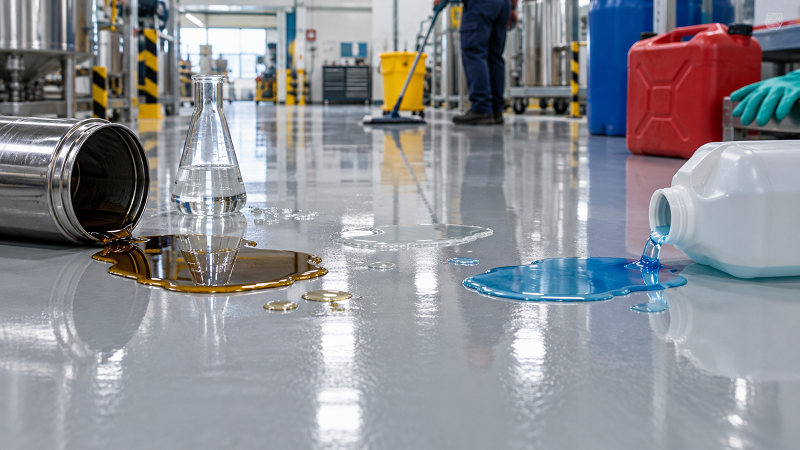
A lot of chemical resistance failures don’t look like failures at first. The floor holds up fine for eight months. Then a spill sits overnight, and by morning there’s a soft, discolored patch that never quite bounces back. Nobody did anything wrong on install day — the coating just wasn’t built to handle whatever landed on it.
Chemical resistant epoxy floor coating isn’t really one product. It’s more of a spectrum, and where a given formulation lands on that spectrum comes down to resin chemistry most buyers never think to ask about until after something’s already gone wrong.
Why “Epoxy” Alone Doesn’t Tell You Much
Every epoxy floor coating starts from a base resin chemistry, and that base sets the ceiling on chemical resistance. No amount of careful installation can push a formulation past what its resin backbone allows in the first place.
Standard bisphenol-A (BPA) epoxy — the most common resin used in epoxy floor coating — handles moderate chemical exposure reasonably well: diluted acids, common cleaning agents, the occasional oil or fuel contact. For most commercial and light-industrial floors, it’s the right call, and it’s usually the cheaper option per gallon too.
Novolac epoxy is a different animal entirely. Its higher cross-link density translates directly into stronger resistance against concentrated acids, aggressive solvents, and sustained chemical immersion. It costs more, cures somewhat less forgivingly, and honestly, most facilities don’t need it. For the ones that do, though, nothing else in the epoxy family comes close.
There’s also the amine-versus-polyamide curing question, which shifts resistance in more specific directions than people expect. Amine-cured systems tend to hold up better against solvents; polyamide-cured systems usually do better outdoors or under UV exposure, though solvent resistance takes a bit of a hit in exchange. None of that nuance shows up in a generic “chemical resistant” label slapped on a data sheet.
Reading a Resistance Chart Without Getting Lost in It
Most epoxy floor coating data sheets come with a resistance chart — rows of chemicals rated something like Excellent, Good, Fair, or Not Recommended, occasionally with an exposure-time qualifier tucked in.
A few things are worth knowing before trusting that chart at face value.
Concentration changes everything. A coating rated “excellent” against 10% sulfuric acid can fail against 50% sulfuric acid within a matter of hours. If a data sheet doesn’t specify concentration, that’s worth asking the manufacturer directly rather than assuming the best-case scenario.
Duration matters just as much as the chemical itself. A coating that shrugs off a quick splash might still soften after 24 hours of standing contact with that same substance. Facilities dealing with drips, leaks, or standing puddles need the immersion rating — not the splash rating that usually gets quoted first.
And temperature almost always pushes resistance in the wrong direction. A chemical a coating tolerates fine at 70°F can degrade that same coating noticeably faster at 120°F, which matters a great deal for facilities running hot process equipment anywhere near the floor.
Matching the Resistance Level to the Facility
Starting from a chemical list and working forward tends to be slower than starting from the facility type and working backward to figure out what level of epoxy floor coating resistance actually applies.
Light manufacturing, warehousing, and retail floors usually see occasional oil drips, routine cleaning chemicals, and light foot or cart traffic. Standard BPA epoxy handles all of that without needing anything specialized — spending more here mostly buys a margin nobody ends up using.
Automotive shops and vehicle maintenance facilities cycle through motor oil, brake fluid, coolant, and battery acid — none of it constant, but all corrosive enough in concentrated form. A mid-tier chemical-resistant epoxy, applied a bit thicker than a standard system, is usually the right fit, particularly underneath lift stations where fluid contact happens more often.
Food and beverage processing plants bring their own chemistry into play: daily cleaning and sanitizing agents that are often hot, frequently alkaline, and occasionally acidic depending on the product line. These environments call for a system specifically rated for repeated hot-caustic washdown — a narrower spec than general chemical resistance, and one worth confirming by name on the data sheet rather than assuming from a vague “food-safe” label.
Chemical processing plants, battery manufacturing, and facilities handling concentrated acids or solvents are where novolac epoxy earns its higher price tag. Standard BPA systems in these settings don’t fail gradually — they tend to fail within just a few exposure cycles, and the cost of redoing a chemical plant floor dwarfs whatever premium the right resin would have cost upfront.
Parking structures and outdoor-adjacent commercial floors bring a different chemical load entirely — de-icing salts, brake dust residue, gasoline drips — combined with UV exposure that a purely indoor facility never has to think about. This is actually one of the few cases where the amine-versus-polyamide question matters at the selection stage, since UV stability and chemical resistance pull in slightly different directions depending on which curing agent gets used.
Thickness and System Design Matter Almost as Much as Resin Choice
A thin coat of epoxy floor coating with a highly resistant resin can underperform a thicker coat of a more moderate one, simply because chemical resistance is partly a function of how much material stands between the chemical and the concrete underneath it.
Self-leveling systems at 1/8″ to 1/4″ thickness offer noticeably more resistance margin than a thin 10-15 mil coating, for the straightforward reason that there’s more material to work through before anything reaches the substrate. For facilities with genuine chemical exposure risk, adding thickness is often a cheaper way to buy resistance than chasing a fancier resin alone — though the two aren’t really interchangeable, and a thick coat of the wrong resin still fails against the wrong chemical soon enough.
Topcoat selection adds one more layer to the decision. Running a novolac epoxy topcoat over a standard epoxy body coat is a common, cost-effective way to concentrate high chemical resistance right where it’s needed — at the exposed surface — without paying novolac pricing across the entire system depth.
How Epoxy Floor Coating Resistance Actually Gets Tested
These ratings don’t come from guesswork, at least not from a formulator worth buying from. The standard method is ASTM D543: cured coating samples get submerged in specific reagents for a set period, then checked against the untreated baseline for changes in weight, hardness, and appearance.
Passing a 24-hour immersion test against a given chemical doesn’t automatically clear a coating for 30-day exposure to that same chemical. The duration listed on a data sheet is the duration that’s actually been verified — not a floor for how long the coating can be expected to hold up. Manufacturers who only publish short-duration results for a chemical a facility expects to see in longer contact are, intentionally or not, leaving a gap that eventually shows up as a maintenance headache.
Worth knowing too: resistance testing is usually run on fully cured samples, typically after seven days at standard temperature. A coating tested and rated highly resistant still needs its complete cure window before that rating actually kicks in. Chemical exposure during the first week — even on a product rated highly resistant once fully cured — can cause damage that the same coating, given time to finish curing, would have shrugged off entirely.
A Quick Reference for Common Exposure Types
A few patterns hold across most epoxy floor coating data sheets, useful as a starting point before checking any specific product.
Dilute acids and bases, roughly pH 3 to 11, are handled well by standard BPA epoxy in most facilities. Push below pH 2 or above pH 12, though, and you’re generally looking at novolac chemistry or a specialty coating outside the epoxy family altogether.
Petroleum products — motor oil, diesel, hydraulic fluid — sit comfortably within standard epoxy’s resistance range for occasional contact. Sustained immersion, like a drip pan that never gets emptied, pushes things toward needing a heavier-duty system.
Strong solvents — ketones especially, along with some chlorinated compounds — are where a lot of standard epoxy systems quietly fall short. These can soften or even dissolve a coating not specifically rated against them, and it’s one of the more common gaps between what a facility assumes “chemical resistant” means and what a given product was actually tested against.
What’s Worth Asking Before You Buy
A buyer sourcing chemical resistant epoxy floor coating — whether for one facility or for resale — usually gets more out of a handful of pointed questions than out of a spec sheet alone.
What chemicals, at what concentration, will actually touch this floor — not a generic list, the real inventory. What’s the expected exposure pattern: occasional splash, daily washdown, or standing immersion? Is there a resistance chart with actual concentration and duration data attached, rather than just a qualitative rating? And for OEM or private-label buyers specifically — does the resin supplier disclose base chemistry (BPA versus novolac, amine versus polyamide cure), or just sell a finished blend under a generic “chemical resistant” label with no way to verify what’s actually inside it?
That last question tends to matter more for distributors than it first seems. A blended product with an unclear resin base becomes a liability the moment a customer’s real-world exposure doesn’t match what the coating was actually built for — and at that point, “chemical resistant” printed on the label doesn’t protect anyone.
For OEM and private-label buyers, resin transparency also shapes how confidently a distributor can field their own customers’ questions later on. A formulator willing to hand over base resin type, cure agent, and ASTM D543 data by chemical gives a distributor something real to stand behind. A generic blend with a marketing label doesn’t.