



Epoxy floor coating rarely fails loudly in cold weather. More often it’s a floor that stays tacky longer than it should, a hazy film nobody can quite explain, or a coating that looks fine through the winter and then peels off in sheets come spring. Trace most of these back far enough and you land on the same root cause — someone installed epoxy floor coating outside the temperature window the chemistry actually needs.
None of this makes epoxy floor coating in cold weather impossible. It just runs on a different set of rules than the ones most crews default to in July.
Temperature Controls the Chemistry, Not Just the Comfort Level
Epoxy cures through an exothermic reaction between resin and hardener, and that reaction is temperature-dependent in a way a lot of other trades never really have to think about. Drop the temperature, and the reaction doesn’t slow down a little — it slows down exponentially.
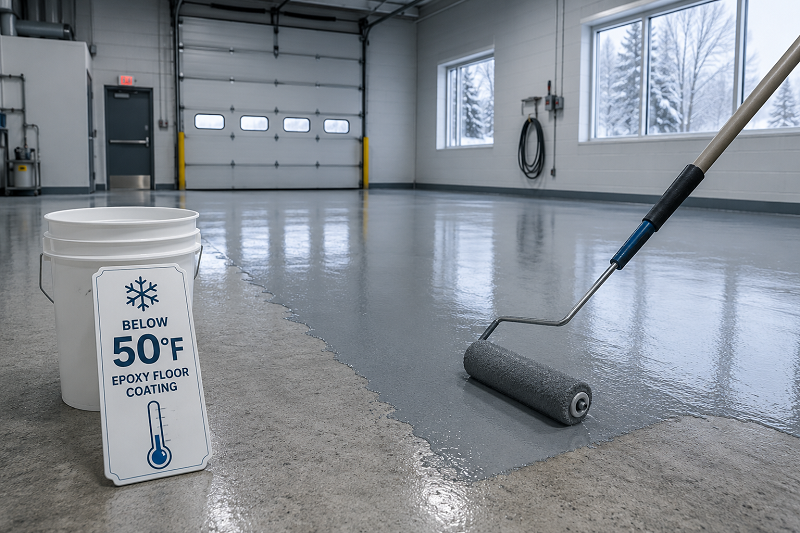
Below 50°F (10°C), standard epoxy formulations cure dramatically slower. Something that would normally set in six to eight hours can take 24 hours or more, and a full cure can stretch out to a week. Push below 40°F (4°C) and most conventional epoxy resins basically stop curing in any practical sense — the material stays wet or tacky indefinitely, and even if it eventually skins over on top, the cross-linking underneath never really finishes.
There’s a third scenario that trips up more crews than either of those thresholds: a rapid temperature swing mid-cure. Even when the starting temperature is fine, a sudden drop — a warehouse door left open overnight, an unheated space losing heat fast after sunset — can lock the reaction partway through. What you’re left with is a floor that’s permanently soft underneath.
This is chemistry, not a liability-driven guideline someone made up to cover themselves. Epoxy floor coating cured in cold weather can look hard on the surface and still be soft a few millimeters down, and that gap — between looking done and actually being done — is exactly where floors start failing six months to a year later.
Amine Blush: The Defect Nobody Seems to Budget For
Amine blush is the hazy, waxy film that turns up on epoxy cured in cold, humid conditions, and it’s specific enough to cold weather that most installers don’t plan around it the way they should.
Here’s roughly what’s happening: amine-cured hardeners react with moisture and carbon dioxide in the air, and that reaction picks up speed once the surface gets cold enough for condensation to form. The byproduct sits on top of the coating as a slippery, waxy layer. In mild cases it’s purely cosmetic — wipe it off with solvent and move on. In worse cases, it blocks a subsequent coat from adhering properly, and a topcoat applied over uncleaned blush can delaminate later.
The fix is genuinely simple, which is probably why it gets skipped — keep the substrate at least 5°F above the dew point through the entire cure window, and actually check for it between coats rather than only at the start of the job.
The Temperature Range That Actually Works
For epoxy floor coating, cold weather thresholds are usually spelled out clearly on the data sheet: most manufacturers list a minimum ambient and substrate temperature of 50°F (10°C), with the sweet spot sitting somewhere between 65-85°F (18-29°C). A handful of details matter more here than people tend to assume.
Substrate temperature isn’t the same thing as air temperature, for one. Concrete holds cold far longer than the air around it does. On a 55°F morning, a slab that sat unheated overnight can still read well under 50°F right at the surface — worth checking with an infrared thermometer rather than trusting a hand on the concrete.
Whether the temperature is rising or falling matters too. Installing during a cooling stretch is riskier than installing during a warming one, even starting from the same number on the thermometer, because the floor needs to stay above threshold for hours, not just at the moment the roller touches down.
Material temperature is the one people forget most. Resin and hardener that sat overnight in a cold warehouse or an unheated truck cure more slowly even once you’re working in a warm space, and cold material also runs thicker, which throws off mixing ratios and self-leveling.
Options When Waiting for Spring Isn’t on the Table
Some facilities can’t schedule epoxy floor coating around the calendar — a distribution center that can’t shut down until warmer weather, a production floor with one fixed downtime window a year. For those, there are real options, not just workarounds.
Temporary heating and enclosure is the most obvious one. Portable heaters or a heated enclosure can bring both ambient and substrate temperature into range, but the heat source matters more than people expect. Propane heaters throw off combustion byproducts that add moisture and CO2 to the air — which makes amine blush worse, not better. Electric heat is the safer call for an enclosed cure space.
Low-temperature cure formulations are the next option, and probably the most reliable one. Some epoxy and polyaspartic systems are built specifically to cure at lower temperatures, sometimes down to 35-40°F, using modified hardener chemistry. They cost more per gallon. For a genuinely cold job, though, that’s the difference between a floor that cures correctly and one that never does.
Polyaspartic topcoats tolerate a wider range than standard epoxy and cure faster even when it’s cool out, which is a big part of why they’ve become the default for facilities running tight seasonal windows — loading docks, cold-climate warehouses, spaces that sit close to an outdoor opening and can’t wait around for a 65°F day.
There’s also a scheduling trick worth mentioning: in shoulder seasons, midday application — after a slab has had a few hours to soak up warmth — often clears the threshold even when the morning and evening readings wouldn’t.
What This Means If You’re Buying or Distributing Epoxy Floor Coating for Cold Weather
If you’re specifying material for a cold-climate job, or for a facility that can’t build its schedule around the weather, the formulation matters more than whatever brand is printed on the bucket. A standard epoxy pushed outside its cure window isn’t a slower version of the same floor — it’s a different, weaker product that happens to look similar for a while.
For distributors selling into cold-climate markets — the northern US, Canada, parts of the UK — carrying a genuine low-temperature or polyaspartic option alongside a standard summer formulation isn’t really optional at this point. It’s the difference between a job that’s finished and a job that turns into a callback six months later, and the cost gap is usually smaller than people assume next to what a full rework runs.