



Put two epoxy floors side by side on installation day and you may struggle to tell them apart. A year later, one is holding up fine and the other is chipping at the forklift turns. The difference is usually underneath: one was a thin protective film, the other carried several millimeters of aggregate-filled resin.
So the right epoxy floor coating thickness depends on two things, the condition of the concrete and the abuse the floor will take. Foot traffic, forklift turns, dropped tools, chemical spills, hot-water cleaning, all of it feeds into the spec. Thickness matters, but it never works alone. Resin chemistry, adhesion and surface prep carry just as much weight.
Below, we cover the common builds, how to compare quotes fairly, and how to turn a thickness target into a material estimate.
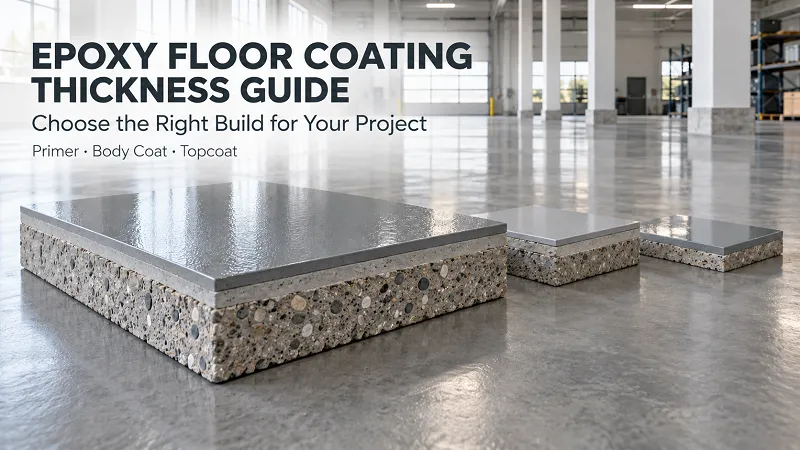
What Does Epoxy Floor Coating Thickness Actually Mean?
It depends on who is talking. Some contractors quote the thickness of a single coat. Others quote the whole installed system. A “0.5 mm epoxy body coat” may still need a primer and topcoat on top of it, while another supplier’s “0.5 mm” may already include every layer. Before you compare prices, pin down which number you are looking at.
Three terms come up constantly:
- Wet film thickness (WFT): the thickness right after application.
- Dry film thickness (DFT): the thickness after curing, once any volatile components have left.
- Total system thickness: primer, body coat, broadcast aggregate and finish coat added together.
Units cause their own trouble. One millimeter equals 1,000 microns, or about 39.4 mils. One mil is 0.001 inch, or 25.4 microns. Mixing up mils and millimeters is a classic and expensive mistake.
Water-based and solvent-based coatings shrink as they cure, so the dry film is thinner than the wet one. To estimate by how much, use the product’s volume solids percentage. Weight solids is a different figure, and swapping one for the other will throw off your numbers.
Common Epoxy Flooring Thickness Ranges
Treat these as planning categories, not hard limits. Formulations overlap, and the approved system data sheet always has the final word.
Thin coatings (about 0.2–0.5 mm total). Good for sound, fairly smooth concrete where the goals are dust control, looks and easy cleaning. They won’t hide flaws, so repair the slab first. Abrasion resistance leans heavily on the finish coat.
High-build coatings (about 0.5–1.0 mm). More material over the substrate, which suits garages, workshops and some commercial spaces. One catch: “high build” has no universal definition, so ask for the per-coat limits instead of trusting the label.
Self-leveling systems (about 1.5–3 mm, sometimes beyond). These form a real wearing surface and soften minor texture in the slab. They won’t fix a big slope, a deep depression or a crack that still moves.
Broadcast systems (about 1.5–4 mm or more). The final build depends on aggregate size, application sequence and sealing coats. Flake and quartz both need enough binder to catch the broadcast and enough finish coat to lock in the texture. Aggregate that gets swept off the floor isn’t part of the build.
Epoxy mortar (about 4–6 mm or thicker). Reserved for demanding service or resurfacing. What sets mortar apart is the aggregate loading and the trowel-applied method, not simply the depth. Heavy industrial duty needs a project-specific spec.
Matching Thickness to the Application
Garages and Vehicle Workshops
A home garage with sound concrete and ordinary cars can often get by with a well-specified coating or broadcast system. Check hot-tire resistance, oil exposure, wet slip resistance and the slab’s condition before settling on a build.
A repair shop is another story. Steel jack stands, dragged equipment and dropped parts will wreck a surface that parked cars never bother. Those work bays may justify an aggregate-filled system, while storage zones next door need far less. And a thicker floor still needs compatible chemistry and a full cure before vehicles roll back on.
Warehouses and Industrial Floors
“Heavy duty” is not a specification. What matters is wheel material, loaded axle weight, how often trucks turn and where they brake. Loading bays and tight aisles take the worst punishment, often in small patches.
Weigh self-leveling, broadcast and mortar systems against those conditions. A warehouse moving a few pallets a day shouldn’t get the same build as a busy distribution center. And keep one thing in mind: resin flooring does nothing for the structural capacity of a weak slab.
Commercial and Wet Areas
Retail shops and showrooms care mostly about looks, cleaning and foot traffic. If impact is low and the slab is sound, a thinner system with a proper topcoat is a practical choice.
Wet production areas are harder. Drainage, slip resistance, chemical exposure and wash temperatures can drive the system choice more than thickness does. If the floor sees frequent thermal shock or aggressive chemicals, ask whether a different resin technology is needed. Piling on more ordinary epoxy rarely solves that.
Start With the Concrete
A thickness spec should come after a substrate survey, not before. Look for cracks, laitance, contamination, weak spots, old coatings and surface profile. Confirm that moisture levels sit inside the limits of every layer you plan to use.
Deep pits and broken edges need proper repair mortar first. Burying them under extra finish coat leads to uneven consumption and leaves weak spots in place. Movement joints should stay working, with a joint detail designed for it.
Moisture deserves its own check. Standard epoxy floor coating is not a vapor barrier. If testing says you need mitigation, pick a compatible system with documented moisture limits and its own application rate. A thicker decorative coat won’t do the job.
Surface texture also changes how much material you use. Rough concrete has more area and more valleys to fill than a smooth slab. Budget for that, but don’t shave the wearing layer to make up for it.
Specify Each Layer Separately
Primer. It wets the substrate and builds adhesion. Porous concrete soaks up part of it, so primer consumption doesn’t always become film thickness above the surface.
Body coat. This delivers most of the build, and it may carry pigment or approved aggregate. Use a formulation designed for your target thickness. A roll-on epoxy isn’t automatically fit for several millimeters just because it’s epoxy.
Topcoat. The exposed layer, responsible for wear, stain resistance, gloss and cleanability. On suitable projects, a compatible polyaspartic floor coating can go over epoxy if its documented properties match the service demands. Check adhesion, prep and recoat timing for the exact products.
When you ask suppliers for quotes, request a layer schedule: product, thickness basis, application rate, aggregate loading and cure requirements. It makes quotes far easier to compare, and installers can order the right quantities from it.
How to Calculate Epoxy Material Requirements
For an unfilled liquid coating, theoretical consumption comes from volume solids:
Wet volume (liters) = area (m²) × target DFT (mm) ÷ volume solids fraction
Take 100 m² at 0.5 mm DFT with a 100% volume solids product: about 50 liters before allowances. At 80% volume solids, the same job needs about 62.5 liters.
For mass, multiply the mixed volume by the mixed density. At 1.4 kg/L, those 50 liters weigh roughly 70 kg. These are illustrations only, not application rates for any particular Jincheng product.
Work out primer, body coat and topcoat one at a time. Then add allowances for roughness, absorption, mixing residue and application loss. No flat percentage fits every slab, so confirm the estimate by inspection and, where it makes sense, a trial area.
One warning: don’t use liquid resin density to calculate the weight of an aggregate-filled screed. Those systems need the manufacturer’s resin-to-aggregate ratios and consumption data. Full-broadcast systems also call for extra aggregate during installation, and some of it gets removed afterward.
Can an Epoxy Floor Be Too Thick?
Yes. Go past a product’s approved thickness and you can affect flow, exotherm and cure. How badly depends on the formulation, the temperature and how much mixed material sits in one place. A coating made for thin application is not a deep-pour resin or a mortar binder.
If the job needs more build, choose an approved multilayer system or a product designed for that depth. Respect the maximum thickness per coat, the pot life and the recoat window. Miss the window and the next coat may need mechanical prep.
Too much build creates other headaches: blocked drains, less clearance under doors, awkward transitions. Check finished levels at thresholds, channels and equipment bases while you’re still planning.
How to Check Thickness During Installation
Divide the floor into measured zones. Record how much mixed material goes into each zone and compare it against the specified consumption. That catches over-spreading early, before you’ve coated half the building.
Use a wet film gauge where it suits the coating and the substrate profile. On rough concrete or aggregate-rich layers, read results with care, since a gauge sitting on a surface peak doesn’t represent the whole system.
For cured floors on concrete, pick a verification method that fits the system and the acceptance criteria. Calibrated ultrasonic equipment can work in the right conditions. Agreed destructive sections or cores can also confirm layer build. The magnetic gauges used on steel don’t measure epoxy on concrete.
Put repairs, inspection points and tolerances into the quality plan. Thickness records help, but handover should also cover adhesion, cure, surface defects and the intended texture.
Frequently Asked Questions
Is 1 mm of epoxy enough for a garage?
Sometimes. It works when the formulation, slab prep and service conditions all support it. But 1 mm on its own says nothing about hot-tire resistance, adhesion or impact performance.
Does thicker epoxy last longer?
Extra build gives you more wearing material, but only inside a properly designed system. Traffic, aggregate, topcoat quality and maintenance all play in. A thick floor with poor bond can fail before a thin, well-installed one.
Can I apply 3 mm in one coat?
Only if the product is designed and approved for it. Follow the technical data sheet, including aggregate requirements and application conditions. A standard epoxy paint can’t simply be poured at 3 mm.
What should I send a supplier for a thickness recommendation?
Floor area, photos of the substrate, moisture test results, traffic details, chemical exposure, cleaning method and the shutdown time you have. Ask for a full layer schedule and current data sheets. If you’re discussing a project with Jincheng, the same information gives our technical team a solid basis for recommending an epoxy floor coating system and estimating quantities.
The right build starts with a clear picture of service conditions. Confirm the substrate, pick a compatible system, and specify every layer before you compare material prices.