



Picking a floor coating supplier is one of those decisions that looks simple on a quote sheet and gets complicated on site. The coating matters, of course. But so do batch consistency, whether the layers actually work together, the quality of the technical paperwork, and whether the material shows up when the crew is ready to start.
Industrial and commercial jobs make this even sharper. A warehouse with forklift traffic needs abrasion resistance. A workshop lives with oil and chemical splash. A showroom cares about gloss and UV stability. A retail renovation cannot afford to stay closed for a week. No single coating solves all four.
That is why a good floor coating manufacturer does more than ship drums of epoxy, polyurethane, polyurea or polyaspartic. It knows how those products behave when stacked into a system, and it helps you build the right one for the job in front of you.
So how do you tell a dependable partner from a supplier who simply has the lowest number on the quote? Here is what to check before you commit.
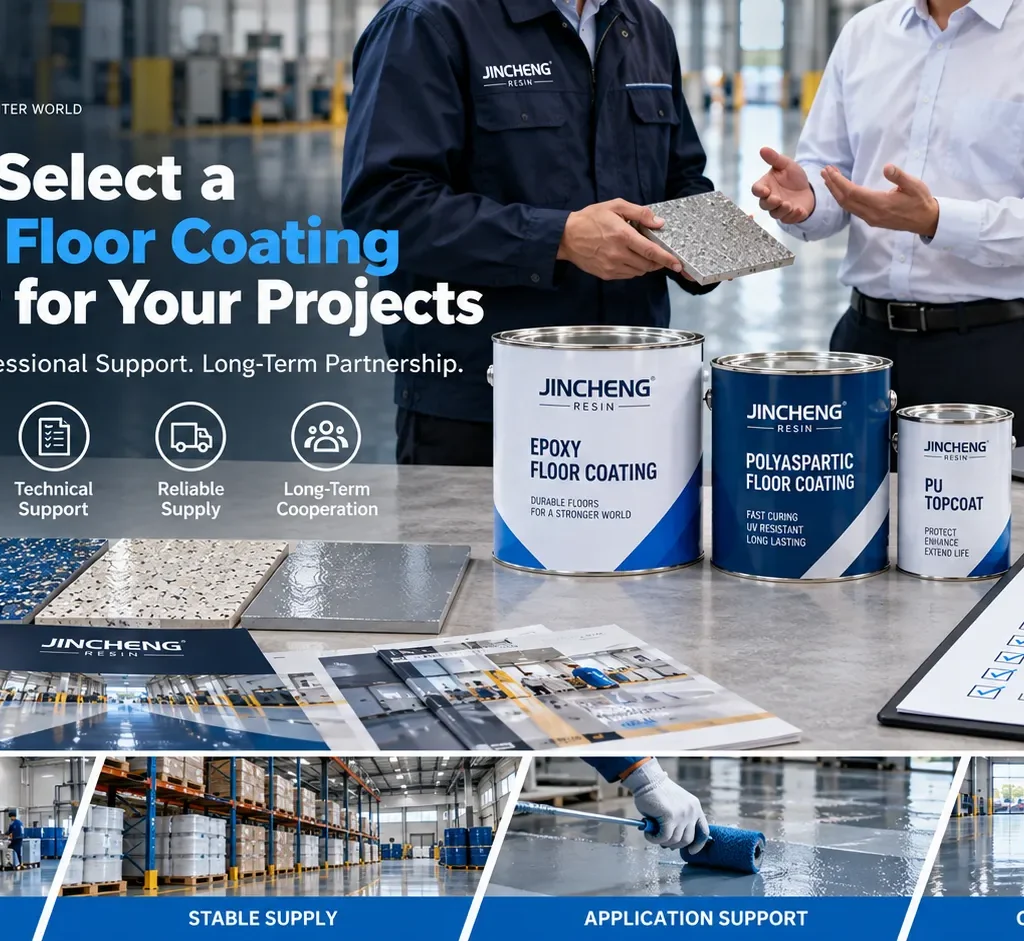
1. Look Beyond the Price per Kilogram
Price matters, particularly for distributors and big commercial tenders. It just shouldn’t be the first filter, and it definitely shouldn’t be the only one.
Two coatings can sit at the same price per kilogram and still differ wildly in solids content, coverage rate, recommended film thickness, cure speed, working time, abrasion resistance and service life. The cheaper drum often needs a second coat, or simply gets used up faster per square meter. Slow curing adds labor days and keeps the space out of service.
So compare the cost of the whole floor, not the cost of the bucket: material, coverage, labor, installation time, downtime and future maintenance. On a commercial site, a lost trading week can easily cost more than the coating itself.
2. Choose a Supplier Who Thinks in Systems
Almost no industrial floor is a single coat. A typical concrete floor goes from prepared substrate to primer, base coat, a build or decorative layer, and finally a topcoat. Each one has a job. The primer grips the slab. The base coat builds film thickness and mechanical strength. Quartz or flake adds texture, slip resistance or color. The topcoat takes the traffic, the cleaning chemicals and the sun.
A supplier who understands these layers can tell you which combinations work. An epoxy primer with an epoxy build coat and a polyaspartic topcoat is a proven pairing. So is a fast-cure polyurea basecoat with decorative flakes under a polyaspartic clear coat.
Buy each layer from a different source, purely on price, and you are gambling with adhesion, recoat windows and cure behavior. Those failures rarely show up on day one. They show up in month eight, when the client is already calling.
3. Check How Wide and How Compatible the Product Range Is
You don’t need a catalog of hundreds of products. You do need enough range to cover the conditions you actually meet.
Epoxy is still the workhorse for industrial concrete. It bonds well, cures hard and builds thickness, which is why it dominates warehouses, factories, workshops and commercial interiors. A capable epoxy floor coating supplier should offer primers, self-leveling systems, clear and pigmented coatings, and decorative products, not just one general-purpose resin.
Polyurethane earns its place where you need more flexibility or surface toughness, and it works well as a protective topcoat over a compatible epoxy base.
Polyaspartic floor coating is the fast one. Depending on the formulation, it cures quickly, recoats within a short window, resists abrasion and UV, handles many chemicals and gives a high-gloss finish, indoors or out. That combination suits garages, showrooms, workshops, retail spaces and any job where every hour of downtime costs money.
Decorative flake and quartz systems bridge performance and looks. Flakes are the garage and showroom favorite. Quartz adds texture and grip for tougher environments. If one supplier can provide the primer, base, decorative media and topcoat together, specifying a job gets much easier.
4. Ask for Technical Data Before You Buy
Words like “high strength,” “excellent adhesion” and “chemical resistant” appear on every brochure. They tell you almost nothing.
Ask for the Technical Data Sheet (TDS) and the Safety Data Sheet (SDS) for each product. A serious supplier will send them without a fuss. Then read the numbers that matter: mixing ratio, viscosity, solids content, pot life, tack-free time, recoat window, full cure, recommended thickness and coverage, hardness, adhesion, abrasion resistance, application temperature range, storage conditions and shelf life.
With those figures in hand, you can compare two products fairly and judge whether either will behave on a hot, humid job site. Without them, you are comparing adjectives.
5. Ask How Batch Consistency Is Controlled
Contractors and distributors often care about repeatability more than peak performance. A great sample means little if the next batch behaves differently.
Picture it. You test a sample that levels beautifully and gives you 30 minutes of working time. The bulk order arrives, and the material starts kicking off much faster. Now you have a half-finished floor and a crew with a problem.
The properties that need to stay steady from batch to batch include viscosity, color, gloss, mixing behavior, pot life, cure speed, hardness and general application feel. So ask the manufacturer directly:
- How are incoming raw materials inspected?
- Are production batches recorded, and are finished products tested?
- Do you keep retained samples from each batch?
- How do you control color?
- Can a customer complaint be traced back to a specific production record?
This matters even more if you are building a local brand. When something goes wrong, your customer calls you, not the factory in another country.
6. Test Their Knowledge of Concrete Preparation
An excellent coating on a badly prepared slab will still fail. That makes substrate preparation one of the quickest ways to gauge how much a supplier really knows.
Listen for whether they bring it up on their own. A knowledgeable supplier will ask about concrete strength, existing coatings, oil contamination, laitance and dust, surface profile, cracks, joints and moisture. Depending on the project, the answer might involve diamond grinding or shot blasting, coating removal, crack repair and a thorough clean.
Be wary of anyone who says their product “goes on almost any concrete.” Adhesion starts at the slab, not in the can.
7. Make Moisture Part of the Conversation
Moisture is among the biggest hidden risks in resin flooring. Water vapor travelling up through a slab can cause blisters, delamination, peeling and outright loss of adhesion. Older buildings, slabs on grade, basements and underground spaces are the usual suspects, especially when nobody knows whether a vapor barrier sits underneath.
A capable supplier will understand this and, where it makes sense, recommend a compatible moisture vapor barrier (MVB) or moisture-control primer. Note the “where it makes sense.” The goal is not to sell MVB on every job. The goal is to test the slab, for example with in-situ relative humidity or calcium chloride testing, and then design the system around the result.
8. Verify Chemical Resistance for the Real Application
“Chemical resistant” is not a rating. A coating can shrug off one chemical and fail against another, and the result also shifts with concentration, temperature, exposure time, cleaning routine and film thickness.
An auto workshop worries about oils and vehicle fluids. A manufacturing plant might face acids, alkalis, solvents or process chemicals. A warehouse mostly needs to survive cleaning agents and the odd spill.
So don’t ask, “Is your coating chemical resistant?” Ask, “Is this system suitable for the specific chemicals in my facility?” A professional supplier will want to know what actually hits the floor before answering.
9. Check UV Stability for Sun-Exposed Areas
Conventional epoxy performs well indoors, but many formulations yellow or shift in color under prolonged UV. That matters on outdoor floors, loading docks, open garages, entrances, patios, pool decks and anywhere near big windows or doors.
In those spots, a suitable polyurethane or aliphatic polyaspartic floor coating is the usual fix, applied as the protective finish. A trustworthy supplier will tell you plainly which products are indoor-only and which are designed for UV exposure. If someone pitches one coating as perfect for everything, walk away.
10. Weigh Cure Speed Against Commercial Downtime
For commercial work, time is often the deciding factor. Shutting a workshop, showroom, warehouse aisle or shop floor for several days costs real money, which is why demand for fast-curing floor coating systems keeps growing. Polyaspartic and fast-cure polyurea, when properly specified, can shorten an installation schedule considerably.
But “fast dry” on its own is a weak claim. Ask for the full timeline, because these are separate milestones: pot life, recoat time, foot traffic, vehicle traffic and full cure. Once you know all five, you can plan crews, schedules and client expectations with far fewer surprises.
11. Ask Whether They Offer a One Day Floor System
When downtime is the main worry, a complete One Day Floor system can be worth a lot. But a real one-day floor takes more than a quick topcoat. The primer or base layer, decorative media, topcoat and recoat windows all have to be designed to work together.
Jincheng’s One Day Floor solution is built on that system approach. A typical build runs from prepared concrete to a fast-cure polyurea basecoat, then a decorative flake broadcast, and finally a polyaspartic clear topcoat. The polyurea base shortens the installation cycle. The polyaspartic topcoat provides the protective surface, with good abrasion resistance, UV stability and a decorative finish.
For suitable projects and application conditions, this can cut the time a conventional multi-stage floor would take. Actual return-to-service times still depend on temperature, substrate condition, humidity, film thickness and the specific product system, so treat any schedule as a plan to be confirmed on site.
12. Test Samples Before a Bulk Order
A professional supplier should be willing to supply samples where practical. But don’t stop at “does the cured coating look nice?”
Watch how it mixes. Note the viscosity, how it levels, whether bubbles release, how long you really have to work, how fast it cures, how hard the surface gets, the gloss, the adhesion and how it bonds to the neighboring layers. For decorative floors, test the whole build (primer, base coat, flake, clear topcoat), because one component in isolation says little about the system.
On large commercial or industrial jobs, a small trial area under real site conditions is even better. It costs a day and can save a project.
13. Evaluate Technical Support
Floor coatings are technical materials, and even experienced crews meet surprises. The concrete drinks more primer than expected. The temperature climbs mid-application. The working time shrinks. The moisture reading turns out different from the estimate.
A reliable industrial floor coating supplier can help with product selection, mixing ratios, coverage, film thickness, recoat timing, temperature issues, layer compatibility and troubleshooting. Support matters most with fast-curing products. Once mixing starts, there is very little time to fix a mistake.
14. Check Production and Supply Capacity
A good lab sample proves nothing about commercial delivery. Distributors and larger contractors should ask about production capacity, standard lead times, raw material availability, packaging options, pallet configuration, storage requirements, export experience and how flexible order sizes can be.
It matters most when you run several projects at once or keep local stock. Running out of primer or topcoat halfway through a job is expensive and embarrassing. Treat supply reliability as part of supplier performance, not as an afterthought.
15. Look at Packaging and Private Label Options
For distributors, packaging affects both job-site convenience and brand building. Two-component products should come in matched kit sizes based on their mixing ratio, which cuts measuring errors and makes application easier. Many manufacturers also offer custom labels, private label packaging, different container sizes, distributor branding and product documentation.
One warning for private label buyers: don’t start with the packaging. Confirm performance first. The right order is product performance, then system compatibility, then quality consistency, and only then packaging. A handsome container cannot rescue an unreliable coating.
16. Treat Suppliers as Long-Term Partners
Flooring businesses grow. A contractor who starts with epoxy warehouse floors may move into flake garages, commercial renovation, polyaspartic systems, outdoor coatings, quartz flooring and moisture control. Distributors expand their range as local demand develops.
Working with a manufacturer that offers several compatible technologies makes that growth easier. You avoid piecing together primers, base coats and topcoats from unrelated factories. So the best supplier is not always the one with the lowest quote on today’s order. It is the one that can keep supporting your business as it gets bigger.
A Practical Floor Coating Supplier Checklist
Before placing an order, put these questions to your supplier:
- Which complete flooring system do you recommend for my application?
- What concrete preparation is required?
- Which primer and topcoat should I use?
- What film thickness do you recommend?
- What is the mixing ratio?
- What are the pot life and recoat windows?
- When can the floor take foot traffic and vehicle traffic?
- Is the system UV stable?
- Which chemicals can it resist?
- How should slab moisture be handled, and do you offer an MVB system?
- Can you provide TDS and SDS documents?
- Can I test samples before buying in bulk?
- How do you control batch consistency?
- What technical support do you offer?
- What is your normal production lead time?
- Can you supply the complete flooring system?
The quality of the answers will tell you a lot about the company behind them.
Why a Complete Flooring Partner Matters
A good floor is never made by resin alone. It comes from the right substrate preparation, a suitable primer, a compatible base coat, the correct topcoat, careful installation and proper curing, all working together.
That is the real reason choosing a floor coating supplier is about more than comparing prices. Epoxy suits indoor industrial floors that need adhesion, film build and durability. Polyurethane adds flexibility and surface protection. Polyaspartic floor coating brings UV stability and fast return to service. For quick commercial renovation, a system like Jincheng’s One Day Floor solution combines fast-cure technologies into one coordinated build designed to cut downtime.
Which one is right depends on the floor, the environment and what the customer values most.
Final Thoughts
A reliable floor coating supplier balances technical capability, manufacturing consistency, product range, support and commercial dependability. So look past the quotation. Ask whether the manufacturer understands your application, hands over technical data, supports sample testing, controls production quality, knows substrate preparation and moisture, and can recommend compatible products as a complete system.
For contractors and distributors, that approach means fewer application problems and more consistent results from job to job.
Any supplier can provide coating materials. A real flooring partner provides the materials, the system knowledge, the technical support and the manufacturing consistency to turn them into a successful floor.
That difference is worth far more than a few cents on the price per kilogram.