

Appearance is only one of several factors to consider when selecting a lane marking coating. Various factors influence the choice of coating, such as usage by vehicles, sun exposure, changes in temperature, curing time, and maintenance. Both Polyaspartic driveway coating and epoxy coatings serve as protective layers for concrete surfaces. However, these two types of coating differ greatly in their curing time, UV resistance, application, and cost. Therefore, the choice of coating material can be made taking into account particular conditions of its usage and financial opportunities.
1. What Is Polyaspartic Driveway Coating?
Polyaspartic driveway coating is an innovative coating system based on polyaspartic polyurea chemistry. Commonly used on concrete roads and driveways, these coatings are particularly suitable for applications requiring resistance to abrasion, water penetration, and environmental deterioration. Depending on the particular composition, polyaspartic driveway coating can be used as the base coat, intermediate coat, and top coat. It should be noted that when choosing polyaspartic driveway coating, it is important to pay attention to its purpose and compatibility with other coatings.
How Polyaspartic Coating Works
The chemical reaction occurs after mixing the components, resulting in the formation of a hard film of the coating on the treated surface. The surface should be correctly prepared; otherwise, it should be tough, clean, and free from substances impeding adhesion.
Most of the coatings that are utilized are quick-curing, meaning that the entire procedure will be less time-consuming than the traditional process of epoxy coating. However, the time it takes for curing and application depends on several factors such as the type of coating material, the temperature, humidity, and the thickness of the coating.
2. What Is Epoxy Driveway Coating?
Epoxy Driveway coating is a two-component system including epoxy resin and the hardener. Once these two components are mixed, a hard and adherent layer of the coating is created. Epoxy coating is commonly used for coating concrete floors since it allows for relatively thick and decorative layers.
How Epoxy Coating Works
The resin and hardener are mixed before the process of installing the driveway in the required proportion. The solution is applied to the treated concrete surface and slowly dries out, forming a hard film. Installers might use primer, one or multiple epoxy coats, decorative granules, and a finish coat to create a coating system.
Polyaspartic driveway coating systems differ from most epoxy systems in that they provide a longer window for application. This can be an advantage if the application needs to be done carefully. On the other hand, curing time might be longer for such coatings. The outdoor performance depends on certain formulations and the presence of the coating’s topcoat resistant to UV radiation.
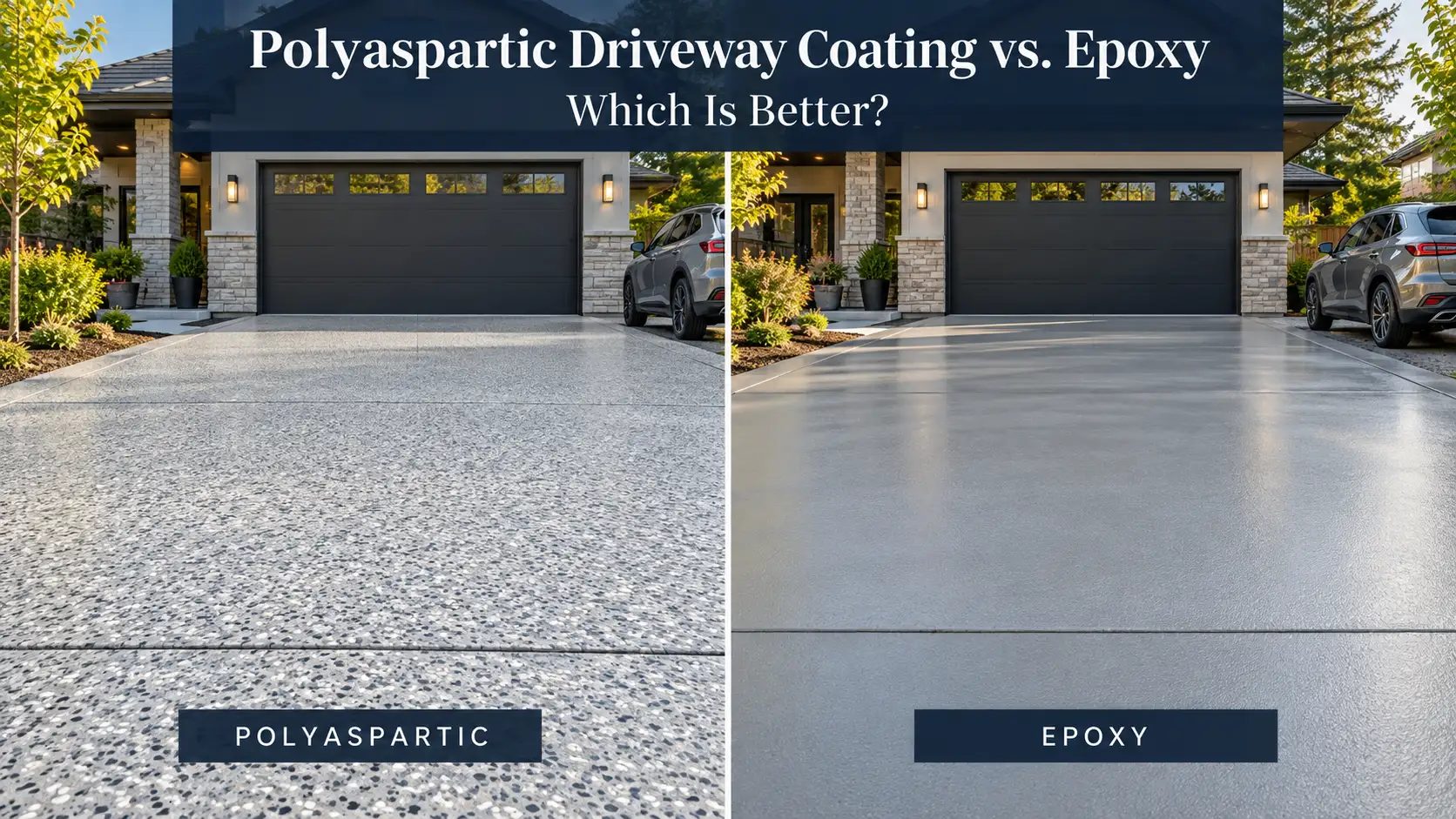
3. What Are the Key Differences Between Polyaspartic Driveway Coating and Epoxy?
One has to choose the most appropriate option not by material but by its performance on the drive. It is important to compare the technical data of the coating systems before choosing.
Curing Time and Installation Speed
The first benefit of polyaspartic systems is fast curing. With some products, you may use the coating for walking in a few hours and drive on it in about 24 hours, but the exact times differ from one product to another. It will help to minimize disturbance when a driveway has to be used again soon.
Usually, epoxy takes more time to cure. With some products and temperatures, you will be able to walk on it in 12–24 hours, but it may take a few days to drive on. Use only the recommended reopening time for your product.
UV Resistance and Color Stability
Some epoxy coatings have the possibility of becoming yellowed, faded, or changed with UV exposure. This is especially important for driveways that are directly exposed to sunlight throughout the day. One way to help maintain the aesthetics of the epoxy coating is to use a UV-protective topcoat, although the degree of protection varies depending on the products used.
The reason for selecting the polyaspartic driveway coating is that most types provide good UV resistance and colorfastness. It is extremely necessary for colored, gray, or any other decorative surface coatings.
Durability and Weather Resistance
Both products may act as protection against abrasion and constant traffic if applied properly. It will depend on the thickness of the coating, its adhesion properties, condition of the concrete, as well as chemicals, moisture, and temperature changes.
Polyaspartic driveway coating are favored for their strong resistance to wear and their flexibility, which helps them withstand substrate movement and deformation. Epoxy is known for forming a tough surface, but again, this is going to depend on the type of coating as well as the condition of the concrete.
Initial Cost and Long-Term Value
Epoxy coatings can be considered more affordable because of the reduced material cost of epoxy systems. This makes epoxy coatings favorable for the construction of a budget-friendly driveway. In contrast to epoxy systems, polyaspartic coatings can be more expensive due to the formulation of the coating system and the rapid installation process required. Other factors that can influence the cost of the project are the costs of labor, surface preparation, decorative finishes, and application of the top coat.
| Comparison factor | Polyaspartic coating | Epoxy coating |
| Curing | Often faster | Generally slower |
| UV stability | Often strong | May require a UV-resistant topcoat |
| Initial cost | Often higher | Often lower |
| Application window | Can be short | Often longer |
| Decorative options | Available, system-dependent | Broad range of finishes |
For an accurate comparison, one should ask for detailed estimates including preparation costs, materials, labor, top coats, and curing time. Despite the increased cost of the project due to polyaspartic driveway coating, fast curing and UV resistance can be of use in some outdoor projects.
Coating Thickness and Decorative Options
It also allows for thicker application, which makes epoxy appropriate for systems meant to build film thickness or to use decorative flakes. It also gives you longer working time, which might be beneficial for some decorative applications.
Polyaspartic driveway coatings can also be used for decorative purposes, as well as those that have color flakes or any other additives. Some coatings are developed for quick-curing thin applications and others for other purposes. You should check for recommended film thickness and compatibility with the system instead of thinking that one of these materials will always be thicker or more decorative.
4. Where Is Polyaspartic Driveway Coating the Better Choice?
Driveways with High Sun Exposure
A polyaspartic coating can be used for the uncovered driveway that gets a lot of sunshine throughout the day since this coating holds color better than most materials do under UV light. This will prove very useful where retaining the color of the coating is your prime focus. Polyaspartic driveway coating could be ideal for your requirements where color retention is one of your prime concerns.
Projects Requiring Fast Installation
Nonetheless, a quick-set system can be used to reduce downtime of a driveway. Where accessibility becomes a problem, in instances such as residential homes and building sites, Polyaspartic coating can help minimize the application time. But the contractors must give sufficient time for the preparation and repair of the concrete before the application of the coating.
High-Traffic Driveways Exposed to Changing Weather
Those driveways that face exposure to sun rays, water, temperature, and the movement of cars need strong construction materials. For instance, when dealing with a gravel driveway, the bonding system should work by binding stones and providing stability to the surface and drainage of water through the aggregate system.
For gravel driveway projects, JINCHENG’s Polyaspartic Gravel Binder is a suitable option. This two-component binder combines resin and hardener at a 1:1 weight ratio and bonds gravel or pebbles into a durable, permeable surface. It is suitable for driveways, pathways, and patios, helping create a cohesive finish while preserving the natural appearance of decorative aggregates.
5. When Is Epoxy Driveway Coating the Better Choice?
Budget-Conscious Projects
Perhaps the best option would be epoxy if cost is the primary factor to consider while the installation time is flexible. The comparison of total system cost is crucial since preparatory work, decorations, and topcoats have the potential to affect the overall cost.
Covered or Low-UV Areas
In case there is limited exposure to UV rays in the particular setting for which the floor coating is intended, epoxy tends to be a great option. However, the selected coating substance should meet specific requirements of the project regarding resistance to moisture, abrasion, and chemicals.
Projects Requiring a Thick Protective Layer
For projects where the focus is on film build or flake coverage, certain epoxy systems may be used as a base coat. It would be important to verify the thickness needed, the state of the concrete, and the compatibility of other layers.
6. Conclusion
Polyaspartic coating and epoxy coating are two coating products that both protect concrete driveways. There are, however, differences between the two, and different circumstances require different products. Polyaspartic coating is preferred since it provides UV protection and fast-curing properties, while the epoxy coating could be less expensive, allows time for application, and provides a thicker system.
When choosing which coating to apply, first look at the technical data sheets for both coatings and make sure all the surface preparation, application parameters, thickness, and time required after application to allow the vehicle’s use have been considered. In case of any doubts, JINCHENG will be glad to help you. Please feel free to contact us.