



A grocery chain isn’t going to close for four days to redo a stockroom floor. A hospital wing can’t sit dark over a weekend on the hope that a coating will be walkable by Monday’s shift change. And a distribution center running three shifts around the clock never gets a slow stretch long enough to let standard epoxy cure on its own schedule.
That’s the pressure reshaping commercial flooring right now — and it isn’t really about coatings getting tougher. Most systems have held up fine for a decade. What’s changed is that cure time has become the deciding factor in what gets specified, because downtime carries a dollar figure, and that figure keeps climbing.
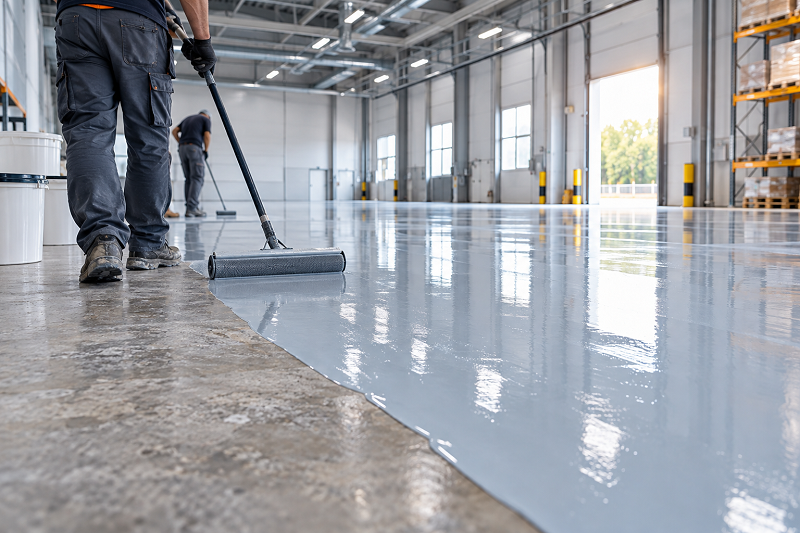
What “Fast-Curing” Actually Means
The term gets used loosely, so it helps to be specific. In flooring, cure time is usually measured at three checkpoints: tack-free (the surface stops pulling at socks and dust), light foot traffic (staff can walk it without damage), and full cure (forklifts, racking loads, and rolling equipment are safe).
Standard solvent- or water-based epoxy needs 12–24 hours before light foot traffic and 5–7 days before it’s rated for full chemical and load resistance. That’s the baseline commercial buyers have lived with for years.
Fast-curing systems compress that timeline hard. Rapid-cure epoxy formulations reach foot-traffic-ready in 6–8 hours. Polyaspartic and polyurea systems go further still — some are walkable in 60 to 90 minutes and can take vehicle traffic the same day. That’s not a marginal gain. It’s a different category of scheduling entirely.
The Chemistry Behind the Speed
Cure speed comes down to reaction chemistry, not formulation tricks.
Standard epoxy cures through a slower amine-epoxide reaction, which is also why it’s so sensitive to temperature. Drop below 50°F and the reaction crawls — sometimes stalling out completely and leaving a soft, amine-blushed surface behind.
Polyaspartic coatings run on aliphatic polyurea chemistry instead. It reacts faster and cares a lot less about temperature; some polyaspartic topcoats will still cure near 0°C, which matters just as much to cold-climate installers as it does to anyone racing a deadline. Polyurethane sits in the middle — quicker than standard epoxy, more chemical- and abrasion-resistant, and increasingly used as a topcoat over an epoxy base layer specifically to shave time off the return-to-service window.
Roughly how the three compare on a typical commercial job:
| System | Foot Traffic | Full Cure | Temp Sensitivity |
|---|---|---|---|
| Standard epoxy | 12–24 hrs | 5–7 days | High — stalls below 50°F |
| Polyurethane topcoat | 4–8 hrs | 24–48 hrs | Moderate |
| Polyaspartic / polyurea | 1–2 hrs | Same day–24 hrs | Low — cures in cold weather |
These aren’t lab figures. They’re the ranges contractors and distributors are actually quoting on live jobs right now.
Why Buyers Suddenly Care About Cure Time
None of this came from flooring contractors deciding speed mattered more. It came from the people writing the checks.
Retail and grocery chains can’t absorb multi-day closures, particularly around promotions or holiday inventory cycles — a stockroom or loading-dock resurfacing job that used to mean a “closed for renovation” sign now has to fit inside one off-hours shift.
Warehousing runs into the same wall from a different direction. Facilities operating 24/7 don’t have a quiet season to schedule around, and every hour a bay sits idle is throughput lost. Automated equipment and tight racking tolerances also mean the floor can’t just be “good enough for now” — it needs full cure before loads go back on.
Healthcare and food service add a regulatory layer. Shorter cure times mean shorter exposure windows and fewer headaches around VOC off-gassing during occupied hours, which matters when a recoat can’t wait for an ideal closure schedule.
Parking structures and EV charging areas bring weather into it too — UV exposure, temperature swings, concrete that doesn’t wait for perfect curing conditions. This is where polyaspartic’s cold tolerance and UV stability (no yellowing, no chalking) make it the default over standard epoxy for anything facing the outdoors.
The common thread across all of it: chemical resistance isn’t what’s driving the decision anymore. Whether the facility can afford the downtime the coating requires is.
The Downtime Math Owners Are Running
A mid-size distribution facility losing even four hours of throughput can outweigh the material-cost gap between a standard epoxy system and a polyaspartic one many times over. That’s the calculation procurement teams run now, and it’s why “cheaper per square foot” stopped being the only number that matters.
Fast-cure systems generally cost more per gallon — polyaspartic resin runs higher than standard epoxy resin, no way around it. But the real comparison was never material-to-material. It’s material cost plus downtime cost plus labor cost, and faster cure often means fewer shifts, less overtime scrambling, and lower odds of a job bleeding into a second day because temperatures dropped overnight.
What You Give Up for Speed
Fast-cure isn’t free, and it’s worth being straight about where the trade-offs sit.
Pot life is short. A system that cures in an hour also sets up in the bucket fast — sometimes just 5 to 15 minutes of working time. That takes experienced applicators and tight batch-mixing discipline; a crew used to standard epoxy’s forgiving window can get caught out fast.
Surface prep tolerance drops too. There’s not much room to fix mistakes mid-application when the coating isn’t going to sit around waiting. Moisture testing, grinding, profile prep — all of it has to be right before the coating goes down, because there’s no slow cure window left to catch problems during.
And the price per square foot is higher upfront. For a project with real flexibility on timeline — a warehouse resurfacing during a planned two-week shutdown, say — standard epoxy can still be the more economical call.
Which one wins depends on what actually constrains the project more: budget, or downtime. Increasingly, it’s downtime.
Fast-Cure in Practice: The One Day Floor System
This is the exact gap Jincheng’s One Day Floor System was built to close — a polyaspartic-based turnkey solution aimed at facilities that simply can’t take a multi-day shutdown for a floor coating job.
It runs on Jincheng’s aliphatic polyaspartic polyurea topcoat, which gets a floor foot-traffic ready within 24 hours and holds up under UV exposure without yellowing or chalking — useful whether it’s going down on an indoor loading dock or an outdoor-adjacent parking deck. Recommended application sits around 25°C, though the chemistry gives installers more working room in cooler conditions than standard epoxy allows.
For distributors and installers building out a fast-cure product line rather than sourcing one system at a time, One Day Floor comes with OEM and private-label terms — the same polyaspartic chemistry can ship under a distributor’s own brand instead of requiring a separate supplier relationship for every project type.
It’s a concrete answer to the questions raised below: a documented cure profile, a defined application process, and a supply chain built to scale past a single job.
What Buyers Should Ask Before Specifying a Fast-Cure System
A few questions cut through most of the marketing noise:
What’s the actual walkable time at the job site’s expected temperature? Cure charts are usually rated at 70–75°F — ask for the real number at the temperature the job will actually run at.
Is it a full system, or just a fast topcoat? Some “fast-cure” products are accelerated topcoats sitting over a standard epoxy base, and that base layer still needs its own cure window before topcoating happens.
What’s the VOC profile? Faster curing doesn’t automatically mean lower VOC. In occupied buildings, that distinction affects reoccupancy timing just as much as the coating chemistry itself does.
Can the supplier document batch consistency? Fast-cure chemistry tolerates formulation drift between batches even less than standard epoxy does — a supplier who can’t produce consistent COAs is a bigger risk here than elsewhere.
Is there OEM or private-label flexibility once volume scales? For a distributor building a fast-cure line, that answer matters almost as much as the resin chemistry.
Where This Is Heading
Fast-curing floor coatings aren’t a niche upgrade anymore. They’re becoming the baseline expectation on any commercial project where the facility can’t afford to go dark. Polyaspartic and polyurea systems are moving from specialty high-end option to standard spec for warehouses, cold storage, parking structures, and any retrofit squeezed into an overnight or weekend window.
For manufacturers and distributors, that shift is worth planning around now rather than reacting to later — stocking rapid-cure resin lines, training installer networks on tighter working times, and being ready for the downtime-cost conversation buyers are increasingly the ones to bring up first.
The coatings didn’t get more durable. The clock got shorter. And in commercial flooring, the clock is what’s writing the spec sheet now.