



The quote looks fine. Then the pallets arrive, and halfway through the job the primer is gone, the body coat is thinner than spec, and the topcoat stops two metres short of the far wall.
Nine times out of ten, the mistake was made at the desk. Someone applied a single coverage figure to the whole system. But primer, body coat and topcoat don’t behave alike. Each has its own rate, its own number of coats, and its own quirks.
A decent floor coating coverage calculator works layer by layer. It also keeps three numbers apart that people love to blur together: theoretical consumption, what you’ll practically use, and the number of full kits you have to buy.
The method below works whether you’re quoting an epoxy floor coating for a workshop or a polyaspartic floor coating as a protective finish. (Quick conversion if you think in imperial: 1 m² ≈ 10.76 sq ft.)
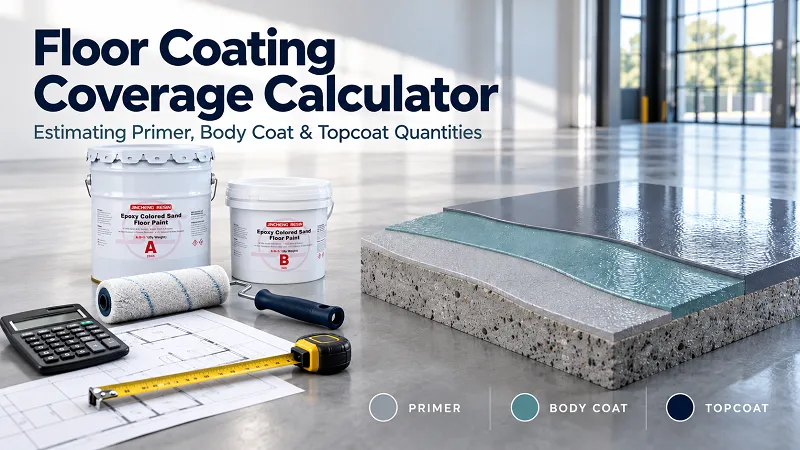
What you need before you start
Pull these from the project spec and the latest technical data sheets, not from memory:
| Input | Why it matters |
|---|---|
| Actual coating area | The surface you’re covering |
| Consumption or coverage rate | Material per coat |
| Number of coats | Repeat applications |
| Specified film thickness | Needed for thickness-based maths |
| Mixed-product density | Converts litres to kilograms |
| Volume solids | Links wet film to dry film |
| Substrate condition | Absorption and surface profile |
| Complete kit size | Turns calculations into purchase quantities |
Check that each figure matches your real application. A rate quoted for a smooth floor won’t hold on a fully broadcast flake surface.
Also, published consumption is usually theoretical. Porosity, surface profile, unevenness and wastage sit on top of it. Don’t assume the data sheet has already absorbed them. Ask.
Step one: measure the area that’s actually being coated
For a rectangle, it’s length times width. A 20 m × 15 m room gives you 300 m².
Irregular layouts? Break them into rectangles and add them up. Leave out permanent obstructions, but keep areas under equipment if they’re part of the scope. Ramps, steps, vertical returns and coving get measured on their real surface, not their footprint.
On bigger jobs, it pays to split the floor into zones. A 300 m² floor might be 220 m² of sound concrete, 50 m² of rough repairs and 30 m² of decorative broadcast. Those zones won’t all drink material at the same rate.
Step two: calculate from a consumption rate
If the data sheet gives kg/m², the formula is simple:
Quantity (kg) = Area (m²) × Consumption (kg/m² per coat) × Number of coats
Say the primer is 0.25 kg/m² for one coat:
300 × 0.25 × 1 = 75 kg
That’s before any allowance. Two coats at the same rate? 150 kg.
One trap here. Make sure the published figure is per coat, not for the whole layer. If it’s already a total and you multiply by the coat count again, you’ll over-order.
Step three: calculate from a coverage rate
Some products give you coverage instead: square metres per litre, or per kilogram.
Quantity (L) = Area (m²) × Coats ÷ Coverage (m²/L)
A topcoat covering 5 m²/L over 300 m²: 300 ÷ 5 = 60 L. Use the same approach for m²/kg.
The two formats are just inverses. A product covering 4 m²/kg consumes 1 ÷ 4 = 0.25 kg/m².
Don’t swap litres and kilograms without the density of the mixed product. Not component A, the mixed product.
Step four: calculate from film thickness
When the spec calls for a wet or dry film thickness, work from that. The handy fact: one square metre at 1 mm thick takes one litre.
Wet volume (L) = Area (m²) × Wet film thickness (mm)
At 0.50 mm over 300 m², that’s 150 L. Multiply by a mixed density of 1.40 kg/L and you get 210 kg.
This is pure geometry. It ignores absorption, uneven substrate and application losses.
If the spec gives dry film thickness, bring in volume solids:
Wet film = Dry film ÷ Volume solids fraction
A coating with 80% volume solids and a 0.40 mm dry target needs 0.40 ÷ 0.80 = 0.50 mm wet. Over 300 m², that’s the same 150 L.
Use volume solids, never weight solids, and don’t add thinner the manufacturer hasn’t approved. For filled or broadcast systems, go with the manufacturer’s system consumption. Don’t treat the finished layer as a simple liquid film.
Primer: estimate it on its own
Primer is the most substrate-sensitive layer on the job. Dense, tight concrete takes less. Absorbent, heavily profiled concrete takes more, sometimes a second coat.
Before you put a number down, nail four things: which primer is approved, its rate for your prepared substrate, how many coats the spec asks for, and whether repairs or unusually thirsty zones need separate treatment.
If the system includes a scratch coat, give it its own line. Don’t bury it in the primer allowance.
When the job is large, a trial patch is cheap insurance. It tells you more than any data sheet.
Body coat: usually the biggest line in the budget
The body coat, or intermediate coat, tends to eat most of the material budget. How you calculate it depends on what it is.
For a neat-resin layer, thickness and mixed density do the job. For a filled, self-levelling layer, use the published consumption for the complete mixture.
That distinction trips people up, because a published rate can describe any of these:
- mixed A+B resin only
- resin plus aggregate
- the finished mortar or slurry
A levelling mortar at 1.80 kg/m² per mm of thickness, for instance, describes the whole resin-and-quartz blend. At 1 mm over 300 m², you need 300 × 1.80 = 540 kg of complete mixture. Then you split that into resin and aggregate according to the approved formulation.
And don’t count on a nominal 1 mm body coat to fix an uneven slab. Levelling and repairs need their own estimate.
Topcoat: match it to what’s underneath
Use the rate specified for the actual surface. A smooth epoxy finish and a textured broadcast floor shouldn’t get the same number. Flakes, quartz and texture all change the area and the voids the topcoat has to fill.
Confirm whether the spec wants one coat or two. For a polyaspartic floor coating, use the rate for that specific product and system.
Piling on extra thickness doesn’t make up for skipping a coat in the sequence. Manufacturer coverage figures are tied to a film-thickness range and a substrate condition, so stay inside both.
Worked example: a 300 m² floor
These rates and pack sizes are illustrative, not Jincheng Resin product specifications.
Assumptions: 300 m² area; primer at 0.25 kg/m²; body coat at 1.50 kg/m²; topcoat at 0.20 kg/m²; one coat each; a 10% estimating allowance on every layer.
| Layer | Calculation | Base | With 10% |
|---|---|---|---|
| Primer | 300 × 0.25 | 75 kg | 82.5 kg |
| Body coat | 300 × 1.50 | 450 kg | 495 kg |
| Topcoat | 300 × 0.20 | 60 kg | 66 kg |
| Total | Layer by layer | 585 kg | 643.5 kg |
That 10% is an example, not a rule. Set your allowance from the project, a trial application and what your supplier tells you.
Now convert to kits
Say primer and body coat come in 20 kg kits and topcoat in 10 kg kits. Divide, then round up:
| Layer | Required | Kit size | Kits | You buy |
|---|---|---|---|---|
| Primer | 82.5 kg | 20 kg | 5 | 100 kg |
| Body coat | 495 kg | 20 kg | 25 | 500 kg |
| Topcoat | 66 kg | 10 kg | 7 | 70 kg |
| Total | 643.5 kg | 670 kg |
You end up buying 670 kg for a 643.5 kg requirement. Packaging does that. It’s normal, and it’s worth knowing before the purchase order goes out.
Allowance and loss are not the same thing
Adding 10% to a base quantity: 75 × 1.10 = 82.5 kg.
Expecting to lose 10% of what you buy: 75 ÷ 0.90 = 83.33 kg.
Different answers. If you’re building a spreadsheet, label the input clearly as either “extra allowance” or “loss percentage.” Don’t apply both to the same problem, and don’t add an allowance on top of a consumption rate that already includes one.
Keep the supporting materials on separate lines
A full flooring estimate covers more than liquid coatings. List each of these on its own:
- Components A and B
- Quartz or other approved fillers
- Decorative flakes
- Broadcast aggregate
- Repair compounds
- Coving materials
- Any extra primer or seal coat the spec calls for
Aggregate broadcast to excess isn’t the same as aggregate that stays in the floor. If you plan to recover and reuse it, follow the system requirements.
With two-component kits, confirm the stated weight includes both components. For partial batches, use the specified mixing ratio and check whether it’s by weight or by volume.
FAQ
How much epoxy floor coating do I need per square metre?
There’s no universal figure. Use the consumption specified for your product, thickness, application method and number of coats.
Can I convert litres to kilograms?
Yes. Multiply litres by the mixed-product density in kg/L, not the density of component A alone.
Does a 100% solids coating mean zero waste?
No. Material still stays in containers and on tools, and you’ll still have practical losses.
Should I always order 10% extra?
No. Ten percent is an estimating example. The right allowance depends on the substrate, the system, the layout and the site conditions.
Can I work out the topcoat from total system thickness?
Calculate it on its own. Total thickness includes primer, body coat and aggregate, each with different consumption.
Get a more accurate quote
Sending Jincheng Resin an enquiry? Include the floor area, the prepared substrate condition, the layer build, the decorative finish and the service conditions.
Ask for a layer-by-layer schedule: each product, its consumption rate, number of coats and kit size. Then work out the practical requirement and round each material up to the pack it ships in.
A good floor coating coverage calculator shows its working. When you can see where every number comes from, the estimate is easier to check before you buy, and easier to manage once the crew is on site.