



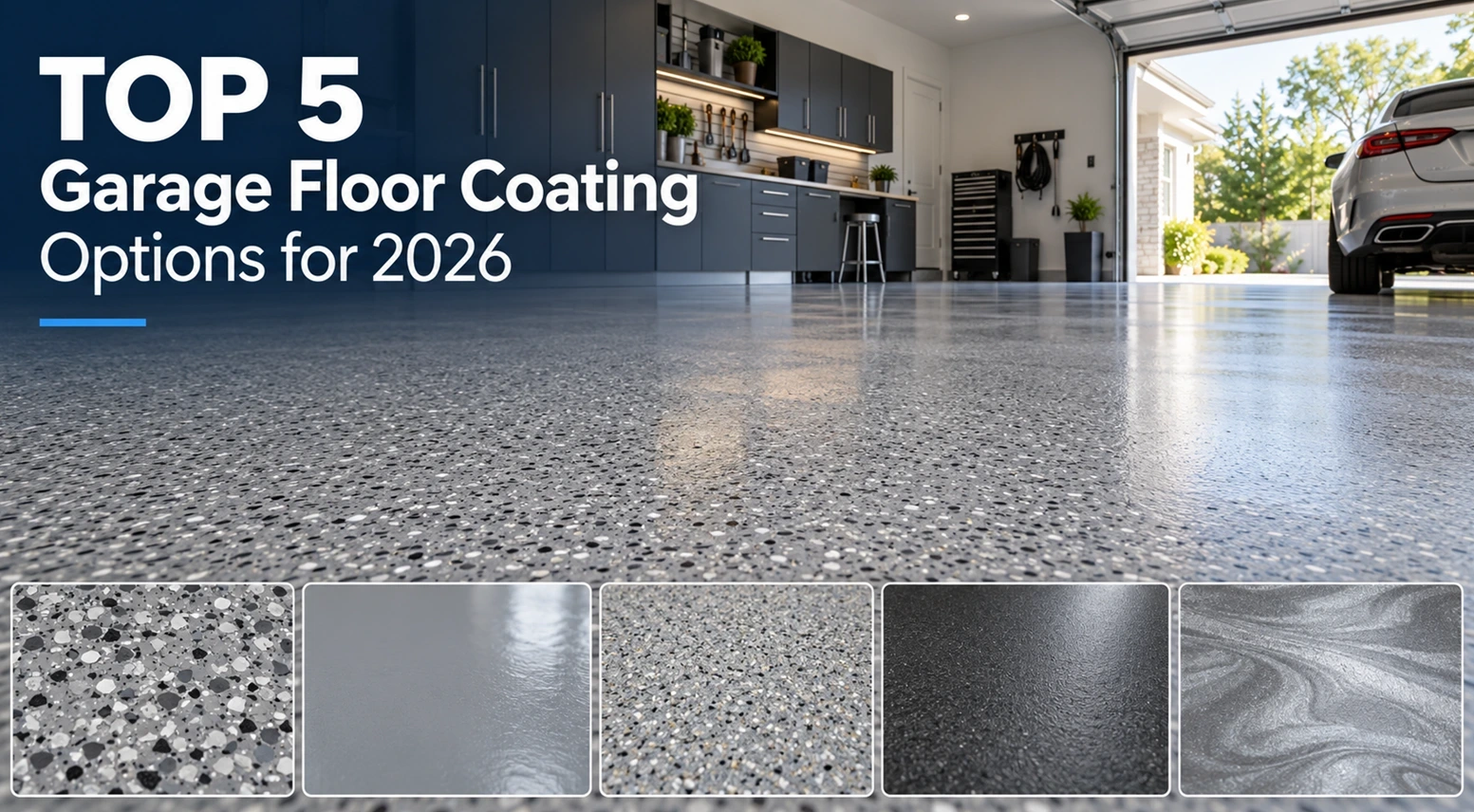
The garage floor is continuously exposed to physical deterioration. The weight of cars, heat produced by the tires, chemical spills, and continuous movement of vehicles can easily damage the concrete floor without any form of protection. Property owners often struggle to find a solution for dusting, cracking, and staining while ensuring the concrete stays protected in the future. Garage floor coating options depend on your performance expectations, downtime, and budget. In order to assist you in making an informed choice, this article is going to provide you with a comprehensive analysis of the best five garage floor coating options that will be available in 2026 based on their main technical characteristics, advantages, and appropriate application cases.
1. Polyaspartic & Polyurea Coatings
Polyaspartic and polyurea coatings embody the cutting edge of rapid-curing polymers as of 2026. Created specifically to eliminate the lengthy downtime associated with traditional floor systems and their vulnerability to UV rays, these state-of-the-art aliphatic-based coatings create an impermeable coating on concrete substrates. They are widely acknowledged as the best garage floor coating options for use in commercial bays and luxury residential garages that need fast turnaround and durability.
Fast Pot Life: Being highly reactive, these coatings will dry out into a film within 2-4 hours and withstand any traffic after 24 hours, reducing the downtime by up to 75% when compared to traditional epoxies.
100% UV Resistance: As opposed to aromatic resins, polyaspartics have no tendency to degrade from exposure to UV radiation. There will be no yellowing, chalking, or ambling.
Flexibility: These coatings exhibit great elongation properties (from 150% to 250%), which makes the final membrane capable of absorbing impacts and accommodating minor slab movement without any micro-cracks.
As the pot life of these coatings is very short and allows no time for any mistakes, mechanical profiling of surfaces (usually CSP 2–3) and quick, professional application are required.
2. 100% Solids Epoxy Coatings (Top Industrial Garage Floor Coating Options)
In the realm of tough residential garage floors, commercial workshops, and automotive facilities, 100% solids epoxy will always be the industry standard when it comes to concrete protection. Contrary to thin liquid paint, which shrinks due to evaporation of its carrier, this thick coating does not contain any volatiles or water, thus curing to a solid and impenetrable thermosetting film from the applied liquid. For those who require the strongest garage floor coating options, 100% solids epoxy is the way to go.
- High Film Thickness and Hardness: A single coat can achieve an impressive dry film thickness (DFT) of 10–30 mils (0.25–0.75 mm), providing a hard, durable surface.
- Chemical and Thermal Resistance: Its dense polymer structure creates a non-porous protective barrier that withstands thermal shock up to 90°C (194°F) and resists chemical exposure by motor oils, transmission fluids, salts used on roads, and mild acids.
- Material Application for High Performance: Epoxy coating durability depends on resin quality and rheology control. For example, Huizhou Jingcheng’s high-viscosity, anti-sag epoxy resin is designed for heavy-duty garage floor coatings, cove applications, ramps, and baseboards. It resists sagging at high temperatures and cures quickly in hot summer conditions.
Although achieving full chemical and mechanical cure typically requires 3 to 7 days, the exceptional load-bearing performance and cost-per-mil efficiency of 100% solids epoxy make it a preferred choice for demanding environments.
3. Water-Based and Solvent-Based Epoxy Kits for DIY Garage Floor Coating Options
One of the easiest and most affordable ways to get started with garage floor coating is to use ready-to-use kits that you can buy at any store. These products come in one or two parts, which can be applied easily using regular paintbrushes and rollers, without needing any industrial grinding machines.
Solids Content and Film Thickness:
These consumer-grade coatings typically contain 40%–60% solids. As the water or solvent carrier evaporates during drying, it leaves a thin coating build of 2 to 4 mils, providing surface sealing without impact resistance.
Ease of Application:
The kits have an extended pot life ranging from 45 to 60 minutes, making it easy for homeowners to apply an even film. Also, the water-based kits do not exceed VOCs in amounts higher than 50 g/L, ensuring odorless application.
Service Life and Limitations:
Under light residential vehicle use, these thin-film coatings typically last 2–5 years. Over time, heat generated by vehicle tires and steering can soften the film, resulting in peeling off in specific areas (hot tire pick-up).
4. Polyurethane Coatings & Topcoats (Extending Garage Floor Coating Options)
On the other hand, although polyurethane (PU) is never used alone on concrete without primer because of bad penetration properties and weak bond properties between concrete slab and paint, polyurethane acts as an important ingredient of a premium top coat that will ensure the necessary protection for the garage floor coating options.
Scratches and Abrasion Resistance:
Due to high cross-linking of the polymer molecules, PU is more resistant to scratches than traditional epoxies; thus, PU is scratch-resistant at 30-50% levels.
Chemical and Solvent Resistance and Gloss Retention: Polyurethane acts as a great barrier, protecting from penetration by aliphatic solvents and staining of tires. Any sheen surface finish is possible, starting from 20% satin sheen up to 90%+ gloss.
Coating System:
Industrial specifications for standard application include a 100% solid heavy-body epoxy base coating (10-15 mils) that is responsible for impact resistance and a polyurethane top coating (3-5 mils).
5. Acrylic Sealers & Garage Floor Paints
When the owner wants to control dust and improve appearance through the most economical process, acrylic sealers and latex paint for garage floors should be used. In contrast to structural materials, such coatings, being liquids, form thin films on porous concrete garage floor coating options and can be used for light storage.
- Penetration into Concrete:Whether solvent- or water-based, acrylic sealer will penetrate the concrete capillary system up to 1 to 3 mm deep, creating a film layer on top, which decreases water penetration into concrete up to 80%.
- Drying Time & Cost:The products are quick-drying (1 to 2 hours) and they do not require any special equipment.
- Usage Limitations:Due to having a dry film thickness of less than 1 mil, acrylic sealers cannot handle rolling tire load, thus requiring application every 12 to 18 months.
6. How to Select the Best Garage Floor Coating Solutions
Selecting the best solutions when it comes to garage floor coating entails weighing the physical characteristics, application considerations, and overall cost of ownership.
Here are the three main criteria for the right garage floor coating material options:
- Test for Moisture Content: Perform either a calcium chloride test or a relative humidity test. For MVERs exceeding 3 lbs / 1,000 sq. ft. / 24 hrs, apply the epoxy moisture management primer before the second application.
- Consider Usage Requirements: Workshop areas requiring multiple activities must feature an epoxy base containing 100% solids with the help of anti-sag resins provided by Huizhou Jingcheng for the perimeter walls and slopes, combined with polyurethane as the top coat.
- Consider Time and Budget Factors: Given the time constraint, you should choose polyaspartics. It’s hard to beat thick film epoxies when you need to gain maximum thickness in the fastest way possible.
Conclusion
Ultimately, making a decision in favor of one of the currently available garage floor coating options for garages relies on your own requirements and the current condition of the concrete floor. Rapid-curing polyaspartics offer unparalleled quick cure time and UV resistance; 100% solids epoxy coatings offer strong mechanical and chemical durability for harsh environments, while basic acrylic sealers are easy, affordable solutions to prevent dusting in less-frequented areas. Comparing the traffic level, chemical aggression, moisture content of the concrete floor, and your overall budget to these characteristics will help you choose the right product.