



Getting the thickness right on an industrial epoxy floor coating is one of those decisions that quietly determines whether the floor lasts eight years or eighteen. Too little material and the coating wears through under forklift traffic. Too much and you spend money you didn’t need to. The goal is simple: match the dry film thickness and overall system build to the actual traffic the floor will see.
This guide breaks down practical industrial epoxy floor coating thickness ranges in mils (one mil equals 0.001 inch, or roughly 0.0254 mm) and millimeters. It covers the common system types—thin-film coatings, high-build epoxy floor systems, self-leveling toppings, broadcast systems, and epoxy mortars—and ties each one to real traffic conditions found in warehouses, manufacturing plants, and distribution centers. For a deeper look at how different builds perform, see our detailed epoxy floor coating thickness guide.

How Traffic Levels Actually Differ Across a Facility
Not every square foot of an industrial building sees the same abuse. A quiet storage corner behaves nothing like the main forklift aisle or the loading dock where pallets get dropped. When you classify zones for epoxy floor thickness by traffic level, look at three things:
- What is moving across the floor—people only, hand carts, pallet jacks, forklifts, or steel-wheeled equipment?
- How often and how aggressively it moves—occasional traffic versus constant turning and braking.
- Extra factors such as chemical spills, wash-downs, temperature swings, or abrasive grit.
Most facilities end up needing more than one system. Specifying the same coating everywhere usually means either overpaying in low-traffic areas or under-protecting the high-wear zones.
Why Thickness Still Matters (Even When Prep and Chemistry Matter More)
Epoxy protects concrete by forming a continuous barrier. More thickness generally means better resistance to abrasion, impact, and chemical attack. It also helps the coating bridge small cracks or surface imperfections. That said, thickness is only one piece of the puzzle. Poor surface preparation, the wrong primer, or a weak topcoat will ruin even a thick system. Applying one very thick coat in a single pass can also create problems—solvent entrapment or internal stress. Multi-coat or aggregate-filled builds are usually more reliable.
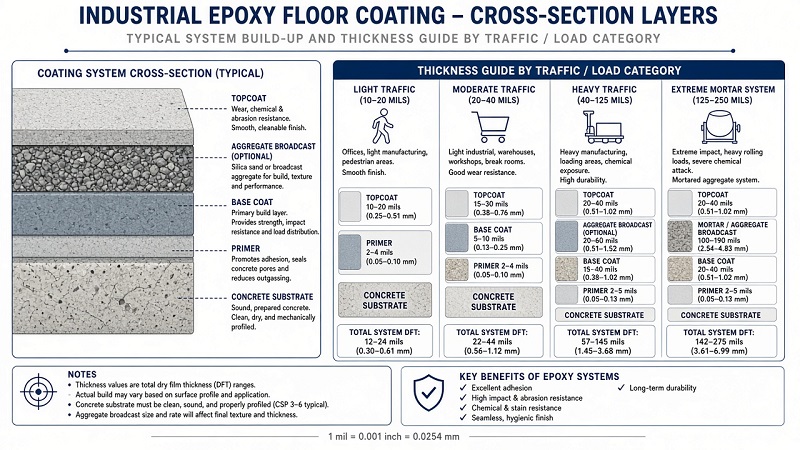
In practice, most professional industrial systems land somewhere between 20 and 250 mils (0.5 to 6.4 mm). Light-duty work starts lower. Heavy-duty mortar systems go higher, often reaching 1/8 to 1/4 inch. Understanding dry film thickness epoxy flooring requirements helps avoid both under- and over-specification.

Thickness Recommendations by Traffic Level
Light Traffic – Pedestrian Areas, Hand Carts, Storage Rooms, Offices
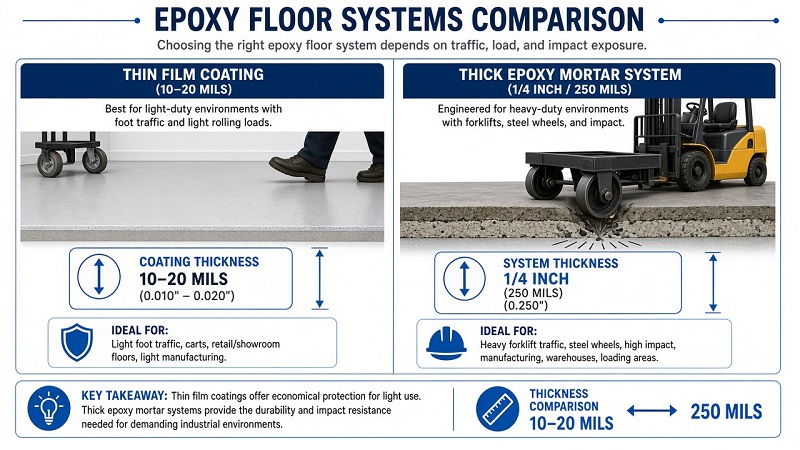
Total system thickness typically falls between 10 and 20 mils (0.25–0.5 mm).
A simple multi-coat system works well here: a penetrating or high-solids primer, one or two coats of 100% solids epoxy applied by roller or squeegee, and an optional urethane or polyaspartic topcoat if extra abrasion resistance or cleanability is needed.
These floors mainly need dust control, better light reflectance, and basic chemical resistance. They install quickly and cost less. They will not survive regular forklift traffic or repeated impact.
Best suited for quiet storage, light assembly areas, mechanical rooms, or zones that see mostly foot traffic.
Moderate Traffic – Pallet Jacks, Occasional Forklifts, Workshops, Light Manufacturing
Aim for 20 to 40 mils total (0.5–1.0 mm).
High-build epoxy floor systems shine in this range. Start with a primer, follow with one or two thicker body coats, and consider a light flake or fine quartz broadcast if you want added texture or a bit more film build. Finish with a durable topcoat.
This thickness handles daily pallet-jack traffic and the occasional forklift without looking or feeling heavy. Many warehouses and light industrial plants use this build for the bulk of their floor and only upgrade the busiest aisles.
You get noticeably better wear resistance than a thin film, improved impact performance, and some ability to hide minor concrete irregularities. These industrial epoxy floor recommendations work well for most mid-level applications.
Heavy Traffic – Daily Forklift Use, Main Warehouse Aisles, Distribution Centers
Expect 40 to 125 mils overall, with many high-wear zones landing in the 60–100 mil range or higher.
Here the options expand. High-build or self-leveling epoxy systems work. Full broadcast systems (quartz or flake) build thickness through the aggregate itself—each complete broadcast layer can add roughly 1/16 inch once sealed and top-coated. Light slurry or filled systems also appear in this category.
Forklift aisles, turning areas, and loading zones take repeated rolling loads, sharp braking, and occasional impacts. Aggregate helps spread those forces. Self-leveling products deliver the smooth, seamless surface preferred in cleaner or higher-speed operations.
In high-traffic warehouse environments, the choice of system becomes even more critical. You can compare epoxy against faster-curing options in our guide to the best floor coating for warehouse applications.
A common approach is to run a solid 20–40 mil high-build system across most of the floor and increase the build only where traffic is heaviest. Quality industrial epoxies routinely deliver compressive strengths above 10,000 psi—often stronger than the concrete underneath when the system is installed correctly. Proper forklift traffic epoxy floor coating selection at this stage prevents premature wear.
Extreme Traffic and Impact – Heavy Machinery, Steel Wheels, Dropped Loads, Thermal Shock, Aggressive Chemicals
Thickness jumps to 125–250 mils or more (roughly 3–6+ mm), frequently specified at 1/8 to 1/4 inch.
Epoxy mortar, heavy slurry, and urethane cement systems dominate this category. These are troweled or screed-applied mixes that pack graded aggregate into the resin. The aggregate does most of the heavy lifting—distributing point loads and absorbing impact energy. Correct epoxy mortar thickness for heavy traffic is essential here.
You will see these systems in heavy manufacturing, loading docks and ramps, food and beverage plants (especially where thermal shock or steam cleaning occurs), and any area that regularly sees dropped loads or severe abrasion. Thicker mortar systems can also rebuild damaged or uneven concrete at the same time the coating goes down. With proper maintenance, service lives of 15–20 years or longer are realistic.
Other Factors That Push Thickness Up or Down
Traffic is the starting point, not the whole story.
Damaged or uneven concrete may need extra material or a separate leveling step. Aggressive chemicals or constant wash-downs favor higher builds and specialized resins such as Novolac epoxies or urethane cements. Thermal cycling pushes many facilities toward mortar or cementitious urethane systems. Hygiene requirements often favor seamless self-leveling or sealed broadcast floors. Slip resistance and appearance come from broadcast media and topcoat choice. Tight project schedules sometimes favor faster-curing polyaspartic topcoats even on thicker builds.
Always confirm the final thickness against the manufacturer’s technical data sheet for the specific products you select. Check wet film thickness during application and verify dry film thickness after cure with a calibrated gauge.
Practical Specifying and Installation Notes
Start with a real site survey—traffic patterns, loads, chemicals, moisture vapor rates, and concrete condition. Specify the complete system DFT (primer through topcoat) rather than a single number. Demand proper surface preparation to the profile the manufacturer requires, usually in the CSP 2–5 range. Prefer 100% solids products for industrial work so you get full film build without shrinkage. Build thickness in layers instead of trying to put everything down in one thick pour. Match the topcoat to the actual exposure. Plan for inspection both during and after application. Zone the building so lighter areas do not receive the same heavy system as the busiest corridors.
Thickness alone never guarantees success. Proper substrate profiling is essential, which is why we recommend reviewing the principles of concrete surface preparation for epoxy floors before finalizing any specification.
Common Mistakes Worth Avoiding
Using thin residential-grade coatings (often under 10 mils) in industrial spaces is a common failure point. Ignoring the extra wear at turning and braking zones is another. Skipping moisture testing or vapor barriers when they are needed leads to later problems. Over-building quiet areas while under-building critical aisles wastes money and shortens life. Focusing only on thickness while neglecting surface prep or topcoat quality undermines the entire investment.
Closing Thoughts
Industrial epoxy floor coating thickness should follow the real traffic and environmental demands of each zone, not a generic rule of thumb. Light-traffic areas usually succeed at 10–20 mils. Moderate traffic typically needs 20–40 mils of high-build material. Heavy forklift zones benefit from 40–125 mils with broadcast or self-leveling builds. Extreme impact and chemical exposure call for 125–250+ mil mortar systems.
Matching the system type and total dry film thickness to how each area actually operates produces floors that last longer, cost less to maintain, and keep people and equipment moving safely. Work with experienced industrial flooring contractors and always cross-check current manufacturer data sheets before finalizing the specification. A well-chosen and properly installed industrial epoxy floor coating will handle demanding industrial conditions for many years.