



Charging stations are getting built faster than anyone has had time to figure out what should go on the ground underneath them. Most sites start with bare concrete or asphalt, and a fair number of them end up with whatever coating the contractor happened to have on the truck. Sometimes that works. Often it doesn’t, and the reason usually comes down to one question nobody asked early enough: is this spot indoors, outdoors, or somewhere in between?
That single detail changes which material makes sense. Epoxy floor coating is a great product, and it’s also a poor fit for a lot of charging sites.
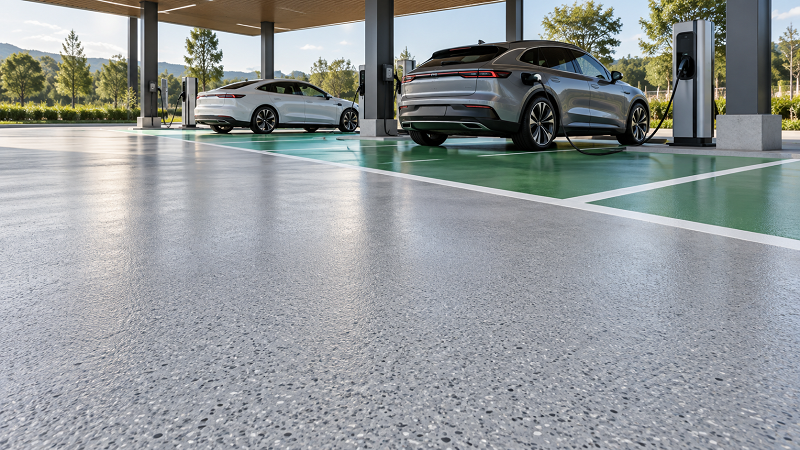
What a Charging Bay Actually Puts a Floor Through
An EV charging bay isn’t a normal parking stall. It sits somewhere between a parking floor and a light service area, and the wear pattern reflects that.
Tires are the first thing. Electric vehicles are heavier than comparable gas models because of the battery pack, and instant torque means more twisting force on the floor when cars pull in and out. That’s hard on any coating, and it’s a big part of why hot tire pickup shows up more often on charging bays than on ordinary parking surfaces.
Then there’s fluid. Charging bays see fewer oil drips than a gas-car lot, since EVs have less engine oil to leak, but coolant, washer fluid, brake dust, road salt, and the odd fuel spill from a visiting hybrid all still land on the floor. Slip resistance matters too, particularly around wet plugs and cable handling.
The last factor is one that gets overlooked constantly: cables. Heavy charging cables get dragged, dropped, and left lying across the surface all day. Abrasion resistance is a real spec here, not a nice extra.
Where Standard Epoxy Runs Into Trouble
Epoxy is hard, chemically tough, and bonds beautifully to concrete. Indoors, those qualities make it the default choice for a lot of commercial floors. Outdoors, one thing gets in the way: ultraviolet light.
The chemistry that gives epoxy its strength also makes it absorb UV. Left in direct sun, a standard epoxy floor coating will yellow, then dull, then start to chalk — a powdery surface layer that wears off under foot traffic and takes the color with it. The coating underneath may still be sound, but the surface looks tired within a season or two, and a chalked surface is also slicker than it should be.
That doesn’t make epoxy wrong for charging stations across the board. It makes it wrong for the parts that see the sun.
Polyurethane and Polyaspartic: Built for the Outdoors
Aliphatic polyurethane and polyaspartic coatings don’t have the same UV weakness. Their chemistry holds color and gloss under sunlight, which is why they’re the standard topcoat choice on anything exposed.
Polyurethane gives a flexible, abrasion-resistant surface that handles thermal movement well. Concrete expands and contracts through the seasons, and a coating with a bit of give is less likely to crack along with it. Polyurethane also handles chemical splash and cable abrasion comfortably.
Polyaspartic goes a step further on speed. It cures in hours instead of a day or more, and it keeps curing at low temperatures where standard epoxy stalls. For a charging site, that has a practical payoff: a bay that’s out of service for a few hours costs less than one that’s closed for three days, and operators tend to notice that number.
Both cost more per gallon than a plain epoxy system. Over a five-year horizon on an exposed surface, though, that premium is smaller than the price of recoating a floor that chalked in eighteen months.
A Side-by-Side Look
| Epoxy | Polyurethane | Polyaspartic | |
|---|---|---|---|
| UV stability | Poor — yellows and chalks | Good | Very good |
| Abrasion and cable wear | Good | Very good | Very good |
| Cure and return to service | 12–24 hrs or more | About 12–24 hrs | A few hours |
| Low-temperature cure | Limited | Moderate | Strong |
| Cost per gallon | Lowest | Middle | Highest |
| Best role | Primer and body coat | Topcoat, flexible surfaces | Topcoat, fast turnaround |
The table is a starting point, not a verdict. Formulations vary a lot between manufacturers, and the data sheet for the specific product is the document that counts.
Matching the Material to the Site
Rather than picking a product first, it helps to sort charging sites by exposure.
Open-air lots and roadside stations. Full sun, rain, road salt, temperature swings. This is polyurethane or polyaspartic territory, ideally over a primer that suits the substrate. Skipping the UV-stable topcoat here is the mistake that shows up in year two.
Covered canopies and carports. Shade from direct sun, but still exposed to wind-blown moisture and temperature changes. A polyurethane or polyaspartic topcoat is still the safer call, though a well-designed epoxy base under it is reasonable for added build and bond strength.
Parking garages and multi-level structures. Indoors, or close enough to it that UV isn’t the main threat. Here a system with an epoxy primer and body coat, finished with a polyurethane or polyaspartic topcoat, gives a good balance of adhesion, wear resistance, and cost. Straight epoxy is workable in fully enclosed decks, but a topcoat helps with tire marks and cleaning.
Indoor fleet depots and workshop-style charging areas. Fully enclosed, heavy vehicles, forklifts or service equipment sharing the space. This is where epoxy floor coating performs well as a primary system, particularly a high-build or self-leveling version, since UV isn’t in play and chemical and impact resistance matter more.
The pattern is simple enough: the more sunlight the floor sees, the more the topcoat matters. The more the floor is protected, the more epoxy’s value-per-dollar shows up.
Composite Systems: Getting Both Benefits
For many charging sites, the right answer isn’t a single material. It’s a layered system where each coat does the job it’s good at.
An epoxy primer bonds to the concrete and blocks moisture vapor. An epoxy or polyurethane body coat builds thickness and impact resistance. A polyurethane or polyaspartic topcoat carries the UV stability, color retention, and abrasion resistance where the surface is exposed. That layering gives you epoxy’s grip on the substrate and the topcoat’s weather resistance, without paying premium pricing on every millimeter of the system.
It’s also the reason “epoxy or polyurethane?” is sometimes the wrong question. The more useful one is which material goes in which layer.
Mistakes That Keep Showing Up
Some failures repeat often enough to be worth naming.
Using a garage-grade epoxy kit on an open-air site is probably the most common. It looks great for the first summer, and by the second the bays are yellowing and the paint lines have gone chalky. The fix is a UV-stable topcoat, and adding it after the fact means grinding the surface back down first.
Another is treating the coating as decoration. Charging bays are working floors, so specifying only color and gloss without looking at abrasion, slip resistance, and chemical exposure leaves gaps that show up under real use.
A third is ignoring the schedule. Many charging sites are built around tight commissioning dates, and a slow-curing system that holds up the opening costs money the coating budget never showed. Fast-cure options exist for exactly this reason, and they’re worth pricing against the delay rather than against the bucket.
And then there’s cold-weather installation. Outdoor sites don’t get to wait for perfect conditions, and a system that can’t cure below 50°F will stall a winter schedule. A low-temperature polyaspartic topcoat handles that far better than standard epoxy does.
Details That Affect How Long the Floor Lasts
A few practical points separate a charging bay floor that lasts from one that doesn’t, regardless of chemistry.
Surface preparation still decides most outcomes. Diamond grinding beats acid etching on dense or previously sealed concrete, and moisture testing before coating avoids the delamination problems that cost the most to fix.
Slip resistance should be specified, not assumed. A light broadcast of aggregate or a textured topcoat keeps wet conditions safe, and it helps around cable-handling zones where people are crouching and pulling.
Color also carries functional weight. Marked bays, directional arrows, and accessible-space designations need to stay visible, and a topcoat that keeps its color makes that easier over the years.
Finally, expansion joints and cracks need proper treatment before coating. Charging stations often sit on newly poured slabs that are still settling, and a coating laid over unaddressed movement joints tends to crack in a pattern that follows them.
What This Means for Distributors and Buyers
Demand for EV infrastructure is a growth market, and the flooring conversation around it is still forming. Contractors are looking for guidance on which system to specify, and many are working from habits built on ordinary parking floors.
For distributors serving that market, carrying both an epoxy base system and a UV-stable polyurethane or polyaspartic topcoat gives contractors a complete solution instead of forcing a single-product compromise. It also gives you an easy way to steer a customer toward the right specification for their site, rather than watching them pick the wrong one and come back with a warranty complaint.
For OEM and private-label buyers, this is a segment where a well-matched system line, with clear guidance on indoor versus outdoor use, becomes a selling point on its own.