



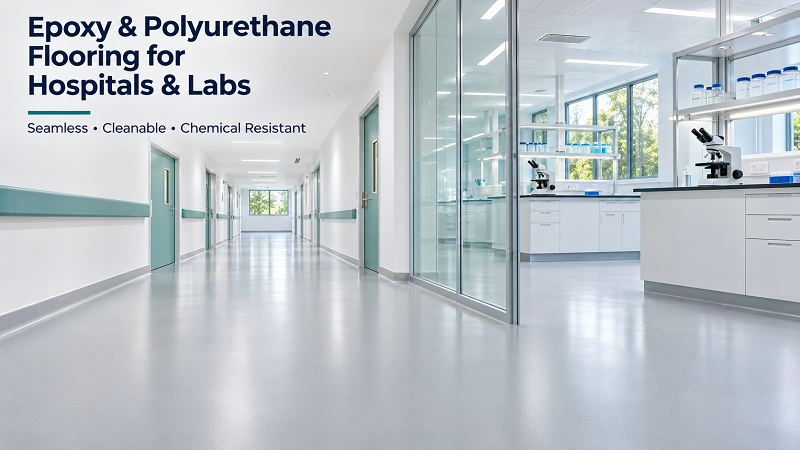
Walk a hospital corridor and you’ll notice the floor mostly by what it isn’t. No cracks. No grout lines. No curling vinyl seams. That’s deliberate. In healthcare and laboratory spaces, the floor is part of the cleaning program, and every joint, pore, or scratch is a place where dirt and microbes can settle in.
Hospital epoxy flooring and polyurethane systems solve that problem by turning a floor into one continuous, sealed surface. This article covers what these spaces demand from a floor, how epoxy and polyurethane each handle it, and what to check before you specify or stock a system for medical and lab projects.
Why Healthcare and Lab Floors Are Different
A warehouse floor has to survive forklifts. A hospital or lab floor has to survive cleaning.
Think about what hits it in a normal week. Gurneys, carts, and equipment roll over it all day. Hospital-grade disinfectants get mopped across it, often several times a shift. Labs add solvents, acids, and the occasional spill nobody reported. Meanwhile the facility can’t simply close for a week, because patients and researchers are still in the building.
So the checklist reads differently from industrial work. The surface must be non-porous. It must tolerate repeated chemical cleaning without clouding or softening. It needs to be seamless, including where the floor meets the wall. And it has to go in fast, with low odor, in a building that stays occupied.
Most vinyl sheet and tile systems fail at least one of those. Seams lift. Edges collect moisture. Over years, the joints become the weak point of the whole floor.
Seamless Is the Whole Point
A poured resin floor has no joints in the field. Liquid epoxy or polyurethane flows out, levels, and cures into a single sheet. There’s nothing for a mop to catch, and nothing for liquid to wick under.
The detail that matters most is where the floor meets the wall. In a proper healthcare install, the coating curves up the wall in a cove, commonly four to six inches high, so there’s no 90-degree corner to trap dirt. Corners, door frames, floor drains, and equipment bases all get the same attention. A seamless floor with a sharp wall junction has only moved the problem to the edge.
Joint planning matters too. Concrete cracks and slabs move, so control joints and saw cuts need to be filled and bridged with a flexible material, not coated over and forgotten. A hairline crack that reflects through the coating isn’t just cosmetic in a clean environment. It’s a groove that can hold contamination.
If you’re sourcing for projects like these, the substrate work counts as much as the coating. Our guide to concrete surface preparation for epoxy floors covers grinding versus shot blasting and the surface profiles that give a seamless system its grip.
Cleanability: What Disinfectants Actually Do to a Floor
Cleaning a floor sounds gentle until you run the numbers. A hospital floor may see quaternary ammonium compounds, bleach solutions, hydrogen peroxide, and alcohol-based products, sometimes in the same week. Dwell time matters too, because many disinfectants have to sit wet on a surface before they work.
A well-formulated epoxy or polyurethane coating shrugs this off. A poorly formulated one dulls, stains, or turns tacky. The best way to know which you have is to ask for resistance data against the products the facility actually uses, not a general claim that the coating is chemical resistant. The test method matters as well. ASTM D543 is the standard reference for evaluating plastics against chemical reagents, and reputable suppliers can show results from it or an equivalent.
One more point about cleanability: gloss and texture. A smooth, high-gloss surface wipes clean easily but can get slippery when wet. In wet areas such as sterile processing, wash-down rooms, and entrances, a fine aggregate in the topcoat adds traction. The trade-off is a surface that’s harder to clean than a smooth one, so the texture should be as fine as the safety requirement allows, not as coarse as it can go.
Some coatings include antimicrobial additives. They can be a reasonable feature, but they aren’t a substitute for a cleaning protocol, and claims should be backed by test data. A seamless, non-porous surface is the real hygiene advantage.
Chemical Safety in Laboratories
Labs push chemical exposure well beyond what a hospital sees. Depending on the facility, the floor may meet acids, bases, organic solvents, and reagents that would strip a standard coating in an afternoon.
This is where the resin choice matters. Standard bisphenol-A epoxy handles a broad range of chemicals and is a sound base for general lab areas. For heavier exposure, such as concentrated acids or aggressive solvents, novolac epoxy has a denser cross-linked structure and holds up better. Polyurethane topcoats add resistance to abrasion and many cleaning chemicals while keeping a bit of flexibility.
The honest answer to “which one is chemical-safe” is: it depends on what’s spilled. A resistance chart helps, but only if you read it properly. Concentration, contact time, and temperature all change the result, and a rating that says “resistant” for a 24-hour exposure at room temperature may not hold for a hot solution sitting overnight.
Labs add other requirements. Some need static-dissipative flooring around sensitive electronics. Some need low-particle, low-outgassing finishes for cleanroom work. A few need both. Those specs should be defined with the end user before a coating is chosen, not after.
Epoxy vs Polyurethane: Where Each One Fits
Neither is universally better. They do different jobs, and in healthcare the best answer is often both.
Epoxy is the foundation. It bonds hard to concrete, builds thickness well, and forms a dense, durable body. A self-leveling epoxy layer, commonly in the range of two to three millimeters depending on the design, gives the seamless base. Its weakness is UV and abrasion over time. Epoxy can yellow near sunlit windows and scuff under heavy rolling loads.
Polyurethane is the protective skin. Aliphatic polyurethane topcoats hold color and gloss, resist scuffing from gurney wheels and carts, and handle repeated cleaning well. They also add a little flexibility, which helps the surface survive minor movement without cracking.
That’s why a common healthcare system is epoxy base plus polyurethane topcoat. The epoxy carries the load and delivers the seamless body. The polyurethane takes the daily abuse and cleaning. Where fast return-to-service matters, a polyaspartic topcoat can cut the closure window further.
For areas with unusually high chemical exposure, a novolac epoxy base under a chemically resistant topcoat is worth the added cost. For waiting rooms and corridors, a simpler system is often enough.
Installing in an Occupied Building
The coating chemistry is half the job. The other half is doing it without disrupting a hospital.
Contractors typically work in phases, closing one section at a time. Infection control risk assessments (ICRAs) usually govern the work, with containment barriers, negative air, and dust control. Low-odor and low-VOC formulations matter here, because a strong solvent smell reaching a patient ward is a real problem. So does cure speed. A system that’s walkable in hours rather than days lets a department reopen quickly.
Adhesion is the other thing nobody wants to discover late. Before the full area is coated, a pull-off test on a trial section confirms the bond. See floor coating adhesion testing for how it’s done and what readings to expect.
Moisture needs checking before anything goes down. A slab that’s still releasing vapor will blister a seamless floor, and a blistered floor in a sterile area is an expensive failure. Moisture mitigation, such as a vapor barrier primer, belongs in the plan where testing shows it’s needed.
Mistakes That Show Up Years Later
Most failures in these projects aren’t dramatic. They’re slow.
Skipping the cove is the classic one. The floor looks seamless in the middle of the room, but the wall junction stays a hairline gap, and the contamination sits right there. Coating over a working joint is another. It looks fine at handover, then the joint moves and a crack tracks straight through the system.
Choosing on price alone causes the third. A thin, inexpensive coating that dulls after a year of disinfectant cleaning costs far more to redo than the system that should have been specified in the first place. And specifying without the cleaning products in hand means the coating gets tested by the facility’s janitorial staff instead of a lab.
Sourcing Medical and Lab Floor Coatings
For distributors and brand owners, healthcare is a documentation-heavy market. Buyers want data sheets, test results, and consistent batches, and they’ll ask for them.
Jincheng Resin is a floor coating manufacturer with more than ten years of export experience, five OEM production lines, and customers in over 40 countries. The factory holds ISO 9001 and SA8000 certifications. Our range covers epoxy, polyurethane, and polyaspartic systems, and our ODM and OEM program supports custom formulas, private-label packaging, and branding for distributors serving healthcare and lab markets.
When you evaluate any supplier for these projects, ask for:
- Chemical resistance data against disinfectants and lab reagents, with concentration and exposure time stated
- Low-VOC and low-odor data suited to occupied buildings
- Cure and recoat times at realistic site temperatures
- Batch consistency records, since color and gloss shifts show up fast on a large seamless floor
- Samples for a mock-up before committing to a full order
A supplier who can answer those with documents is one you can build a healthcare line around.
The Bottom Line
A seamless floor in a hospital or lab earns its keep through details: a proper cove, a sealed joint, a topcoat that survives disinfectant, and a base chosen for the chemicals it will actually meet. Epoxy builds the body. Polyurethane protects it. Together, with good prep, they give facilities a floor that cleans easily and lasts.
Need samples, technical data, or an OEM quote for healthcare and lab flooring systems? Contact Jincheng and our team will send material samples and spec sheets for your market.