



A parking deck takes more abuse than almost any floor in a building. Tires scrub the surface. Rain sits on it. Road salt rides in on every car and stays behind. Then the temperature drops, the water in every hairline crack freezes, and the crack gets a little wider.
Traffic alone rarely kills a deck. Water does. Once moisture gets through the slab and reaches the rebar, corrosion takes over, and the repair bill turns into structural work instead of a recoat.
A parking deck coating is the first line of defense: a waterproof membrane with a wearing surface on top, built to handle tires and weather together. This guide covers how polyurethane and polyaspartic systems do that job, where each one fits, and what separates a deck that lasts from one that’s back on the repair list in three winters.
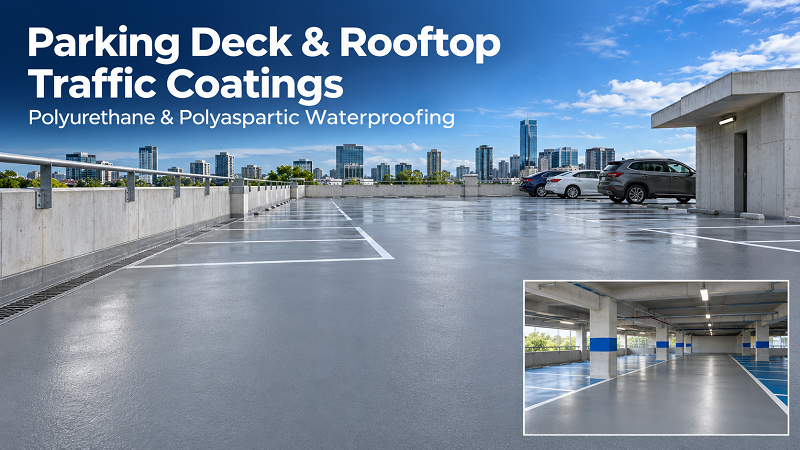
Why Decks and Rooftops Need Their Own Coating Category
Epoxy is the default answer for interior floors, and it’s the wrong answer here. It’s rigid, so it can’t follow a slab that moves. Under sunlight it chalks and yellows. A garage floor in a heated building never sees freeze-thaw cycles, UV, or standing rain. A deck sees all three, every year.
Concrete outdoors expands and contracts with the temperature. Cracks open and close. A coating that can’t stretch with them splits right along the line of the crack, and water finds the gap within a week.
Then there’s chloride. Deicing salt dissolves into meltwater, soaks into the concrete, and attacks the steel inside. Rusting steel swells and pushes the concrete off the slab, which is why spalling at the underside of a deck usually traces back to a failed surface membrane years earlier.
That’s why the industry treats traffic-bearing membranes as a separate category. In North America, ASTM C957 covers cold liquid-applied elastomeric waterproofing membranes with an integral wearing surface, and it’s the reference most specifiers look for. Rooftops with vehicle or foot traffic follow the same logic, with extra attention to drainage, equipment pads, and higher surface temperatures from direct sun.
Polyurethane Traffic Coatings: The Flexible Workhorse
Polyurethane is the long-standing choice for deck waterproofing, and the reason is elasticity. A good polyurethane membrane stretches several hundred percent before it tears (the exact figure depends on the formulation and thickness), so it bridges hairline cracks and absorbs the small movements that wreck rigid coatings.
In a typical traffic system, the polyurethane base coat forms the waterproof layer. Aggregate is broadcast into it for traction. A polyurethane or polyaspartic topcoat then seals the aggregate and takes the wear.
One distinction matters for anything exposed to sun: aromatic versus aliphatic. Aromatic polyurethane is cheaper and works well as a base layer, but it darkens and chalks under UV. Aliphatic polyurethane holds its color and gloss outdoors, which is why it belongs in topcoats.
Where polyurethane works best:
- Large decks where crack movement is expected
- Budget-sensitive projects with big square footage
- Jobs where a long, proven track record counts in the spec
Where it struggles is speed and moisture. Many polyurethane products cure slowly, sometimes overnight between coats, which stretches the closure time on a working garage. Moisture-cure types also react badly to damp substrates and high humidity. Apply over a slab that’s still releasing moisture and you get bubbles, pinholes, and weak adhesion.
Polyaspartic Coatings: Fast Cure and UV Stability
Polyaspartic is an aliphatic polyurea chemistry, and its selling points are speed and durability. Recoat windows are measured in hours, not days. Some formulations keep curing in cold conditions that would stall an epoxy or a standard polyurethane. Jincheng’s low-temperature polyaspartic topcoat, for example, cures down to 0°C (32°F).
That matters on a deck for a practical reason: the shorter a lane is closed, the less the owner loses. A polyaspartic topcoat can often go on the same day as the base system, which turns a multi-day shutdown into something much tighter.
Polyaspartic is also hard. It resists abrasion, motor oil, brake fluid, and the salt brine that sits in tire tracks all winter. And because it’s aliphatic, it doesn’t yellow in sunlight.
The trade-off is flexibility. Polyaspartic films are far less elastic than polyurethane membranes. On a deck with active cracking, they’re usually the wearing surface over a flexible base, not the waterproofing layer itself. Pot life is short too. Once mixed, the material starts gelling quickly, so the crew has to be organized and the batches sized to the area. In hot weather that window shrinks further.
Polyurethane vs Polyaspartic: Side by Side
| Polyurethane | Polyaspartic | |
|---|---|---|
| Typical role | Flexible waterproof base coat | Hard, UV-stable topcoat |
| Crack bridging | Strong | Limited |
| UV stability | Aliphatic grades: good. Aromatic: poor | Excellent |
| Recoat time | Hours to overnight | Often 1–3 hours at normal temperatures |
| Cold-weather cure | Slows significantly | Better, especially low-temp grades |
| Pot life | Longer, more forgiving | Short, needs a prepared crew |
| Abrasion and chemical resistance | Good | Very good |
| Best fit | Membrane layer, large areas | Wearing surface, fast turnaround |
Neither one is “better.” They solve different problems, which is why most specified systems use both.
The Hybrid System That Gets Specified Most Often
On a serious parking deck or rooftop, the strongest approach is layered:
The slab gets shot-blasted, cracks and joints are treated, and a primer goes down to lock in the surface. A flexible polyurethane membrane follows as the waterproof layer, reinforced with fabric at cracks and joints. Aggregate is broadcast into the wet membrane for slip resistance. A polyaspartic or aliphatic polyurethane topcoat then closes the system and takes the abuse.
The flexible layer handles movement. The hard layer handles wear and sunlight. Because the topcoat cures quickly, the deck comes back into service sooner than a pure polyurethane system would allow.
Total system thickness varies with the design, but traffic membranes commonly run from roughly 40 to 100 mils (1 to 2.5 mm) depending on whether the area sees light vehicles, heavy vehicles, or foot traffic only. Ramps and turning areas often get thicker build and heavier aggregate because tires scrub hardest there.
Substrate Prep and Details Decide the Outcome
Coating chemistry gets the attention, but prep decides whether the system survives. Most deck failures start under the membrane, not in it.
Surface profile. Shot blasting to a concrete surface profile in the CSP 3 to 5 range is common for traffic membranes, depending on the product. Laitance, curing compounds, oil, and old sealers must go. A coating can’t grip a surface that’s already letting go. Our guide to concrete surface preparation for epoxy floors covers CSP levels and method choice in detail, and the same logic applies to decks.
Cracks. Hairline cracks get routed and sealed. Cracks that move get a flexible sealant plus a reinforcing fabric strip embedded in the membrane. Rigid fillers in a moving crack just break again.
Joints. Working expansion joints should never be coated over as if they were solid concrete. They need a traffic-rated joint system, with the coating terminated cleanly at the edge. Control joints and saw cuts get sealed and bridged according to the manufacturer’s spec.
Drainage. Ponding water is a membrane killer. Check the slope toward drains before coating. Standing water accelerates wear, breeds algae, and finds every weak spot. Drains need proper flashing and the membrane needs to wrap into them.
Moisture and weather. The slab has to be dry enough for the product. Surface temperature should sit comfortably above the dew point, a margin of 5°F (3°C) or more is the usual rule, so condensation doesn’t form during application. Rain within the cure window can ruin a polyurethane base coat, so scheduling around the forecast is part of the job.
Verification. Pull-off adhesion testing on a trial area confirms the bond before the full deck gets coated. See floor coating adhesion testing for how it’s done and what readings to expect.
Why Decks Fail Early
Most premature failures trace back to a short list of causes.
Delamination usually means moisture or contamination under the membrane. The coating lifts in sheets, often first near drains or low spots. Blisters and pinholes come from air or moisture escaping the concrete as the coating cures, the same outgassing problem we cover in preventing pinholes during primer application. Worn tire tracks mean too little build or aggregate, or a topcoat that was never right for traffic loading.
The most expensive mistake is the quiet one: coating over a joint or crack that still moves. It looks fine at handover. Two winters later, the line of the old crack shows through, water gets in, and the whole section needs stripping.
Sourcing Traffic Coatings for Distribution or Private Label
For distributors and brand owners, deck coatings are a different buying decision from interior floor products. The customer is often a contractor or facility manager who needs documentation, not just a datasheet, and a failed batch means a warranty claim on a large structure.
Jincheng Resin is a floor coating manufacturer with more than ten years of export experience, five OEM production lines, and customers in over 40 countries. The factory holds ISO 9001 and SA8000 certifications. Our range includes polyurethane and polyaspartic systems, including a polyaspartic waterproof coating, and our ODM and OEM program covers custom formulas, packaging, and branding.
Before you commit to any supplier for traffic coatings, ask for:
- Test data against the relevant standard (such as ASTM C957), not just a claim of compliance
- Elongation and tensile numbers at a stated film thickness
- Pot life at 77°F (25°C) and at hot-weather temperatures
- Recoat windows and low-temperature cure limits
- VOC data matched to your market’s regulations (US state limits, UK/EU, Australia)
- Batch consistency records and retained samples
A supplier who answers these quickly, with documents, usually has the process to back it up. One who dodges them is telling you something.
Choosing the Right System
If your deck sees active cracking and you want the most dependable waterproofing, start with a flexible polyurethane base. If downtime and UV exposure are your biggest concerns, add a polyaspartic topcoat. If the budget only allows one product, choose by the problem you can least afford: leaks, or closure time.
And whichever route you take, spend the money on prep, details, and drainage first. A premium topcoat over a bad substrate is a very expensive way to fail.
Need samples, technical data, or an OEM quote for traffic-rated polyurethane and polyaspartic systems? Contact Jincheng and our team will send material samples and spec sheets for your market.